
United States Travel Operations Enter New Phase as United Airlines Twilight Bag Drop at Chicago O’Hare Eases Early Flights, Holiday Congestion, Checked Baggage Pressure and Eligible Passenger Processing

Updated
Published
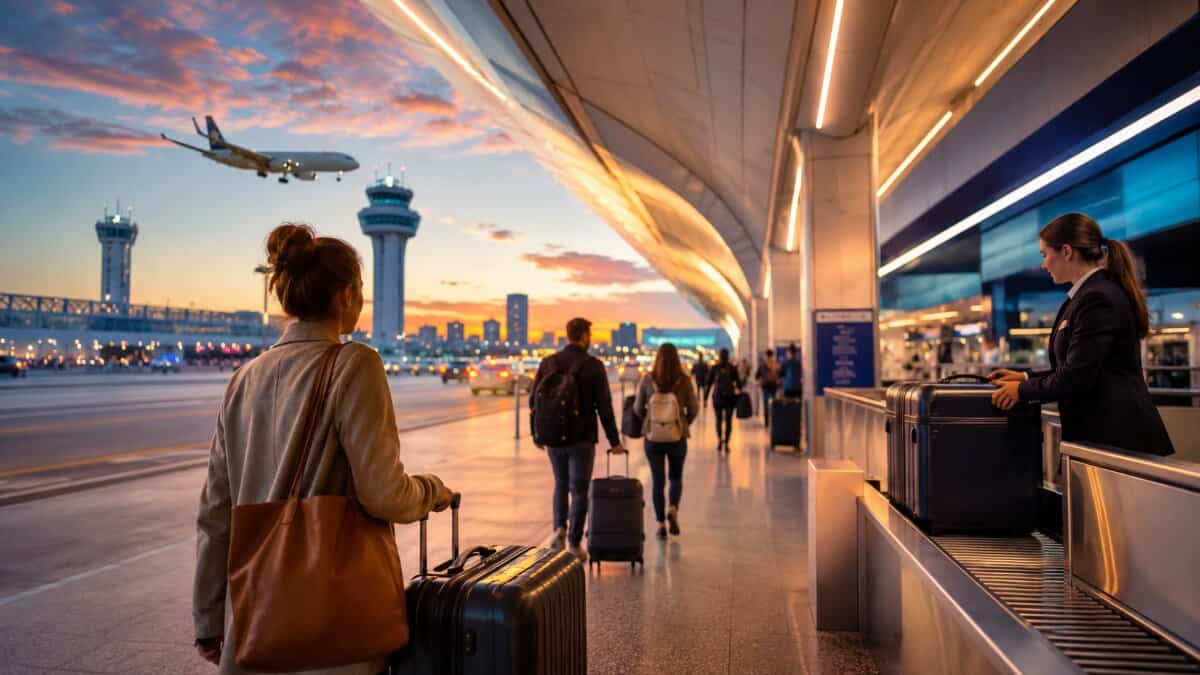
United Airlines’ night-before bag drop at Chicago O’Hare International Airport should be treated as a limited United States airport-processing development, not a systemwide baggage policy. The move fits a wider operational push at O’Hare, where United is scaling its Chicago hub, expanding digital bag drop, and preparing for heavy summer passenger pressure. Official institutional data shows United plans up to seven hundred and fifty daily flights from O’Hare in summer twenty twenty-six, while Chicago’s airports face record holiday demand and FAA schedule controls.
United States O Hare Bag Drop Becomes a Targeted Airport Efficiency Move
United Airlines’ new night-before bag drop option at Chicago O’Hare places baggage handling at the centre of the passenger-experience debate in the United States aviation market. The service is best understood as a targeted early-morning travel tool. It does not represent blanket overnight bag acceptance across United’s network.
Advertisement
Advertisement
For travel agents, tour operators and corporate travel managers, the key editorial point is precision. The development applies to selected United passengers using Chicago O’Hare. It should not be sold as a universal United Airlines benefit for every airport, every flight or every passenger profile.
The operational value sits in timing. Early departures create the most intense pressure on check-in desks, curbside counters, family travel groups and passengers travelling with heavy luggage. A night-before option allows some travellers to reduce morning friction and move more directly towards security screening if they have already completed the required check-in steps.
Advertisement
Advertisement
United Airlines O Hare Growth Raises the Value of Faster Baggage Processing
United’s wider Chicago strategy explains why baggage innovation matters. The airline has announced that it expects to reach seven hundred and fifty flights per day from Chicago O’Hare during summer twenty twenty-six. That would place significant pressure on terminal processing, curbside movements, gate flows and same-day customer support.
United’s own institutional release states that its O’Hare schedule will cover two hundred and twenty-two nonstop destinations during twenty twenty-six. The network includes forty-seven international cities across Europe, Asia and South America, alongside one hundred and seventy-five United States destinations.
Advertisement
Advertisement
This scale makes baggage handling more than a passenger convenience issue. It becomes an infrastructure productivity tool. Every checked bag that moves through a faster, more predictable pathway can reduce counter congestion, protect early departure banks, and improve the traveller journey for families, cruise passengers, MICE groups, sports travellers and premium leisure clients.
| Verified institutional indicator | Confirmed figure | Travel trade meaning |
|---|---|---|
| United planned peak summer flights from Chicago O’Hare | Seven hundred and fifty daily flights | Higher demand for pre-flight processing and baggage flow |
| United nonstop destinations from O’Hare in twenty twenty-six | Two hundred and twenty-two | Wider domestic and international selling opportunity |
| International cities in United O’Hare network | Forty-seven | Stronger long-haul and inbound tourism relevance |
| United States destinations in United O’Hare network | One hundred and seventy-five | Larger domestic feeder base for leisure and corporate travel |
| United planned additional ORD hiring | Around two thousand five hundred people | Operational scale-up supports hub reliability |
| United Bag Drop Shortcut users at ORD in twenty twenty-five | One point two five million passengers | Strong passenger adoption of faster baggage channels |
Chicago O Hare Holiday Travel Pressure Creates the Immediate News Trigger
The timing matters. Chicago’s aviation system is entering one of its highest-pressure summer periods. The Chicago Department of Aviation expected O’Hare and Midway to handle around one point nine five million passengers during the Fourth of July travel period in twenty twenty-six. O’Hare was expected to carry most of that load, with Midway adding more than three hundred and twenty-five thousand passengers.
That demand profile makes the night-before bag drop commercially relevant. Holiday peaks bring more families, more checked bags, more leisure travellers, more infrequent flyers and more travellers with tight ground-transport plans. These segments often create longer dwell times at counters and kerbs.
For B2B travel sellers, the development supports stronger pre-departure guidance. Agents can brief eligible travellers to verify availability inside their booking journey, complete digital check-in early, prepay bags where required, and arrive prepared for security screening rather than counter-based processing.
FAA Controls Show Why O Hare Cannot Rely on Flight Growth Alone
The baggage move also lands inside a controlled aviation environment. The Federal Aviation Administration announced summer twenty twenty-six action at Chicago O’Hare after identifying heavy schedule pressure. The FAA said O’Hare had more than three thousand and eighty flights planned on peak summer days and that it would limit daily operations to two thousand seven hundred and eight between mid-May and late October twenty twenty-six.
This matters for tourism economics. When an airport cannot simply add unlimited flight movements, it must extract more efficiency from landside and terminal processes. Faster bag drop, biometric processing, mobile wayfinding and better passenger distribution become strategic levers.
Advertisement
Advertisement
The FAA also highlighted constraints linked to gate capacity and ongoing taxiway closures from construction. That places additional emphasis on any service that can reduce avoidable congestion before passengers reach the gate system.
| Operational pressure point | Official context | Why night-before bag drop matters |
|---|---|---|
| Peak-day flight pressure | FAA identified more than three thousand planned peak-day flights | Early bag movement can smooth morning terminal demand |
| Daily operation limit | FAA set a two thousand seven hundred and eight operation cap | Airlines must improve reliability inside existing capacity |
| Gate constraint | FAA cited constrained gate capacity | Faster landside processing supports better passenger flow |
| Construction impact | FAA cited taxiway closures | Reducing avoidable terminal friction helps protect schedule stability |
| Holiday demand | Chicago airports expected nearly one point nine five million passengers | Pre-processing becomes valuable during leisure surges |
Chicago O Hare Infrastructure Scale Supports a High-Volume Bag Drop Strategy
Chicago O’Hare is not a small test environment. Chicago Department of Aviation facility data shows O’Hare covers more than seven thousand two hundred acres and had one hundred and ninety-nine gates as of April twenty twenty-six. United leased ninety-nine gates, while American Airlines leased sixty-six.
That scale makes O’Hare one of the most important proving grounds for passenger-processing innovation in the United States. The airport operates eight active runways and supports a major mix of origin-and-destination passengers and connecting traffic. CDA planning material also shows O’Hare’s passenger mix as roughly half local origin-and-destination traffic and half connecting traffic, with domestic passengers accounting for about eighty-two per cent and international passengers about eighteen per cent.
This mix is important. Local passengers can benefit most from night-before baggage acceptance because they can physically access the airport the previous evening. Connecting passengers may benefit less unless they begin their journey at O’Hare or have overnight stopovers.
United Bag Drop Shortcut Data Shows Digital Baggage Behaviour Is Already Established
United’s O’Hare baggage strategy already includes digital processing. The airline says travellers can use Bag Drop Shortcut by checking bags in the app before arriving and then using designated bag drop locations. It also states that one point two five million passengers used Bag Drop Shortcut at O’Hare in twenty twenty-five.
The airline also links baggage handling with TSA PreCheck Touchless ID at O’Hare. United says more than two point eight million customers have opted into TSA PreCheck Touchless ID at ORD since the function launched there in twenty twenty-four.
Advertisement
Advertisement
The night-before bag drop therefore does not appear in isolation. It follows a broader pattern of pre-airport and low-contact processing. The strategic direction is clear. Airlines want passengers to complete more steps before reaching traditional counters.
| Passenger process | Current United ORD relevance | Strategic effect |
|---|---|---|
| Mobile check-in | Supports pre-arrival journey preparation | Reduces counter dependency |
| App-based bag handling | Linked to Bag Drop Shortcut | Speeds baggage acceptance |
| Curbside or shortcut drop | Used by large passenger volumes | Reduces terminal queue pressure |
| TSA PreCheck Touchless ID | Integrated into the ORD experience | Accelerates eligible passenger verification |
| Night-before bag drop | Limited early-flight processing tool | Shifts baggage demand away from morning peaks |
Travel Agents Should Frame This as Eligible Flight Support, Not a Universal Promise
The most important trade takeaway is wording. Travel agents should not tell clients that United now accepts all bags the night before across the United States. The accurate commercial framing is narrower. Some United passengers at Chicago O’Hare may be able to drop checked bags the evening before selected early flights, subject to airline rules, booking eligibility and airport availability.
This distinction protects agents from service failures. It also supports better itinerary planning. A traveller booked at another United hub, a midday departure from O’Hare, an interline itinerary, a special baggage case or an unconfirmed basic-economy baggage scenario may face different rules.
Agents should also consider the traveller profile. The service is most useful for airport-hotel guests, families with several checked items, cruise clients ending a Midwest land stay, senior travellers, passengers with mobility considerations, sports equipment travellers, and corporate groups leaving on early flights.
MICE, Group Travel and Premium Leisure Operators Gain Practical Planning Value
For MICE and group travel, the operational opportunity is clear. Chicago remains a major meetings and events gateway. When groups depart on early flights, baggage can become a major bottleneck. A night-before bag pathway may allow tour leaders to separate luggage management from passenger movement.
Premium leisure advisors can also use this as a service-enhancement point. Families staying near O’Hare before an early departure may value a lighter airport morning. Cruise extensions and rail-air itineraries can also benefit when checked luggage has already entered the airline process.
Advertisement
Advertisement
However, the service needs strict documentation. Passenger names, flight times, bag allowances, special baggage rules, proof of completed check-in and airport timing should be verified before any client receives instructions.
Economic Impact Extends Beyond the Bag Counter
The business impact reaches beyond baggage. Smoother processing supports better airport retail capture, more predictable transfer timing, improved customer satisfaction and fewer missed early departures. For O’Hare, that matters because the airport has a large concessions base.
Chicago Department of Aviation data shows O’Hare had one hundred and forty-nine food and beverage locations, eighty-seven news, gift, specialty retail, duty-free and service locations, and one hundred and fifty-one automated retail and vending locations as of January twenty twenty-six. Total concessions space stood at two hundred and six thousand two hundred and ninety-six square feet.
A passenger who spends less time at bag drop may spend more time in security, lounges, food service, retail or gate-area planning. That supports airport commercial performance, especially during peak holiday and international travel periods.
Critical Operational Takeaways for Travel Agents and Tour Operators
- Treat the United night-before bag drop as a Chicago O’Hare-specific operational option unless United confirms wider airport availability.
- Verify flight eligibility before advising clients, especially for departure time, baggage type, passenger status and itinerary structure.
- Build the service into early-morning leisure, family, MICE and airport-hotel itineraries only after confirming live rules inside the booking flow.
- Do not market the feature as home baggage collection, destination baggage delivery or systemwide overnight check-in.
- Encourage clients to complete mobile check-in, baggage payment and document checks before arriving at the airport.
- Use the service most carefully for large groups, sports equipment, cruise extensions, senior travellers and family bookings.
- Monitor FAA and airport congestion updates when selling Chicago O’Hare departures during summer and holiday peaks.
Forward-Looking Strategic Summary
United’s night-before bag drop at Chicago O’Hare signals a wider shift in United States air travel. Airlines and airports are moving from counter-centred processing towards distributed, digital and time-shifted passenger handling. This matters because flight growth at major hubs now faces physical, regulatory and operational limits.
Chicago O’Hare sits at the centre of this change. United is building a larger hub, the FAA is controlling peak operations, and Chicago’s airport system is managing record seasonal demand. In that context, baggage innovation becomes a competitive tool. It can improve traveller confidence, strengthen early-morning reliability and give travel sellers a more refined way to manage high-value clients.
Long term, this model may influence global airport planning. As international travel grows, more hubs will look for ways to move baggage, identity checks and passenger preparation away from peak counter queues. For the travel trade, the winners will be agencies and operators that understand the exact rules, sell the benefit accurately, and turn airport complexity into a smoother premium journey.
Advertisement
