Published on February 10, 2026
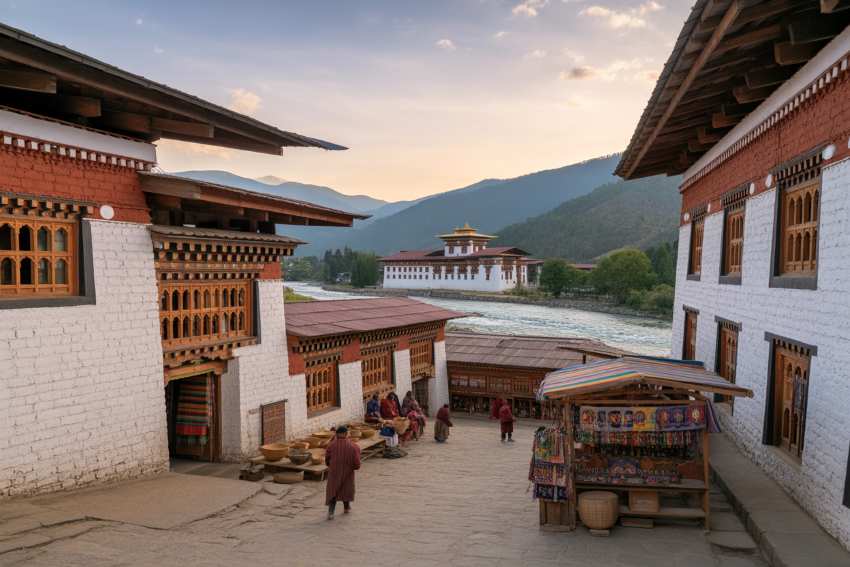
The allure of the Punakha Valley has long been recognised as an essential component of the Bhutanese experience. Nestled in the Himalayan Kingdom’s west-central region, this scenic expanse has a subtropical climate that provides a temperate sanctuary in contrast to the crisper air of Thimphu or Paro. For centuries, the valley’s identity was defined by its status as the nation’s capital, which lasted until 1955. It is still the administrative heart of the Punakha District, sitting at a comfortable elevation of around 1,200 metres. The valley is geographically defined by the dramatic convergence of two vital lifelines, the Pho Chhu (male) and Mo Chhu (female) rivers.
The architectural splendour of the Punakha Dzong attracts many visitors to the valley. Built in the 17th century, the “Palace of Great Happiness” is Bhutan’s second-oldest and largest fortress. Its intricate woodwork and massive whitewashed walls reflect the nation’s long spiritual and political history. Beyond the fortress, the valley is home to Chimi Lhakhang, a temple known worldwide for its fertility associations and the Divine Madman’s legacy. While these historical sites remain the main attractions, the valley is becoming increasingly popular for its outdoor activities, such as river rafting, suspension bridge crossings, and hikes through emerald-green farmlands.
Despite its high volume of international and domestic visitors—ranking just behind Paro and Thimphu in popularity—Punakha has historically faced a significant gap in its tourism infrastructure. While the cultural heritage of the region is profound, a dedicated space for the exhibition and sale of locally produced handicrafts was notably absent for many years. Until recently, the procurement of authentic souvenirs was limited to a few scattered outlets, most notably a small shop situated along the path to Chimi Lhakhang in Barp Gewog.
This lack of a centralized hub has often meant that the economic benefits of tourism were not fully realized by the local artisan community. Travellers seeking high-quality, indigenous products were frequently required to navigate multiple locations, leading to a fragmented experience. It was recognized by regional planners and national authorities that the creation of a specialized craft market would not only enhance the visitor experience but also provide a much-needed platform for the preservation of traditional Bhutanese craftsmanship.
Advertisement
A transformative shift is currently underway in the town of Khuruthang. Under the auspices of the Economic Stimulus Programme (ESP), a dedicated craft market is being constructed to serve as a beacon for Bhutanese creativity. The physical progress of this ambitious project has recently surpassed the 20 per cent mark, signalling a steady march toward its anticipated completion in June 2026. This development is being spearheaded by the Department of Media, Creative Industry and Intellectual Property (DoMCIIP) under the Ministry of Industry, Commerce and Employment, in close coordination with the Punakha District Administration.
The inception of the project was marked by a formal Salang Tendrel (ground-breaking ceremony) on February 7 of the previous year. This significant milestone was presided over by the Minister for Industry, Commerce and Employment. The market is strategically located near the Khuruthang KaJa Throm, ensuring that it is easily accessible to both residents and the steady stream of tourists traversing the valley. This initiative is designed to do more than just facilitate commerce; it is intended to be a living gallery of Bhutanese aesthetics.
Advertisement
Advertisement
The design of the Punakha craft market is deeply rooted in the traditional architectural vernacular of the Kingdom. The complex will eventually consist of 27 structures, each meticulously crafted to reflect the nation’s heritage. Extensive use of rammed-earth walls is being employed, a technique that provides both structural durability and a distinct, organic beauty that harmonizes with the valley’s landscape. These walls are being complemented by intricately carved wooden elements, ensuring that the market itself becomes a destination of visual interest.
Financially, the project is backed by an estimated budget of Nu 48 million. This investment is viewed as a critical component of the national strategy to bolster the creative economy. By providing a centralized venue, the reliance on imported mass-produced goods is expected to be significantly reduced. Instead, the focus is being placed squarely on “homegrown” products. For the traveller, this means that every textile, carving, and painting found within the market’s walls will carry the authentic soul of the Punakha Valley and the wider Bhutanese highlands.
As the completion date of 2026 approaches, the anticipation in the travel community grows. The market is expected to simplify the exploration of Bhutanese artisanal heritage, allowing visitors to find high-quality collectibles in a single, atmospheric setting. By bridging the gap between the artisan and the collector, the market will foster meaningful connections and ensure that tourism-generated wealth is returned directly to the creators.
Punakha’s transformation from a historical seat of power to a modern hub of cultural commerce exemplifies a larger trend in Bhutan: the careful balance of tradition and sustainable development. Punakha will cement its reputation not only as a place of scenic beauty and ancient fortresses but also as a premier destination for those seeking the heart and soul of Himalayan craftsmanship.
Advertisement
Tags: authentic Bhutan travel, Bhutanese handicrafts, Punakha Craft Market 2026, Punakha travel guide















Tuesday, February 10, 2026

Tuesday, February 10, 2026

Wednesday, February 11, 2026

Wednesday, February 11, 2026
Tuesday, February 10, 2026
Tuesday, February 10, 2026

Wednesday, February 11, 2026

Wednesday, February 11, 2026