Published on March 2, 2026
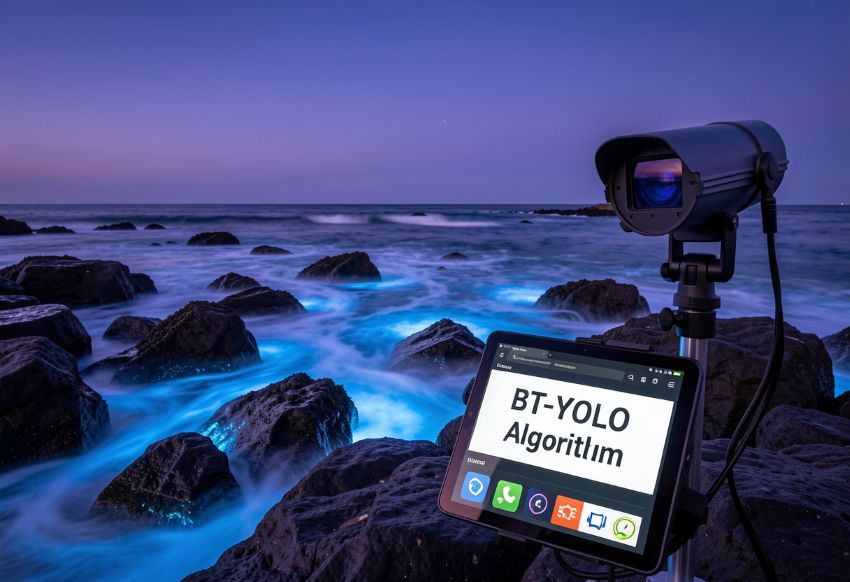
Image generated with Ai
Few sights are as ethereal as the “Blue Tears”—a breathtaking natural phenomenon in which the ocean waves glow with a haunting, neon-blue luminescence. This phenomenon, caused by blooms of bioluminescent microorganisms, has grown in popularity as a “bucket list” travel experience. However, the elusive nature of these blooms frequently disappoints tourists, as their appearance is influenced by complex ecological variables. Researchers at the Shenzhen Institutes of Advanced Technology have developed BT-YOLO, a groundbreaking video monitoring algorithm that bridges the gap between unpredictable nature and sustainable tourism.
The “Blue Tears” are primarily generated by tiny organisms known as dinoflagellates, specifically Noctiluca scintillans. When these creatures are disturbed by the motion of waves or passing ships, a chemical reaction within their cells produces a brief flash of blue light. In recent years, coastal regions such as Pingtan in China and the Matsu Islands have seen a massive influx of “glow-chasers” hoping to witness the shoreline transformed into a field of liquid stars.
However, the pursuit of this glow is fraught with challenges. The occurrence and drift of these algal blooms are notoriously difficult to forecast. Tourists often travel long distances only to find dark waters, while unexpected surges in bloom density can lead to overcrowding and safety risks on narrow coastal paths. Furthermore, the ecological pressure exerted by sudden spikes in tourism must be carefully managed to protect the very marine environments people come to admire.
To address these challenges, an innovative real-time video monitoring solution has been introduced. The BT-YOLO algorithm was engineered by a specialized team led by Prof. Li Jianping, in collaboration with the Ministry of Natural Resources. This technology represents a significant leap forward from traditional observation methods. While previous systems were limited to merely detecting whether the “Blue Tears” were present, this new algorithm is designed to perform pixel-level segmentation.
Advertisement
Advertisement
Through this advanced processing, the glowing areas within video footage can be precisely localized. Quantitative analysis is performed on the intensity and distribution of the blooms, allowing the phenomenon to be measured with unprecedented accuracy. By establishing what researchers describe as “scales” and “rulers” for the sea, the intensity of the blooms can be graded scientifically. This data-driven approach ensures that the visual majesty of the ocean is translated into actionable information.
The implementation of the BT-YOLO algorithm is expected to revolutionize the travel experience. Once a comprehensive network of coastal surveillance cameras is fully deployed, the quantification of “Blue Tears” can be performed rapidly. This capability is the cornerstone of a future operational forecasting system. Just as travellers check a weather app for rain or sunshine, future “glow-chasers” may be able to consult a “Blue Tears” forecast to determine the best timing and location for their visit.
Advertisement
Advertisement
The predictive power of this system is intended to balance the scales between tourism and ecology. By predicting the scale and intensity of the blooms, local authorities can manage crowd control more effectively, ensuring that tourist safety is maintained. Moreover, the environmental impact can be monitored in real time, allowing for a more sustainable approach to coastal management that prevents the degradation of marine habitats.
The utility of the BT-YOLO algorithm is not confined solely to the pursuit of bioluminescence. It has been noted by the research team that the system is highly adaptable. It is envisioned that other significant marine phenomena, such as red tides (harmful algal blooms) and the accumulation of marine debris, will also be monitored using this technology. By integrating these capabilities, an intelligent coastal management solution is provided to local governments.
Advertisement
Advertisement
For the travel industry, this means cleaner beaches and safer waters. Red tides, which can be toxic to marine life and irritating to humans, can be detected earlier, allowing for timely public health advisories. Similarly, the tracking of floating plastic and debris ensures that the pristine beauty of the coastline is preserved for future generations of travellers.
This study has established a solid foundation for predicting the timing, location, and scale of “Blue Tears”. As validation continues with data from various coastal camera networks, the dream of a dependable forecasting system becomes closer to reality. For the modern traveller, this marks a shift towards more informed and responsible exploration.
The convergence of high-tech AI and natural wonder heralds a new era of travel—one in which technology is used not to diminish the mystery of nature, but to facilitate a deeper, more harmonious connection with it. As these “digital eyes” continue to watch over our shores, the “Blue Tears” will remain a source of wonder, safeguarded by science and treasured by those seeking the glow.
Advertisement


















Monday, March 2, 2026

Monday, March 2, 2026

Monday, March 2, 2026