Published on March 1, 2026

Image generated with Ai
South Korea’s cultural landscape has recently been captivated by the humble marsh clam, also known as ‘jaecheop‘. While this tiny bivalve has long been a fixture in the Seomjin River region, the television drama The Tyrant’s Chef accelerated its rise to national prominence. In this popular series, jaecheop soup is portrayed as the pinnacle of devotion and filial piety. The meticulous labour required to harvest and clean these tiny shells serves as a metaphor for maternal love. As a result, there has been a surge in interest in the origins of this dish, prompting visitors to the misty banks of Hadong.
The historical and ecological significance of the region was formally acknowledged on an international scale when the Seomjin River jaecheop fishery was designated as a Globally Important Agricultural Heritage System (GIAHS) by the Food and Agriculture Organization (FAO) of the United Nations. This prestigious status is granted only to land-use systems and landscapes which are rich in globally significant biological diversity. By the Ministry of Agriculture, Food and Rural Affairs (MAFRA), it is noted that the traditional “hand-pulled” fishing method, or sonteul, is recognized for its role in maintaining the river’s health. This recognition ensures that the ancient wisdom of the Hadong fishers is preserved for future generations while being promoted as a primary asset for ecotourism.
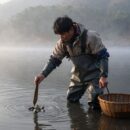
The harvesting of jaecheop is characterized by a unique, eco-friendly technique that has remained unchanged for centuries. Fishers are seen wading into the chest-deep waters of the Seomjin River, equipped with a long-handled bamboo tool known as a georaengi. This rake-like implement is used to scrape the sandy riverbed, effectively collecting the clams while simultaneously aerating the sediment. By this process, oxygen is introduced to the river floor, and the accumulation of pollutants is prevented. Unlike industrialized dredging, this manual labour is celebrated for its sustainability, ensuring that the delicate balance of the estuary remains undisturbed.
In the realm of Korean gastronomy, jaecheop is often referred to as “liver medicine” from the river. This reputation is supported by the high concentrations of taurine and essential amino acids found within the clam’s translucent meat. Traditionally, a clear broth known as ‘jaecheop-guk’ is prepared with chives and a dash of salt, resulting in a flavour profile described as ‘exceptionally refreshing’. It is widely believed that the consumption of this soup aids in detoxification and the alleviation of fatigue. In Hadong, specialized “Jaecheop Villages” have been established, where the authentic taste of the Seomjin River is served to thousands of visitors seeking both culinary delight and wellness.
Advertisement
The local community’s pride in its heritage is most visible during the annual Hadong Seomjin River Cultural Jaecheop Festival. Held during the peak summer months at Songnim Park, the event is designed to immerse tourists in the local lifestyle. Various experiential programmes are hosted, including the popular “Golden Jaecheop Hunt”, where participants search the shallow waters for specially marked gold-coloured clam models. Furthermore, the traditional harvesting process is demonstrated by local experts, allowing the public to witness the physical harmony between the fishers and the river. Through these festivities, the intersection of cultural preservation and modern recreation is achieved.
The integration of GIAHS sites into the national tourism strategy is being spearheaded by the Korea Tourism Organization (KTO) and local government offices. A comprehensive “storytelling” approach is being adopted to transform the Seomjin River into a multifaceted destination. Beyond the culinary experiences, ecological trails are being developed along the riverbanks, connecting the jaecheop fishery with other local landmarks such as the historic Hwagae Market and the ancient tea plantations of Mt. Jirisan. Visitors are encouraged to engage with the environment in a manner that respects both the natural ecology and the local economy, marking a shift toward more responsible travel patterns.
Advertisement
Advertisement
The continued success of the Hadong jaecheop industry is inextricably linked to the purity of the Seomjin River. Since this river is one of the few remaining clean-water habitats for marsh clams in Korea, rigorous environmental protections are enforced by the regional authorities. The symbiotic relationship between the humans who harvest the clams and the ecosystem that sustains them is frequently highlighted as a model for “dynamic conservation”. By the designation of the area as a national and global heritage site, funding and research are directed toward ensuring that the water quality and biodiversity of the estuary are never compromised by over-development.
As South Korea continues to redefine its tourism identity through its “K-Culture” global brand, the rise of Hadong jaecheop serves as a reminder of the importance of local traditions. What was once a humble regional speciality is now revered as a model of sustainable living. Whether through the lens of a high-definition television drama or the experience of wading into cool river waters, the marsh clam’s story is being told to a global audience. The journey to Hadong is more than just looking for food; it is an exploration of a living heritage carved over a thousand years by the Seomjin River.
Advertisement
Tags: Globally Important Agricultural Heritage Systems, Hadong Jaecheop, K-drama filming locations, Seomjin River

















Sunday, March 1, 2026