Published on March 1, 2026
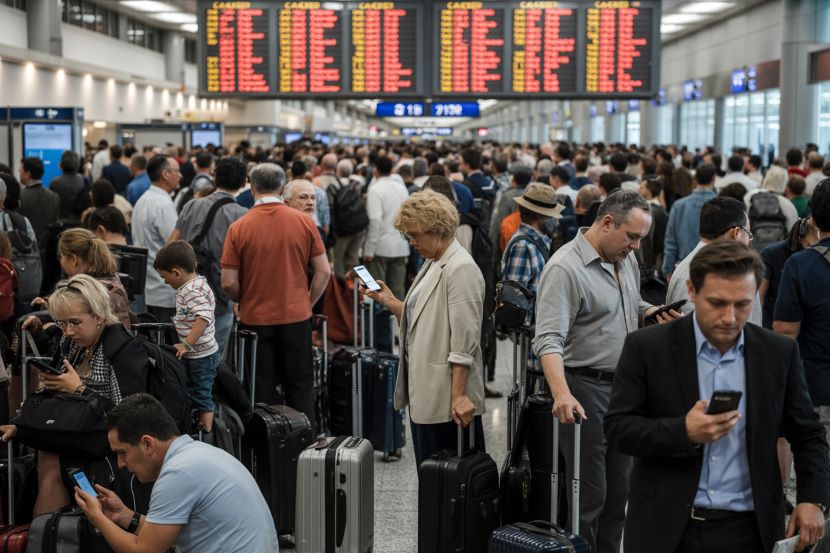
Image generated with Ai
On February 28, 2026, the geopolitical landscape of the Middle East dramatically shifted following coordinated military strikes by the United States and Israel on Iran. These attacks were aimed at Iranian military and strategic infrastructure and were met with immediate consequences for the region’s civilian and military aviation. In response to the escalating tensions and the potential threat to aviation safety, multiple Middle Eastern airspaces were closed.
The aviation impact was immediate and severe. Emirates, Qatar Airways, Etihad Airways, Turkish Airlines, Air India, and several other international carriers experienced significant disruptions in their flight schedules. The affected cities and destinations, such as Dubai, Doha, Abu Dhabi, Tel Aviv, Beirut, and others, serve as critical hubs for international travel, and the closure of their airspaces has led to widespread cancellations and delays.
With over 1,800 flights cancelled in the first 24 hours following the airstrikes, the consequences were far-reaching, affecting not only regional flights but also international connections from Europe, Asia, and beyond. Airlines, regulators, and passengers alike have been caught in the crossfire of this unfolding crisis, with thousands of travelers stranded in airports worldwide.
This article provides an in-depth analysis of the aviation disruptions caused by the Middle East airspace shutdowns, focusing on the airlines and destinations most affected, the advisories issued, and the recovery outlook for affected routes and hubs.
Advertisement
On the evening of February 28, the United States and Israel initiated airstrikes targeting key Iranian military sites. These strikes were part of a larger ongoing conflict between the US, Israel, and Iran. Following these military actions, Iran retaliated with missile and drone strikes, further escalating the conflict and leading to increased security threats in the region.
In the wake of this escalation, multiple Middle Eastern countries including Iran, Iraq, Israel, and the United Arab Emirates (UAE) closed their airspaces to civilian aircraft. The airspace closures were made in an effort to mitigate the risks posed to commercial flights by the ongoing military conflict.
Advertisement
Advertisement
This regional airspace shutdown was critical because the Middle East is a key hub in global aviation. It serves as a central connector between Europe, Asia, Africa, and Australia. With airspaces closed over critical cities such as Dubai, Doha, Abu Dhabi, Tel Aviv, and Beirut, international airlines were forced to suspend flights, reroute, or cancel services altogether.
Emirates, one of the largest and most influential airlines in the world, was forced to suspend all flights to and from Dubai International Airport (DXB). This halt was primarily due to the closure of UAE airspace and the heightened security risks in the region.
Emirates is currently reviewing its operations, with the suspension expected to last until at least March 1. The airline’s operations were heavily impacted as Dubai is not only a hub for Emirates but also a central connection point for long-haul flights from Europe to Asia, Africa, and Australia.
Qatar Airways, another major Gulf carrier, experienced similar disruptions as Qatari airspace was completely closed following the escalation in Iran.
As of now, Qatar Airways is awaiting the reopening of Qatari airspace before it can resume normal operations. The airline has stated that it will continue to monitor the situation and follow safety advisories issued by aviation authorities.
Etihad Airways, based in Abu Dhabi, suspended all outbound flights from Abu Dhabi International Airport after the drone strike near the airport was reported. This added another layer of complexity to the airline’s operations.
Turkish Airlines, a major carrier for flights between Europe and the Middle East, had to cancel all flights to and from several countries, including Iran, Iraq, Syria, Lebanon, and Jordan.
This disruption has affected European to Middle East and Asia flights that typically pass through Istanbul on their way to destinations across the region.
Low-cost carriers that rely on regional connections, such as IndiGo, Air India, flydubai, and Wizz Air, were also significantly impacted.
Both IndiGo and Air India, two of India’s largest carriers, had to cancel all flights to and from Dubai, Jeddah, Doha, Muscat, and other major cities in the Middle East.
The Indian Directorate General of Civil Aviation (DGCA) has advised Indian airlines to avoid the affected airspace until it is deemed safe for operations. Passengers have been advised to check with airlines for rebooking options.
As a budget carrier operating largely within the Middle East and Asia, flydubai was heavily impacted by the closure of airspace over Iraq, Iran, and Israel.
Major international carriers that operate through Middle Eastern airspaces also had to adjust their flight schedules.
As the situation continues to evolve, several official aviation safety advisories have been issued to help passengers navigate the disruptions.
The US-Israel strikes on Iran have caused a massive disruption to air travel, particularly within the Middle East. Airlines such as Emirates, Qatar Airways, Etihad, Turkish Airlines, and others have been forced to suspend flights, cancel routes, and re-route flights through affected regions. The cancellation of over 1,800 flights has left passengers stranded and caused chaos at multiple international hubs, including Dubai, Doha, and Abu Dhabi.
Passengers are strongly advised to stay updated through official airline channels and government aviation advisories to make informed decisions regarding their travel plans. Given the volatile situation, the airspace disruptions may persist for several days or even weeks. It is crucial to remain flexible and monitor the latest updates to avoid further inconvenience.
As this geopolitical crisis unfolds, it remains uncertain when normal flight operations will fully resume across the region. Passengers with upcoming flights through the Middle East should prepare for further delays, cancellations, or alternate routing.
Advertisement
Tags: Abu Dhabi flight cancellations, Air India Middle East, Doha flights, Dubai Flights, Emirates flights suspended


















Sunday, March 1, 2026

Sunday, March 1, 2026

Sunday, March 1, 2026

Sunday, March 1, 2026