Published on February 24, 2026
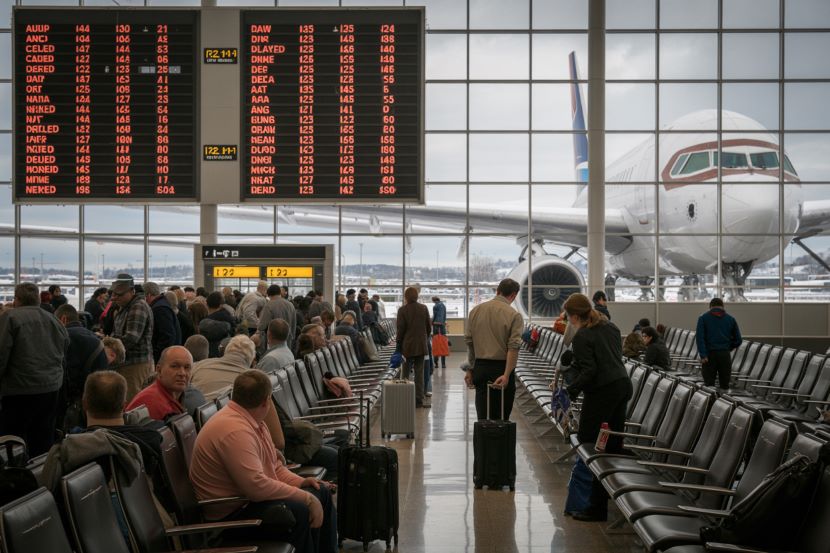
Image generated with Ai
A powerful winter storm system sweeping across parts of the United States has grounded hundreds of passengers after 95 flights were cancelled and 38 delayed, disrupting travel across major cities including New York, Philadelphia, Los Angeles, Chicago, Orlando and beyond. The primary cause of the disruption was severe winter weather conditions — including heavy snowfall, freezing rain, strong winds and reduced visibility — that forced airlines to scale back operations for safety reasons.
The cancellations impacted services operated by Republic Airways, Southwest Airlines, Endeavor Air, JetBlue, United Airlines and several other carriers. With nearly 133 flights affected within a short operational window, the ripple effects quickly spread through multiple aviation hubs, straining airline schedules and leaving travelers scrambling for alternatives.
The 95 cancellations spanned both short-haul regional routes and longer domestic services. Regional flights operated by Republic Airways and Endeavor Air were particularly vulnerable because these aircraft often complete multiple segments per day. If one flight is cancelled due to weather, subsequent legs are often removed from the schedule.
Southwest Airlines and United Airlines saw cancellations across major domestic corridors linking the Midwest, Northeast and Florida. JetBlue experienced disruptions on its Northeast-heavy network, especially routes touching New York and Orlando.
Advertisement
The 38 delayed flights created additional congestion inside terminals as passengers monitored departure boards that frequently updated with revised gate assignments and times.
The disruption was not confined to a single airport. Instead, it cascaded across interconnected hubs:
Advertisement
Advertisement
Because aircraft operate on tightly coordinated schedules, a cancellation in Chicago can affect flights later scheduled to depart from Orlando or Los Angeles. This interconnected structure magnifies weather-related disruptions.
United Airlines and Southwest Airlines, both major domestic carriers with extensive route networks, saw multiple schedule adjustments as aircraft rotations fell behind. JetBlue, with a strong presence in the Northeast and Florida corridors, experienced ripple effects across its high-demand routes.
Republic Airways and Endeavor Air, operating regional services for larger network carriers, faced cascading impacts when aircraft positioning became disrupted. Regional fleets typically have tighter scheduling windows, making them especially sensitive to operational slowdowns.
While airlines activated rebooking protocols and in some cases offered travel waivers, limited seat availability on alternate flights made same-day re-accommodation difficult for many passengers.
The central driver behind the widespread cancellations was a fast-moving winter storm that impacted several key airport regions simultaneously. Snow accumulation and icy runway conditions required extensive de-icing operations, reducing the number of aircraft that could depart safely.
Air traffic control programs were implemented in affected regions to manage congestion and maintain safe separation between aircraft. During winter storms, runway capacity can be reduced significantly, sometimes by up to 40 percent, as additional spacing between flights is required.
De-icing procedures further extend turnaround times. Each aircraft must undergo treatment before departure, which adds minutes to every flight and slows the entire system. When this occurs at multiple hubs at once, airlines are forced to proactively cancel select flights to prevent even deeper gridlock.
High winds and poor visibility also contributed to holding patterns and arrival delays, particularly at busy airports in New York and Chicago.
Inside major airports, long lines formed at airline counters as stranded travelers sought alternate arrangements. Many passengers were automatically rebooked via airline apps, but some faced next-day departures due to limited availability.
Business travelers reported missed meetings, while families traveling during peak season encountered sudden itinerary changes. Connecting passengers were particularly impacted, as a single weather-related cancellation often disrupted multiple legs of travel.
Hotels near airports in New York, Chicago and Orlando reported increased bookings from stranded travelers. Rental car counters and ground transportation services also saw surges in demand.
The disruption highlights how vulnerable the US aviation network remains during winter storm season. Airlines operate with high aircraft utilization and minimal slack capacity. When multiple hubs face weather constraints simultaneously, even moderate cancellation numbers can escalate into nationwide travel turbulence.
Winter weather — including snow, ice and wind — remains one of the most disruptive forces in aviation. Despite advanced forecasting tools and operational planning, severe conditions still require airlines to prioritize safety over schedule reliability.
As storm conditions gradually ease and runway clearing operations conclude, airlines are repositioning aircraft and crews to stabilize operations. Full recovery from more than 100 disrupted flights typically takes 24 to 48 hours, depending on aircraft distribution and congestion levels.
Travelers scheduled to fly in the coming days should:
Preparation and flexibility remain essential during winter weather events.
The cancellation of 95 flights and delay of 38 more due to a powerful winter storm has once again demonstrated how quickly weather can ground hundreds of passengers across the United States. With Republic Airways, Southwest Airlines, Endeavor Air, JetBlue, United Airlines and others affected, disruptions rippled through major cities including New York, Philadelphia, Los Angeles, Chicago and Orlando.
While airlines are working to restore stability, the episode underscores the fragile balance of modern air travel during severe weather. In a system operating at near capacity, even temporary reductions in runway throughput and aircraft movement can trigger widespread delays and cancellations.
As winter storm season continues, travelers across the US are reminded that weather-driven turbulence remains one of aviation’s most persistent challenges — and flexibility remains the key to navigating it.
Source: Regional airport and FlightAware
Advertisement
Tags: 95 flights cancelled US, Endeavor Air disruption, JetBlue flight delays, Republic Airways cancellations, Southwest Airlines delays

















Monday, February 23, 2026

Monday, February 23, 2026

Tuesday, February 24, 2026

Tuesday, February 24, 2026

Monday, February 23, 2026

Monday, February 23, 2026

Monday, February 23, 2026
Monday, February 23, 2026