Published on February 24, 2026
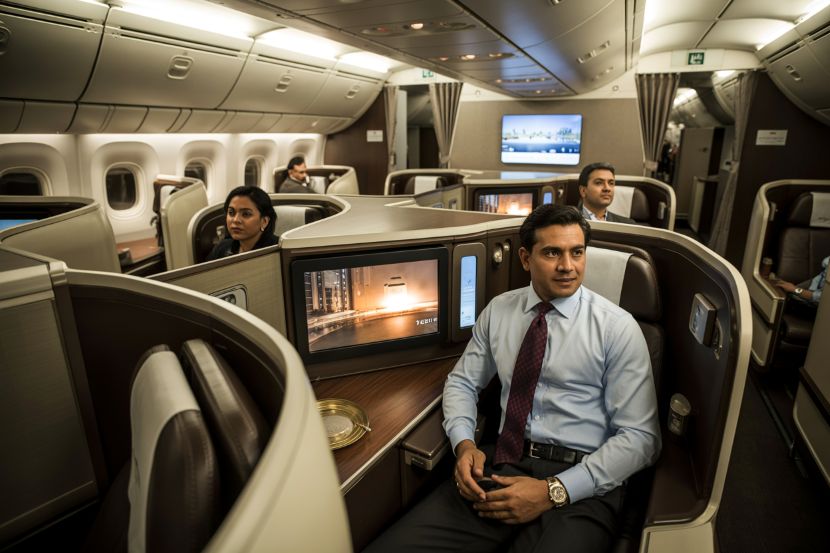
Image generated with Ai
Air India, Emirates and Lufthansa are reshaping the skies over India, Delhi and key global hubs such as London and New York as premium flying makes a powerful comeback. With Indian business travel surging, airlines are racing to expand first and business class cabins, redesign aircraft interiors and elevate airport lounge experiences to capture a new wave of high-spending travelers. At the center of this transformation is Air India’s $400 million cabin retrofit programme, aimed at doubling premium seats and redefining long-haul comfort from its Delhi hub. Meanwhile, international carriers are increasing premium seat supply on India-linked routes by over 31% in the past two years, reflecting renewed corporate mobility and rising outbound leisure demand. As aviation demand rebounds strongly after the pandemic slump of 2021, India is emerging as one of the world’s most lucrative premium travel markets.
India’s aviation sector is witnessing a visible shift toward higher-yield seating. According to aviation analytics data from Cirium, the proportion of first and business class seats offered on international routes connecting India has risen by more than 31% over the past two years. Compared with 2021—when business travel demand collapsed during the pandemic—capacity in these premium cabins has more than doubled.
This growth is not merely a return to pre-pandemic levels. Airlines are actively reconfiguring fleets to increase the share of premium seats, betting on a sustained revival of corporate travel as well as a growing segment of affluent Indian leisure travelers.
Major global airlines serving India—including Emirates and Lufthansa—have invested heavily in cabin upgrades, enhanced catering and improved airport ground services. These enhancements are designed to attract India’s expanding base of entrepreneurs, technology executives, financial professionals and high-net-worth individuals.
Advertisement
Advertisement
At the forefront of this transformation is Air India, which is undergoing one of the most ambitious product overhauls in its history.
The Tata Group-owned carrier has committed approximately $400 million toward retrofitting wide-body aircraft interiors. The programme includes:
Advertisement
Advertisement
In the past month, Air India introduced a newly configured Boeing 787 Dreamliner, reflecting its new design philosophy. At its primary hub at Delhi Airport, the airline also unveiled a redesigned premium lounge that features enhanced dining, business facilities and even a sleeper suite designed for long layovers.
For long-haul travelers flying between Delhi and cities like London, New York, Frankfurt or Dubai, these enhancements signal a competitive push to reclaim market share from established international carriers.
Advertisement
Advertisement
Several structural shifts are driving the premium cabin boom:
As multinational firms expand in India and Indian companies increase global footprints, international travel by executives has resumed at a strong pace.
Affluent Indian travelers are increasingly booking business class for family holidays to destinations in Europe, the Middle East and North America, combining comfort with convenience.
Premium economy has become a fast-growing segment, offering enhanced comfort without the full cost of business class—appealing to startup founders, consultants and upper-middle-class travelers.
Airlines are competing not just on price, but on onboard dining, lie-flat beds, privacy doors and lounge experiences.
For travelers considering premium cabins, timing and route selection can make a significant difference:
Premium cabins are increasingly accessible through strategic booking, corporate discounts and loyalty programme redemptions.
International carriers are clearly treating India as a priority growth market. Airlines such as Emirates have long leveraged Dubai as a connecting hub for Indian passengers traveling onward to Europe and North America. Meanwhile, Lufthansa continues to expand its premium offerings on India–Germany routes, capitalising on strong business links between the two economies.
The India–Europe corridor, especially between Mumbai, Delhi, Frankfurt and London, remains one of the most competitive premium travel routes globally.
India is also becoming a high-value origin market for flights to New York, San Francisco and Toronto, where demand for premium seating reflects strong diaspora ties and corporate travel flows.
Airlines are no longer competing only in the air. Premium ground experiences are increasingly decisive in traveler choice.
Air India’s revamped lounge at Delhi Airport includes:
Similarly, international carriers are enhancing airport lounges in India and at overseas hubs to attract premium flyers.
For business travelers with tight schedules, seamless lounge access, priority boarding and fast-track immigration services significantly improve journey efficiency.
India’s outbound tourism market has been expanding rapidly. Government tourism data and industry estimates show that outbound Indian travel has been rebounding strongly since 2023, with increasing demand for long-haul leisure trips.
Premium cabins are increasingly part of that travel pattern. Luxury travelers heading to:
are opting for higher comfort levels, particularly on overnight routes.
This shift benefits not only airlines but also global hospitality brands, luxury retail and destination tourism boards targeting high-spending Indian travelers.
The expansion of premium cabins improves airline revenue per seat, which helps offset fuel volatility and operational costs. High-yield seats contribute disproportionately to profitability, even if they represent a smaller percentage of total cabin capacity.
For India’s aviation sector, this premium push coincides with record aircraft orders placed by major Indian carriers in recent years. While narrow-body aircraft support domestic and regional growth, wide-body expansions signal serious intent in the long-haul international market.
With Delhi and Mumbai strengthening their positions as international gateways, India’s role in global premium aviation flows is set to deepen.
The rapid increase in **premium cabin capacity—up over 31% in two years and more than double compared to 2021 levels—**underscores a broader transformation in Indian aviation. Airlines are no longer competing solely for passenger volume; they are competing for premium yield and brand positioning.
From Delhi to Dubai, Frankfurt to London and New York, India is now central to global airline premium strategies. With rising corporate mobility, affluent leisure demand and upgraded fleet interiors, the next chapter of Indian aviation is being written in first and business class.
Advertisement
Tags: Air India premium upgrade, Delhi airport lounge expansion, Emirates India routes, India business travel surge, Lufthansa premium cabins
















Tuesday, February 24, 2026

Monday, February 23, 2026

Tuesday, February 24, 2026

Tuesday, February 24, 2026

Monday, February 23, 2026

Monday, February 23, 2026

Tuesday, February 24, 2026

Tuesday, February 24, 2026