
UAE Aligns Initiatives with Qatar and Others in a High Stakes Race to Recover Tourism with “A Dubai Invite” Campaign Offering Rewards to Boost Travel Demand and Economy Amid Continued Middle East Instability

Published
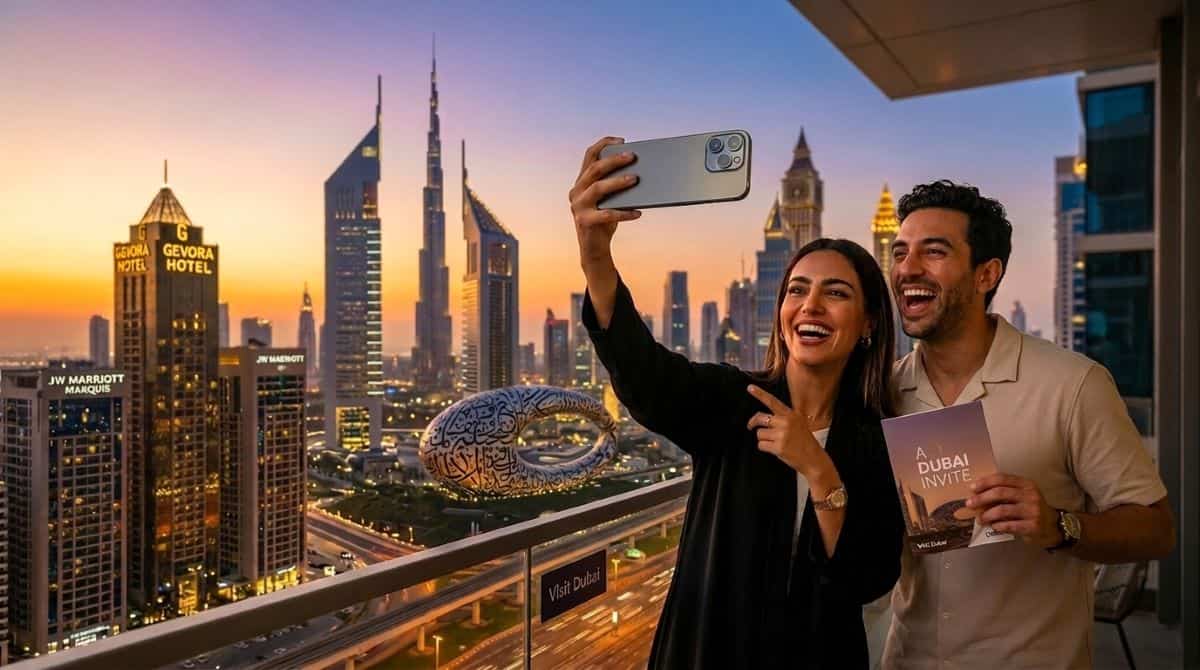
The UAE aligns initiatives with Qatar, Saudi Arabia and Jordan in a high-stakes race to recover tourism with “A Dubai Invite” campaign offering rewards to boost travel demand and economy by empowering residents as city ambassadors. Regional leaders are optimizing grassroots trust and direct financial perks to reignite international arrivals and protect vital non-oil growth amid continued Middle East instability. Instead of relying solely on traditional international marketing, regional tourism authorities are leveraging their most authentic voices: local citizens and foreign residents.
Leading this strategic transformation is the UAE through its resident-led tourism initiative, “A Dubai Invite.” Spearheaded by the Dubai Department of Economy and Tourism (DET), the initiative awards UAE residents with curated incentive packages valued at over AED 3,000 (~$816 USD / £610) when they host overseas family and friends.
What Is the “A Dubai Invite” Program and How Does It Function?
The “A Dubai Invite“ initiative converts the UAE’s multi-national population of over 200 nationalities into active destination advocates. Verified data from the Dubai Media Office confirms that eligible hosts can claim multiple benefit bundles by bringing international visitors to the emirate.
Core Incentive Structure and Value Distribution
Each promotional bundle carries a value exceeding AED 3,000 and features direct discounts, complimentary tickets, and value-adds:
Advertisement
Advertisement
- Free Accommodations & Hotel Discounts: Up to 45% off room rates at properties like Meliá Desert Palm and ME Dubai, alongside free night redemption deals across participating IHG Hotels & Resorts.
- Complimentary Attraction Passes: Full-day complimentary passes to top leisure sites, including Aquaventure World and IMG Worlds of Adventure, plus 50% savings at Grand Hyatt Dubai Waterpark.
- Dining Deals: “Buy One, Get One Free” meal vouchers across popular culinary venues such as Papas, The 305, Asia Asia, and Lock, Stock & Barrel.
- Mobility Perks: 20% discount codes for Careem Rides and Hala Taxis, plus added ride benefits via Careem Plus.
Program Rules and Operational Criteria
| Criteria / Parameter | Official Guideline Details |
| Eligible Host | UAE residents and citizens aged 18+ holding a valid Emirates ID |
| Eligible Guest | Non-UAE residents traveling on a valid tourist visa or visa-on-arrival |
| Incentive Limit | Maximum of 3 reward packages per registered resident |
| Nomination Group Size | Up to 5 visitors per single submission form |
| Travel Arrival Window | Arrivals occurring between July 20 and October 31 |
| Reward Validity Window | Earned vouchers remain valid through December 31 |
Key Rule Notice: Border entry channels automatically verify guest arrivals. DET issues reward packages directly via email within 72 hours of confirmed entry.
Advertisement
Advertisement
Why the High-Stakes Race for Tourism Recovery Matters Amid Ongoing Regional Instability
The rapid rollout of campaigns like “A Dubai Invite”—and parallel initiatives across Qatar, Saudi Arabia, and Jordan—is not merely about filling hotel rooms; it is a fundamental strategic imperative for national economic survival. As persistent geopolitical friction tests the resilience of the Middle East, maintaining momentum in the travel sector has become a high-stakes priority for regional governments for several reasons:
- Protecting Non-Oil Diversification Mandates
- Safeguard for Multi-Billion-Dollar Infrastructure Investments
- Preserving Employment and Local Service Economies
- Managing Perceptions and Sovereign Credit Stability
Why Is the UAE Shifting Toward Resident-Led Travel Campaigns?
This community-centric campaign follows strong momentum across the emirate’s travel industry. According to official performance reports from the Dubai Department of Economy and Tourism (DET), Dubai recorded 19.59 million international overnight visitors, reflecting a 5% year-on-year growth over previous records.
Advertisement
Advertisement
However, heightened regional geopolitical friction—involving regional drone and missile activity, airspace diversions, and international flight suspensions—temporarily impacted long-haul travel confidence.
By shifting focus toward direct peer-to-peer invitations, economic planners aim to bypass generalized media narratives. Personal assurances from local residents carry high credibility among family members and friends, directly addressing safety hesitations while providing tangible cost offsets for incoming travelers.
How Are Regional Hotels Adapting to Market Fluctuations?
To maintain steady occupancy rates during periods of altered air traffic, hotel operators across the region are adjusting room pricing and accelerating asset maintenance schedules.
Strategic Rate Reductions and Operational Adjustments
- Direct Rate Discounts: Luxury and mid-scale hotels across the UAE are offering room discounts ranging between 35% and 45% to capture local staycations and visiting friends and relatives (VFR).
- Accelerated Property Renovations: Several luxury properties are using quiet periods to complete multi-month refurbishments. Notably, the Burj Al Arab structured an 18-month refurbishment phase to upgrade guest facilities while preserving RevPAR (Revenue Per Available Room) efficiency.
- Value-Add Package Bundling: Operators are pairing room bookings with complimentary meal upgrades, extended check-out times, and bundled resort access passes.
How Are Qatar, Saudi Arabia, and Neighboring Nations Aligning Initiatives?
The UAE’s resident-centered drive aligns with coordinated policy movements across neighboring Gulf Cooperation Council (GCC) countries.
Advertisement
Advertisement
Qatar: Leveraged Transit and Family Perks
Official statistics from Qatar Tourism show that Qatar welcomed 5.1 million international visitors, backed by a strong 71% average hotel occupancy rate. The GCC proximity market represents Qatar’s largest feeder segment, driving 35% of total visitor arrivals.
To protect these inbound flows, Visit Qatar and national carrier Qatar Airways expanded companion booking discounts. Qatari residents can issue discounted airfare packages (up to 25% off) and bundled Doha hotel stays to overseas family, supported by streamlined visa processing via the national Hayya platform.
Saudi Arabia: Expanding the Multi-Destination “GCC Grand Tour”
Under Vision 2030 economic goals, Saudi Arabia’s Ministry of Tourism and the Saudi Tourism Authority (STA) reported 123 million total domestic and international visits, generating approximately SAR 300 billion in tourism expenditure according to the General Authority for Statistics (GASTAT).
To cushion against regional headlines, Saudi Arabia is expanding transit visa options and accelerating the GCC Grand Tour visa system. Similar to Europe’s Schengen visa, this unified framework lets international travelers visit all six GCC countries under a single entry permit, converting single-city trips into multi-destination regional itineraries.
Jordan: Ground-Operator and Flight Subsidies
Further west, the Jordan Tourism Board (JTB) has focused on direct B2B risk-sharing mechanisms. To sustain flight frequency into Amman and Aqaba during period of regional tension, the Jordanian government maintains financial subsidies for charter flight operators and low-cost regional carriers. These measures directly reduce seat-risk for aviation partners while keeping ground transportation and package tour costs competitive for incoming cultural travelers.
GCC Tourism Performance Metrics
Advertisement
Advertisement
| Country | Annual Visitor Metrics | Tourism GDP Share | Primary Focus |
| UAE (Dubai) | 19.59 Million annual visitors | ~11.5% of GDP | “A Dubai Invite” Resident Referrals |
| Qatar | 5.10 Million arrivals (71% hotel occupancy) | 15.1% of GDP | Qatar Airways Companion & Family Perks |
| Saudi Arabia | 123 Million total visits (29.3M inbound) | ~10.0% of GDP | Multi-City Transit Visas & Unified GCC Visa |
| Jordan | Subsidized charter & low-cost flight routes | ~13.0% of GDP | Direct B2B Tour Operator Risk-Sharing |
What Is the Long-Term Economic Outlook for Middle East Tourism?
The rollout of resident-focused incentive programs like “A Dubai Invite,” alongside unified cross-border policies across the Gulf, highlights a broader shift in how regional tourism boards handle market disruptions.
- Grassroots Credibility: Peer-to-peer outreach counters general perception concerns faster than broad advertising campaigns.
- Direct Sector Support: Incentive vouchers pour capital directly into local restaurants, transport systems, and municipal attractions.
- Cost-Effective Visitor Acquisition: Organic resident sharing reduces reliance on costly overseas media campaigns.
- Regional Integration: Combined initiatives prepare the region for the full rollout of the GCC Unified Tourist Visa, creating a more resilient multi-nation travel ecosystem.
By engaging local communities, lowering travel costs, and aligning regional policy, Middle Eastern destinations are maintaining robust hospitality networks—positioning the sector for sustained long-term growth as market conditions normalize.
In conclusion, UAE aligns Initiatives with Qatar and others in a high stakes race to recover tourism with “A Dubai Invite” campaign offering rewards to boost travel demand and economy amid continued Middle East instability. By empowering residents as active brand ambassadors and providing high-value incentive packages, regional authorities effectively convert local trust into inbound international visitors. Coupled with unified GCC travel frameworks, this community-led model directly counters regional friction, protects non-oil diversification targets, and secures long-term economic resilience across the Gulf’s hospitality ecosystem.
Advertisement
