

Ghana and More African Countries Transform Ancestral Pilgrimages Into a New Era of Cultural and Eco-Tourism

Published
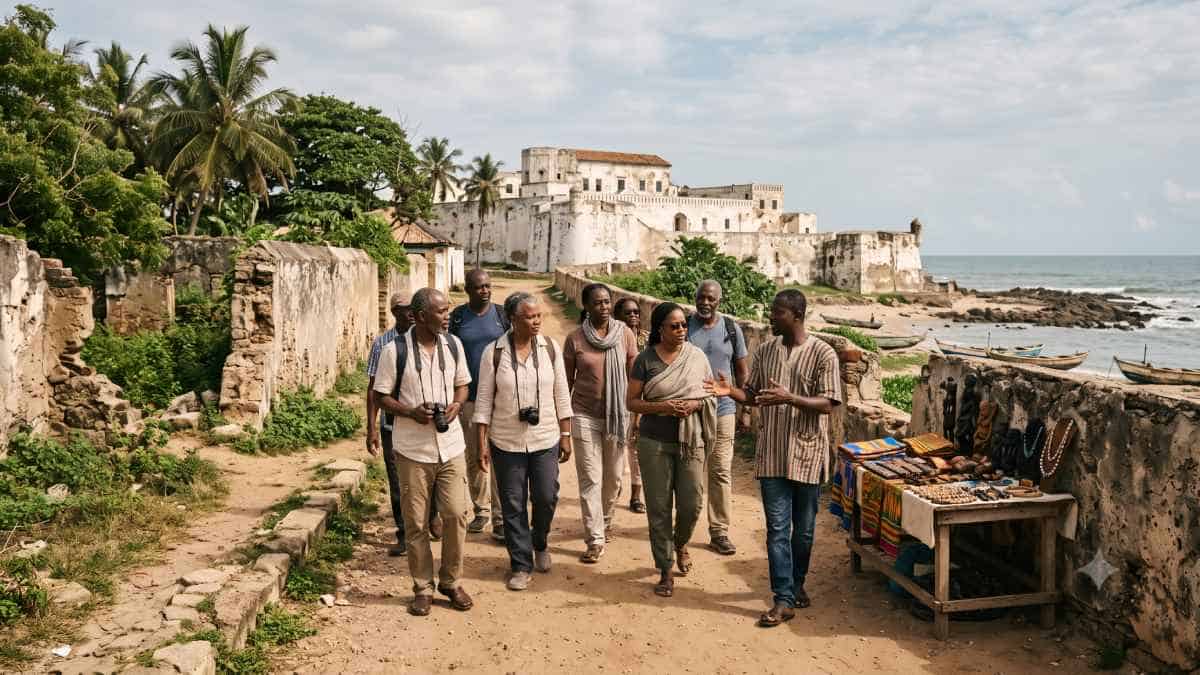
What we are witnessing is an unprecedented paradigm shift that is taking place in Africa, where global tourism is being redefined through the coming together of spiritual rejuvenation, ancestral memories, and environmental conservation. The superficial form of tourism being avoided by many international tourists is becoming obsolete as people seek to embark on life-changing experiences and become one with their rich heritage as well as fragile environments. Sites associated with historical pain are becoming sites of memories, mountain paths associated with spirituality are becoming accessible through technology, and eco-sites managed by communities are being created to finance conservation.
The Theoretical and Historical Framework of Pan-African Pilgrimage
An epistemological transformation is being undergone by the international travel economy as high-density, extractivist holiday formats are progressively rejected in pursuit of personal meaning, ethical accountability, and ancestral reconnection. Within this systemic shift, the African continent has been established as the leading frontier of an unprecedented travel philosophy wherein religious devotion, secular introspection, and landscape conservation are synthesised into unified pilgrimage corridors.
Advertisement
Advertisement
Historically, religious journeys across Africa were interpreted along rigid, institutional lines. Travel was conducted along narrow liturgical tracks, such as ancient Christian monastic circuits in the Nile basin and the Horn of Africa, or regional Islamic brotherhood corridors traversing the Sahel. In parallel, cultural tourism was predominantly tethered to static museum interpretations, colonial architecture, and passive safari itineraries through which local communities were frequently divorced from their ancestral environments.
In the modern era, this dichotomy has been dissolved under a post-colonial revaluation of African heritage. Grounded in the Akan philosophy of Sankofa—the intentional imperative to return to the ancestral past so that knowledge necessary for collective advancement may be retrieved—travel is being transformed by African governments and cultural custodial bodies into a vehicle for restorative justice. By mapping and establishing permanent sacred and secular routes, historical departure ports, ancient highland hermitages, and indigenous woodlands are being converted into spaces of contemplative pilgrimage.
Advertisement
Advertisement
This reorientation coincides with profound structural shifts in global travel economics. Cultural and religious journeys are reported by UN Tourism data to constitute a substantial proportion of international leisure voyages globally, representing an escalating market valuation.
Sub-Saharan Africa has emerged as a high-growth destination within this sector, having recorded significant increases in international tourist arrivals. By pivoting away from seasonal sun-and-sea holidays toward permanent identity-driven routes, high-yield capital is being captured by African administrations, while fragile cultural ecosystems are actively insulated from the damaging volatilities of mass commercial overtourism.
Advertisement
Advertisement
Diaspora-Driven Sankofa and Secular-Spiritual Corridors in West Africa
The focal point of the global diaspora’s secular-spiritual return is represented by the Atlantic rim of West Africa. Here, the harrowing geography of the transatlantic slave trade is systematically reconceptualised, whereby historic forts, slave rivers, and barracoons are shifted from commercial tourist landmarks into sacred sanctuaries of memory and psychological healing.
The Ghanaian Roots-to-Return Architecture and Sanctuaries of Remembrance
The continental benchmark for identity-driven diaspora tourism has been established by Ghana. Building upon the momentum of the landmark “Year of Return”, the long-term “Beyond the Return” policy framework was formalised by the Ministry of Tourism, Arts, and Culture alongside the Ghana Tourism Authority. Rather than treating historical transatlantic sites as passive monuments, an ancestral pilgrimage corridor anchored in Sankofa heritage has been institutionalised by the Ghanaian state.
Itineraries structured around ritual commemoration and emotional restitution are packaged through collaborations between licensed travel operators and national heritage authorities. The pilgrimage route is commenced inland at the Assin Manso Ancestral Slave River Site in the Central Region, historically documented as Donkor Nsuo. It was at this river crossing that the “Last Bath” in continental waters was endured by captured Africans prior to forced marches to coastal dungeons.
Assin Manso is preserved under current state management protocols as an active memorial sanctuary. Guided rituals of silence are observed by pilgrims, river waters are waded into to honour ancestors, and gatherings are held at the memorial cemetery where the repatriated physical remains of transatlantic descendants—Lady Crystal from Jamaica and Carson from the United States—were reinterred so that the spiritual return might be inaugurated.
From Assin Manso, journeys are directed southward to the UNESCO World Heritage forts of Cape Coast Castle and Elmina Castle. Pilgrim groups are guided by state docents through subterranean dungeons toward the historic “Door of No Return”, the narrow portal through which captive Africans were loaded onto transatlantic transport ships.
This trauma is reversed through ritual place-making: the castle courtyard is re-entered by travellers through the opposite side of the portal, which has been officially inscribed by heritage authorities as the “Door of Return”. Substantial economic dividends continue to be yielded by this structured pilgrimage, with significant localized expenditure being delivered across hospitality, artisanal trade, and transport during off-peak periods by targeted diaspora delegations.
Advertisement
Advertisement
Benin’s Vodún Reclamation and South American Transatlantic Alignment
To the east, an equally profound spiritual corridor focused on ancestral religion and cosmological restoration has been pioneered by the Republic of Benin. Through the Ministry of Tourism, Arts and Culture, the historic city of Ouidah has been transformed into the focal destination of the annual “Vodún Days”, whereby what was historically viewed as a local observance has been elevated into an international pilgrimage. Colonial narratives that demonised indigenous spiritual systems are dismantled, allowing Vodún to be celebrated as a sophisticated philosophical discipline and living heritage.
The Afro-descendant diaspora of South America is strategically targeted by the international dimension of Benin’s spiritual route, with direct bilateral cultural initiatives focusing on Salvador da Bahia in Brazil and Buenos Aires in Argentina. Syncretic African traditions, including Candomblé Ketu, Tambor de Mina, and Umbanda—whose liturgical pantheons originate directly from the Fon, Ewe, and Yoruba cosmologies of the Dahomey littoral—are adhered to by millions of South American citizens.
During the multi-day Vodún Days ceremonies, direct engagements are undertaken by South American pilgrims with high priests (Vodunnon), sacred convent societies, and ancestral masquerades such as the Zangbeto and Egungun.
This spiritual reclamation has been strengthened through legislative innovation: Beninese nationality is provided to Afro-descendant applicants worldwide under Law No. 2024-31, passed by the National Assembly. Facilitated through the state digital application portal My Afro Origins (myafroorigins.bj), formal citizenship is secured by diaspora pilgrims through the submission of genealogical or ancestral DNA evidence.
Naturalisation ceremonies are conducted in Ouidah near the historic commemorative monuments, integrating legal belonging with spiritual repatriation. Modern travellers are thereby reconnected with the heritage of the Agudás—Afro-Brazilians by whom settlements, architectural traditions, and family lineages were established in Ouidah during the nineteenth century.
Nigeria’s Badagry Circuit and Regional Inter-Continental Mobility
The regional corridor is complemented by the Federal Republic of Nigeria through the Badagry coastal circuit in Lagos State. A cohesive secular-spiritual corridor has been developed along the Badagry Heritage Trail by the Nigerian Federal Ministry of Tourism in cooperation with the Lagos State Ministry of Tourism, Arts and Culture.
Advertisement
Advertisement
The trail integrates the Vlekete Slave Market, the Mobee Slave Relics Museum, and the Seriki Williams Abass Brazilian Barracoon, guiding pilgrims to the historic Gberefu Island path known as the Point of No Return. The trail between the lagoon and the open Atlantic Ocean is traversed by pilgrims, passing the historic attenuation well where memory-erasing rituals were once administered to captives.
To support multi-destination accessibility, regional transportation and visa infrastructure are being actively improved by West African administrations. Inland cultural hubs are being directly linked to the Atlantic coast through large-scale infrastructure investments, including the Sokoto-Badagry Super Highway corridor.
Simultaneously, seamless journeys across Ghana, Benin, and Nigeria within a single itinerary are facilitated for diaspora travellers through simplified digital e-visa portals, visa-on-arrival protocols, and reciprocal ECOWAS entry systems, establishing an integrated regional pilgrimage corridor.
Trans-Continental Ancient Faith Trails and Digital Monastic Systems
In East Africa, the pilgrimage economy is drawn from an unbroken tradition of liturgical antiquity. Having adopted Christianity in the early fourth century under the Kingdom of Aksum, the ancient monastic geography of Ethiopia has been modernised to connect with international pilgrimage circuits across Eastern Europe, the Mediterranean, and the Americas.
The Northern Monastic Circuit of Ethiopia
A unified northern pilgrimage route linking the country’s most significant spiritual centres has been developed by the Ethiopian Ministry of Tourism in collaboration with regional heritage bureaus. Three primary archaeological and ecclesiastical landscapes are connected along this mountain route:
The architectural core of the circuit is served by Lalibela, featuring monolithic churches excavated from volcanic rock during the twelfth and thirteenth centuries under King Gebre Mesqel Lalibela. Having been conceived as a “New Jerusalem” after overland voyages to Palestine were halted by captures of the Holy Land, a complex network of rock-cut ceremonial trenches, subterranean tunnels, and ritual waterways representing the River Jordan is featured at Lalibela. An international symbol of sub-Saharan liturgical architecture is embodied in the monolithic cruciform church of Biete Giyorgis (Church of Saint George).
Advertisement
Advertisement
The historical and administrative cradle of the Ethiopian state is represented by Aksum (Axum), featuring massive granite stelae, royal subterranean necropolises, and the Church of Our Lady Mary of Zion. It is held by Ethiopian Orthodox Tewahido doctrine that the original Ark of the Covenant, brought from ancient Jerusalem by King Menelik I, is guarded within this chapel.
The trail is completed by the high-altitude hermitages of Tigray and the Gheralta mountain range. Cliff-top monastic sanctuaries such as Abuna Yemata Guh and Debre Damo, carved into sheer rock faces accessible only by scaling vertical stone cliffs, require an austere physical ascent to be undertaken, whereby the journey is transformed into a contemplative spiritual act.
Consistent increases in international arrivals have been recorded in official assessments published by UN Tourism, driven by the expansion of liturgical heritage infrastructure and escalating global interest in ancient celebrations such as Genna (Christmas) and Timkat (Epiphany).
The Digital Pilgrim Passport and Heritage Conservation Technology
To administer this remote highland circuit while delicate ecclesiastical assets are safeguarded, the digital pilgrim passport was introduced by the Ethiopian Ministry of Innovation and Technology together with the Ministry of Tourism.
Drawing inspiration from the European Credencial utilised by walkers along Spain’s Camino de Santiago, the traveller’s journey is monitored, verified, and enhanced through this digital credential using mobile-compatible interfaces, unique cryptographic quick-response (QR) tokens, and decentralised ledgers.
Registration on the platform is completed by international visitors upon securing entry approvals via the official e-visa system (evisa.gov.et). As journeys through Lalibela, Gondar, Aksum, and Gheralta are completed, digital transit markers are scanned and authenticated by ecclesiastical custodians and state-certified guides using mobile devices capable of caching verification data offline in remote mountain areas.
Advertisement
Advertisement
A vital conservation role is also served by the digital infrastructure. Thousands of illuminated Ge’ez manuscripts, ancient vellum bibles, and processional iron crosses housed in fragile monastic scriptoriums are vulnerable to atmospheric humidity and tactile degradation caused by overcrowding.
Visitor foot traffic is distributed by the digital pass acting as an automated access manager, granting library entry permissions only to accredited travellers who complete cultural orientation modules. Upon completing the Northern Historic Route, an authenticated ecclesiastical pilgrimage certificate endorsed jointly by the state and the Ethiopian Orthodox Tewahido Church Patriarchate is received by travellers.
Ethiopian Airlines and Trans-Mediterranean Combo-Itineraries
The commercial viability of this ancient faith route is supported by Ethiopian Airlines through its global transit hub at Addis Ababa Bole International Airport. Comprehensive “Holy Land and Horn of Africa” packages are marketed through its dedicated travel operation branch, Ethiopian Holidays.
Traditional Mediterranean pilgrimage sites are connected with Ethiopian monastic centres via these multi-destination routes. Direct linkages are established between historical Christian centres across Armenia, Greece, Poland, and Lithuania and the northern circuit of Ethiopia. Unbroken apostolic traditions preserved in sub-Saharan Africa can thus be experienced by Central and Eastern European travellers historically accustomed to continental shrines.
African faith heritage is integrated into established global pilgrimage corridors by utilising the extensive flight network of Bole International Airport.
Eco-Pilgrimage, Monastic Conservation, and Anti-Overtourism Governance
Beyond urban centers and historic fortresses, a crucial component of Africa’s pilgrimage landscape is operated at the intersection of spiritual retreat, community forestry, and biological conservation. Across Southern and East Africa, low-density sanctuaries are being established by religious groups, monastic trusts, and indigenous elder councils, generating self-sustaining conservation revenue while wilderness areas are protected from mass commercial development.
Advertisement
Advertisement
Southern African Faith-Based Reserves and Contemplative Sanctuaries
Historic mission lands and church estates situated within delicate mountain and savannah biomes in South Africa and Zimbabwe are being revitalised as conservation models.
In South Africa’s KwaZulu-Natal province, a series of historic Catholic mission stations founded by Abbot Francis Pfanner and the monks of Mariannhill Monastery across the Drakensberg foothills are connected by the Trappist Trail. Spanning indigenous woodlands and vital river catchments, these properties have been designated as quiet retreats.
Through the monastic rule of ora et labora (prayer and work), monastic conservation is advanced by the Trappist stations through low-impact hospitality. Noisy recreational activities are prohibited, while energy efficiency and indigenous habitat renewal are prioritized. The rehabilitation of native riparian zones, the clearing of invasive flora, and the maintenance of private green buffers surrounding national parks are funded directly by visitor fees.
Northward in Zimbabwe, similar initiatives are maintained within the conservation zones surrounding Victoria Falls and Zambezi National Park. Small-scale, quiet wellness retreats have been introduced by church-owned and mission-adjacent properties to counteract the noise and ecological pressure associated with conventional commercial tourism around the falls.
Meditative experiences in untouched nature are offered to a rising segment of wellness-focused travellers. Regional anti-poaching units are supported through fixed portions of nightly lodging fees, financing tracker dog units, perimeter monitoring, and ranger patrols by which vulnerable white rhino populations and African elephants are safeguarded across surrounding conservation corridors.
Kenya’s Sacred Mijikenda Kaya Forests: Indigenous Customary Stewardship
On the East African coast, indigenous spiritual conservation is exemplified by the Republic of Kenya through the Sacred Mijikenda Kaya Forests. Inscribed on the UNESCO World Heritage List, distinct forest patches distributed across Kwale, Kilifi, and Mombasa counties are comprised within the Kayas, having been originally established as fortified forest homesteads by the nine Mijikenda ethnic groups.
Advertisement
Advertisement
The primary site open to supervised visitors is represented by the Kaya Kinondo Sacred Forest, situated in Kwale County behind Galu Beach, south of the Diani Beach resort district. Rare coral-rag coastal rainforest supporting diverse plant species, butterfly varieties, and viable populations of the vulnerable Angolan colobus monkey is encompassed within Kaya Kinondo.
The forest is administered through the Kaya Kinondo Ecotourism Project, managed directly by the local Digo community under the authority of the Council of Elders (Kambi) in partnership with the National Museums of Kenya and the Kenya Forest Service. Regulated ecotourism was initiated by the elders to counter habitat destruction from agricultural encroachment and coastal hotel development.
An authentic, guided “Silent Sacred Hike” is marketed internationally. Access is granted only under strict compliance with traditional Digo spiritual customs enforced by local elders:
Shoes, hats, and non-traditional clothing must be removed by visitors, who are wrapped in a traditional black cloth wrap known as a kaniki. A peaceful, contemplative forest environment is maintained as chanting, shouting, running, overt displays of affection, and littering are strictly prohibited.
Walkers are required to remain entirely on designated ancestral paths; entry into inner clearings—where the community’s sacred fingo protective talismans and ancestral graves reside—is forbidden to non-initiates.
Furthermore, the snapping of branches, gathering of stones, or picking of wild foliage is prohibited; the woodland is treated as a living botanical pharmacy from which healing species are gathered only under traditional elder guidance.
Advertisement
Advertisement
Local village accounts receive all visitor fees directly rather than external tourism intermediaries. Community clean water initiatives, primary school infrastructure, women’s artisanal enterprises, and youth scout patrols protecting the forest from illegal logging and charcoal burning are financed through this revenue. Durable ecosystem conservation is thus illustrated to be achieved more effectively through traditional spiritual stewardship than through conventional paramilitary enforcement.
Macroeconomic Blueprint and Industry Metrics
Systemic challenges in developing tourism economies are intentionally addressed through the expansion of sacred and secular routes across the African continent. Conventional mass leisure and beach tourism are frequently affected by high economic leakage, whereby substantial proportions of visitor expenditures are returned to overseas tour operators, foreign aviation networks, and multinational hotel franchises.
In contrast, significant capital is retained within domestic and municipal economies through Africa’s emerging faith and diaspora corridors, directing resources to local custodians, community guides, regional craft producers, and domestic transport providers.
| Strategic Pilgrimage Pillar | Lead African Jurisdictions | Primary Target Source Markets | Institutional & Regulatory Frameworks | Commercial Metrics & Sustainability Outcomes |
| Sankofa Root-Pilgrimage | Ghana, Benin, Nigeria | Brazil, Argentina, United States, Caribbean | Beyond the Return (Ghana); Law No. 2024-31 on Nationality (Benin); ECOWAS visa alignment. | High-spend, multi-week identity travel; direct capital retention by municipal trusts and local guides. |
| Trans-Continental Faith Trails | Ethiopia (Amhara, Tigray, Aksum) | Poland, Lithuania, Greece, Armenia, Southern Europe | Digital Ethiopia Strategy; Ministry of Innovation route mapping; national e-visa systems. | Direct flight connectivity through Ethiopian Airlines Bole hub; digital QR credentials controlling delicate monastic library access; consistent arrival growth. |
| Eco-Pilgrimage Conservation | South Africa, Zimbabwe, Kenya | United Kingdom, Germany, Scandinavia, North America | UNESCO World Heritage frameworks; National Museums of Kenya elder management; Trappist monastery trusts. | Low-density silent retreats; mandatory conservation levies directly financing rhino protection, anti-poaching patrols, and community-led indigenous forest restoration. |
A notable share of gross domestic product across sub-Saharan Africa is accounted for by travel and tourism. A growing proportion of the global cultural travel market is secured as the continent’s cultural and spiritual circuits expand rapidly.
Because pilgrimage travellers are driven by deep personal, spiritual, or genealogical motivations rather than seasonal leisure, consistent visitor flows are maintained throughout the year, insulating domestic tourism economies from traditional low-season lulls.
Policy Implications and Strategic Outlook
Critical infrastructure and governance priorities must be addressed by regional policymakers as these pilgrimage networks are expanded over the coming decade.
Advertisement
Advertisement
First, continued multilateral visa coordination is required to establish frictionless, multi-destination regional travel corridors. While an innovative statutory model is represented by Benin’s citizenship law, harmonised, reciprocal travel arrangements across West Africa are necessary for its full economic potential to be realized. Seamless travel between historical sites in Ghana, Benin, and Nigeria under a single regulatory framework would be enabled by standardising digital multi-entry cultural visas and mutual entry recognitions across ECOWAS member states.
Second, strong legal frameworks that recognise local governance are required to protect sacred landscapes from commercial overexploitation. Effective protection against illegal logging and environmental damage is offered through customary taboos administered by traditional elders, as demonstrated at Kenya’s Kaya Kinondo.
Indigenous custodians, monastic councils, and village trusts should be formally integrated by national tourism ministries into statutory destination management plans, granting them full legal authority to enforce carrying capacities and regulate visitor behavior. The preservation of fragile historical assets and endangered ecosystems for future generations is ensured by combining these customary protections with digital management systems, such as the digital pilgrim passport implemented along Ethiopia’s monastic routes.
A fundamental evolution in international travel is signified by Africa’s growing network of sacred and secular routes. By linking ancestral identity, religious antiquity, and ecosystem preservation into cohesive corridors, an ethical alternative to conventional mass tourism is offered. Meaningful personal journeys are embarked upon by global travellers while sustainable economic resources preserving Africa’s cultural heritage and natural landscapes are generated.
An enduring bridge uniting historical redemption, liturgical preservation, and ecological defense is established by Africa’s pioneering travel paradigm. Heritage tourism is converted into an engine for socioeconomic emancipation through formalized sacred and secular routes. Consequently, authentic community custody replaces exploitative commercial models, allowing ancestral fissures to be healed while environmental futures are funded.
Conclusion
Ancestral pilgrimages are becoming important instruments for preserving culture, reconnecting spiritually, and promoting sustainable tourism in Africa. Through the protection of sacred sites, empowerment of local people, and retelling of historical stories, nations like Ghana, Benin, and Ethiopia have been able to give their visitors memorable experiences while safeguarding their heritage for generations to come.
Advertisement
