Published on March 5, 2026
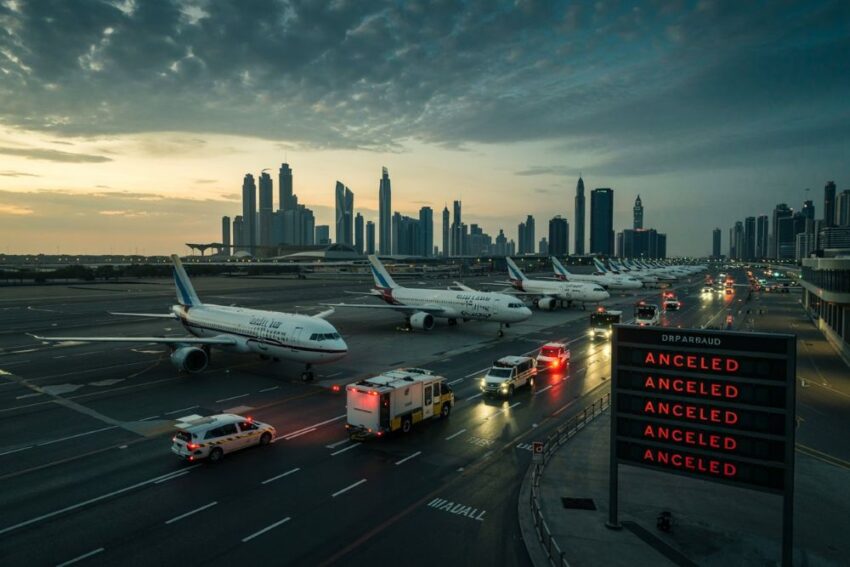
Image generated with Ai
Travel across the Gulf Cooperation Council (GCC) region remains severely disrupted as the fifth consecutive day of regional hostilities has triggered widespread airspace closures, cruise cancellations, and large-scale repatriation efforts. Major aviation hubs including Dubai, Doha, Abu Dhabi, and Riyadh are operating under emergency protocols, while governments are coordinating commercial flights, charter services, and land evacuations to assist stranded travelers. According to updates issued by aviation authorities and foreign ministries across the region, airspace over Qatar, Bahrain, and Kuwait remains closed until further notice, while the United Arab Emirates and Saudi Arabia are operating under controlled and reduced capacity conditions. Meanwhile, cruise operators have suspended sailings from Gulf ports, marking a significant escalation in travel disruption.
Major international hubs such as Dubai International Airport and Hamad International Airport in Doha continue to experience operational limitations. Authorities in the United Arab Emirates confirmed that controlled flight movements are being coordinated through emergency air corridors to gradually restore connectivity across Abu Dhabi, Dubai, Sharjah, and Fujairah. The UAE General Civil Aviation Authority (GCAA) has implemented a contingency air traffic plan allowing up to 48 aircraft movements per hour through designated corridors. The move is designed to manage essential traffic while maintaining aviation safety standards amid regional tensions. While Saudi Arabia and Oman have kept airports operational, neighboring states including Qatar, Bahrain, and Kuwait continue to enforce temporary airspace closures. These restrictions have caused cascading delays and cancellations affecting thousands of transit passengers.
Advertisement
Advertisement
Maritime tourism has also been impacted. Both Celestyal Cruises and MSC Cruises, which were operating Arabian Gulf itineraries, have cancelled their remaining March departures from Doha and Dubai. Celestyal Cruises confirmed that passengers booked on affected sailings will receive either a full refund or future cruise credit. The decision effectively ends the remainder of the Gulf cruise season for the company. Industry observers note that the cancellations reflect broader concerns about regional maritime safety and port accessibility. Cruise vessels previously operating from Doha Port and Port Rashid in Dubai are now adjusting itineraries or redeploying ships outside the region.
Advertisement
Advertisement
With commercial air travel disrupted, multiple governments have activated evacuation and repatriation protocols.
On 3 March, the US Department of State issued a regional advisory instructing American citizens to depart 14 Middle Eastern countries using available commercial options. The advisory covers Bahrain, Egypt, Iran, Iraq, Jordan, Israel, Kuwait, Lebanon, Oman, Qatar, Yemen, Syria, Saudi Arabia, and the United Arab Emirates.
Additionally, the US Embassy in Abu Dhabi and the US Consulate in Dubai suspended operations following a drone-related security incident near the Dubai consulate. These closures follow earlier suspensions at US diplomatic missions in Saudi Arabia and Kuwait, which were affected by similar incidents. American citizens in the region have been advised through official embassy channels to monitor alerts and register their presence.
The UK Foreign, Commonwealth & Development Office (FCDO) has instructed British nationals in affected GCC countries to register their location and avoid proximity to military or strategic sites.
Limited commercial departures from the United Arab Emirates and Oman remain available for those seeking to return to the UK. Additionally, Visa Application Centres (VACs) in the UAE resumed services from 4 March, according to official UK government updates.
A UK-chartered evacuation flight departed Oman on 4 March to assist British nationals unable to secure commercial options.
The Singapore Embassy announced contingency land evacuation planning for citizens stranded in Qatar. The proposal involves organized bus transfers either to Riyadh, approximately seven hours by road, or to Jeddah, a journey of roughly 17 hours, for onward international travel. Singapore authorities have requested nationals to formally register interest via an official government portal to assess capacity requirements.
Authorities in Saudi Arabia confirmed that stranded GCC citizens at Saudi airports may contact the dedicated assistance hotline 992 or visit the Airports Passports Department for travel support and documentation guidance. Airports in Riyadh, Jeddah, and Dammam continue operating under normal conditions, positioning the Kingdom as a critical transit hub amid regional airspace closures.
As flight options remain limited, overland travel is emerging as a key alternative. In Saudi Arabia, land borders with Qatar and Kuwait remain open. However, the King Fahd Causeway linking Saudi Arabia and Bahrain has been temporarily closed. In the United Arab Emirates, Dubai-based transport operator GH Trips has introduced daily bus services for Saudi nationals traveling to Riyadh, Jeddah, Makkah, Madinah, Dammam, and Khobar. Meanwhile, Omani carriers SalamAir and Oman Air are jointly facilitating shuttle bus services between Sharjah and Muscat International Airport from 3 to 5 March to support passengers seeking international departures from Omani airspace.
In a significant development for regional ground transport, Etihad Rail conducted its first passenger trial operation. The service transported more than 350 UAE citizens and residents across three journeys between Al Ghuwaifat, near the Saudi border, and Al Faya in Abu Dhabi. While primarily a pilot program, the trial underscores the growing strategic role of rail infrastructure in crisis response scenarios. Authorities have indicated that further assessments will determine potential expansion of passenger services if needed.
Despite disruptions, some airlines have cautiously resumed limited operations. Virgin Atlantic restarted select services from London Heathrow to Dubai and Riyadh, operating under adjusted flight paths and regulatory approvals. Aviation authorities continue to emphasize that schedules remain fluid and subject to rapid change based on security assessments.
The cumulative effect of airspace restrictions, cruise cancellations, diplomatic mission closures, and emergency evacuations has created one of the most complex travel disruptions in the GCC in recent years. Airlines are recalibrating routes to avoid restricted zones. Cruise operators are redeploying vessels. Governments are expanding coordination through aviation regulators, embassies, and border authorities. Travelers in Dubai, Doha, Abu Dhabi, Riyadh, Muscat, and neighboring capitals are advised to rely exclusively on official government and airline channels for updates.
While some airports in Saudi Arabia and Oman continue operating normally, uncertainty remains across the broader GCC region. Aviation regulators are reviewing conditions daily, and maritime operators are assessing future Gulf deployments. For now, the Gulf travel landscape is defined by controlled reopening, structured evacuation, and evolving contingency planning. Authorities across Dubai, Doha, Abu Dhabi, and Riyadh continue to prioritize citizen safety and transportation continuity as the situation develops.
Advertisement
Tags: Gulf airspace closure, Middle East cruise cancellations, Qatar flight suspension, Saudi Arabia evacuation routes, UAE travel advisory 2026

















Thursday, March 5, 2026

Thursday, March 5, 2026

Thursday, March 5, 2026

Thursday, March 5, 2026

Thursday, March 5, 2026

Thursday, March 5, 2026