Home»Airlines News of Europe» Thousands of Passengers Stuck in Europe as British, Lufthansa, Swiss, Emirates, Qatar, Turkish, and Other Airlines Suspend 565 New Flights and Delay 1,493 across UK, Germany, Turkey, France, Italy at London, Frankfurt, Istanbul, Paris, Zurich, Ferno and More
Thousands of Passengers Stuck in Europe as British, Lufthansa, Swiss, Emirates, Qatar, Turkish, and Other Airlines Suspend 565 New Flights and Delay 1,493 across UK, Germany, Turkey, France, Italy at London, Frankfurt, Istanbul, Paris, Zurich, Ferno and More
Published on
March 1, 2026
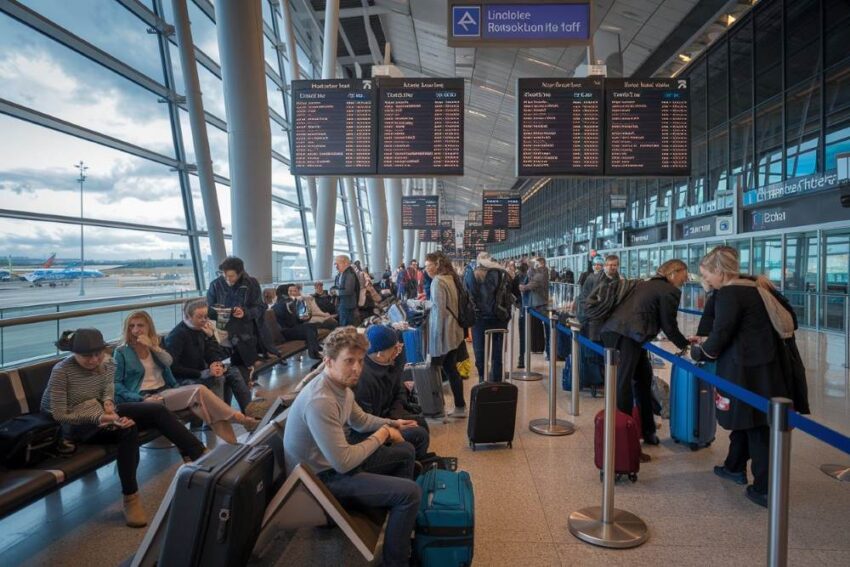
Image generated with Ai
Thousands of passengers are facing travel chaos as British Airways, Lufthansa, Swiss, Emirates, Qatar Airways, Turkish Airlines, and several other carriers have been forced to suspend and delay flights across Europe. A total of 565 flights have been suspended and 1,493 delayed, leaving passengers stranded in key airports like London Heathrow, Frankfurt, Istanbul, Paris Charles de Gaulle, Zurich, and Milan Malpensa. The disruption is particularly severe in the UK, Germany, Turkey, France, and Italy, with many flights to and from Dubai, Tel Aviv, and Abu Dhabi facing significant delays.
Passengers are urged to stay updated with their airlines as airspace closures and safety concerns continue to cause ripple effects. The situation remains fluid, and travelers should prepare for extended waiting times and potential rebookings due to ongoing airspace restrictions.
Reasons of Disruptions across Europe
The disruptions in air travel and flight cancellations across the Middle East and beyond are primarily due to the escalating tensions and military actions between the United States, Israel, and Iran. Several factors have contributed to the widespread chaos:
Retaliatory Attacks by Iran: On Sunday, Iran launched retaliatory attacks on Dubai International Airport and Kuwait’s main airport. These strikes came after the US and Israel targeted Iran, further escalating the conflict.
Airspace Closures: As a direct consequence of these attacks, airspaces in Iran, Iraq, Israel, Syria, Kuwait, Qatar, the UAE, and parts of Saudi Arabia were either fully or partially closed. This led to major disruptions in civilian air traffic. For instance, Iran closed its airspace “until further notice,” while Israel also imposed a blanket closure. Qatar, Iraq, and other Gulf states followed suit, impacting global flights that pass through the region.
Airlines’ Disruption of Services: Gulf carriers including Emirates and Etihad saw significant cancellations—38% and 30% of their flights, respectively. Qatar Airways suspended all flights from Doha, and several European carriers like Air France and British Airways cancelled their flights to and from key destinations like Dubai, Tel Aviv, and Bahrain.
Warnings and Safety Measures: The UK Foreign Office issued travel warnings urging citizens against non-essential travel to Bahrain, Kuwait, Qatar, and the UAE. The agency also advised British nationals to shelter and remain vigilant, especially those in conflict zones or affected regions.
Missile Interceptions: The UAE intercepted Iranian missiles and drones, which further heightened the concerns over air travel safety in the region. This, alongside explosions at Erbil airport in Iraq and other incidents, added to the travel chaos.
These escalating conflicts and retaliatory strikes have caused major disruptions in air travel, affecting airlines, passengers, and national security operations, while governments issue advisories to safeguard citizens.
Advertisement
Total Flight Cancellations and Delays
Total Cancellations: 565
Total Delays: 1,493
This has led to major disruptions in air traffic, especially for European and Turkish carriers, with flights being cancelled or rerouted due to airspace closures and ongoing security concerns.
Airports and Airlines Affected: A Detailed Analysis
Key Affected Airports in Europe
London Heathrow (LHR): The UK’s busiest airport faced significant disruptions. 71 flights were cancelled, and 58 flights were delayed, affecting services to destinations such as Dubai, Abu Dhabi, Tel Aviv, and Bahrain.
Frankfurt International (FRA): Germany’s main hub also saw severe disruptions, with 19 cancellations and 113 delays primarily on flights to and from Dubai and Tel Aviv.
Charles de Gaulle (CDG): Paris’ largest airport recorded 44 cancellations and 112 delays, particularly affecting services to Dubai, Riyadh, and Tel Aviv.
Zurich (ZRH): Switzerland’s busiest airport had 19 cancellations and 68 delays, with flights to Dubai, Abu Dhabi, and Tel Aviv being among the most affected.
These airports have been heavily impacted by airspace closures in the Middle East, leading to long delays and cancellations, especially for passengers traveling to the Gulf region.
Advertisement
Advertisement
Key Affected Airports in Turkey
Istanbul Airport (IST): Turkey’s largest airport experienced 21 cancellations and 72 delays. These disruptions were largely due to airspace closures over the Middle East, affecting flights to and from destinations such as Dubai, Abu Dhabi, and Tel Aviv.
Istanbul Sabiha Gokcen International (SAW): This airport, located on the Asian side of Istanbul, faced 48 cancellations and 35 delays, with services to Middle Eastern cities such as Tel Aviv and Beirut being particularly impacted.
European Airlines Affected
Lufthansa: Germany’s flagship airline recorded 19 cancellations and 68 delays primarily affecting flights to Tel Aviv, Beirut, and Dubai. Lufthansa had to suspend services to and from major Middle Eastern destinations, including Tel Aviv, Beirut, and Dubai.
Swiss International Air Lines: A subsidiary of Lufthansa, Swiss reported 19 cancellations and 68 delays, particularly on flights to Tel Aviv, Beirut, and Dubai.
British Airways: British Airways, based in the UK, saw major disruptions, particularly affecting flights to Tel Aviv, Bahrain, and Amman. 15 cancellations and 49 delays were recorded at London Gatwick, which is another key hub for the airline.
Air France: Air France, operating out of Paris, recorded 44 cancellations and 112 delays, affecting routes to Dubai, Tel Aviv, and Riyadh.
Turkish Airlines: As one of the main carriers in the region, Turkish Airlines experienced 48 cancellations and 35 delays. Services to Lebanon, Syria, Iraq, Iran, and Jordan were among the most affected.
KLM: Dutch airline KLM suspended flights to and from Dubai, Dammam, and Riyadh, along with its Amsterdam-Tel Aviv service. 15 cancellations and 36 delays were reported from Amsterdam.
What Can Affected Passengers Do Now?
For passengers affected by these disruptions, here are some important steps to follow:
Check Flight Status Regularly
Passengers are advised to stay updated on their flight status by checking directly with their airline or using flight tracking services. Given the uncertainty of the situation, airlines are regularly updating their schedules as airspace closures are revised.
Advertisement
Advertisement
Rebooking and Refunds
Many affected airlines, including Lufthansa, Swiss International Air Lines, British Airways, and Air France, are offering rebooking options and refunds to passengers whose flights have been cancelled or delayed due to airspace restrictions. Affected passengers should contact their airline for assistance with rescheduling flights or obtaining a refund.
Seek Accommodation
Passengers stranded in airports or cities should contact their airline for possible accommodation and transport assistance. Many airlines are offering hotel accommodations to affected passengers.
Stay Informed
Passengers should remain informed about the evolving situation. In addition to flight updates, UK Foreign Office and other government advisories have warned against all but essential travel to Bahrain, Kuwait, Qatar, and the UAE. If traveling to these areas, it’s crucial to follow safety guidelines and stay updated on the latest warnings.
Impact on Connecting and Long-Haul Flights
Long-haul flights from Europe and Turkey, especially those connecting to Asia and the Gulf, are facing significant delays as they are rerouted around the closed Middle Eastern airspace. Flights from London, Paris, Frankfurt, Zurich, and Istanbul that would normally pass through these regions are now being diverted to avoid the conflict zone, resulting in longer travel times and delays.
Conclusion
The conflict between the US, Israel, and Iran has caused major disruptions to air travel in Europe and Turkey, with 565 cancellations and 1,493 delays reported as of Sunday. Passengers are strongly advised to check with their airlines, stay updated on flight statuses, and remain flexible as air traffic remains heavily affected by airspace restrictions and ongoing security concerns. With major airports like London Heathrow, Frankfurt International, Istanbul Airport, and Zurich all facing disruptions, the ongoing conflict will continue to affect travel for the foreseeable future.
We use cookies on our website to give you the most relevant experience by remembering your preferences and repeat visits. By clicking “Accept”, you consent to the use of ALL the cookies.
This website uses cookies to improve your experience while you navigate through the website. Out of these, the cookies that are categorized as necessary are stored on your browser as they are essential for the working of basic functionalities of the website. We also use third-party cookies that help us analyze and understand how you use this website. These cookies will be stored in your browser only with your consent. You also have the option to opt-out of these cookies. But opting out of some of these cookies may affect your browsing experience.
Necessary cookies are absolutely essential for the website to function properly. These cookies ensure basic functionalities and security features of the website, anonymously.
Cookie
Duration
Description
cookielawinfo-checkbox-analytics
11 months
This cookie is set by GDPR Cookie Consent plugin. The cookie is used to store the user consent for the cookies in the category "Analytics".
cookielawinfo-checkbox-functional
11 months
The cookie is set by GDPR cookie consent to record the user consent for the cookies in the category "Functional".
cookielawinfo-checkbox-necessary
11 months
This cookie is set by GDPR Cookie Consent plugin. The cookies is used to store the user consent for the cookies in the category "Necessary".
cookielawinfo-checkbox-others
11 months
This cookie is set by GDPR Cookie Consent plugin. The cookie is used to store the user consent for the cookies in the category "Other.
cookielawinfo-checkbox-performance
11 months
This cookie is set by GDPR Cookie Consent plugin. The cookie is used to store the user consent for the cookies in the category "Performance".
viewed_cookie_policy
11 months
The cookie is set by the GDPR Cookie Consent plugin and is used to store whether or not user has consented to the use of cookies. It does not store any personal data.
Functional cookies help to perform certain functionalities like sharing the content of the website on social media platforms, collect feedbacks, and other third-party features.
Performance cookies are used to understand and analyze the key performance indexes of the website which helps in delivering a better user experience for the visitors.
Analytical cookies are used to understand how visitors interact with the website. These cookies help provide information on metrics the number of visitors, bounce rate, traffic source, etc.
Advertisement cookies are used to provide visitors with relevant ads and marketing campaigns. These cookies track visitors across websites and collect information to provide customized ads.