
Russia-India Rail Corridor: Can the INSTC Finally Link Moscow and New Delhi

Published
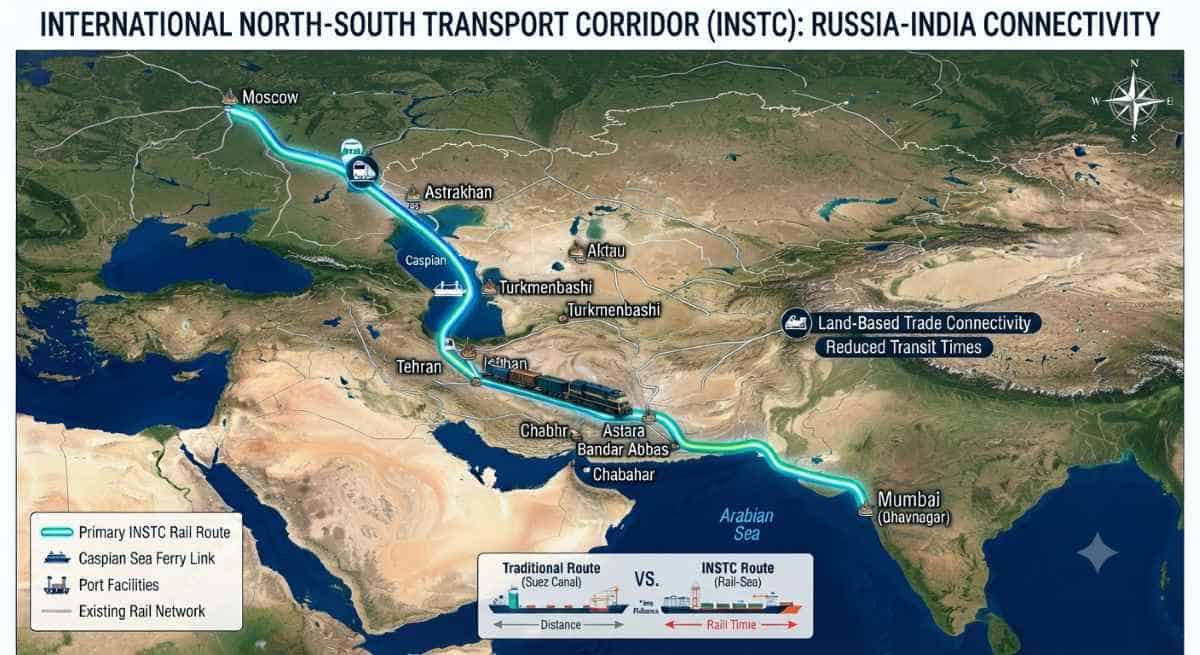
Image generated with Ai
The prospect of establishing a direct railway connection between Russia and India has long occupied minds. Global trade dynamics shift constantly. Reliance on traditional maritime routes is reconsidered. The concept of a trans-continental rail corridor is evaluated now.
This vision links industrial landscapes of Russia with growing markets of India. It is examined through the INSTC. By integrating existing networks across Eurasia, this project aims to transcend barriers. It provides a land-based alternative to volatile shipping lanes.
Practical Information For Travellers
The corridor is primarily designed for large-scale freight movement rather than tourism. Current operations focus heavily on transporting essential commodities such as coal, energy products, and heavy industrial materials across sovereign borders.
- Primary Route Mapping: Goods move seamlessly from Russia through Kazakhstan and Turkmenistan via established freight lines.
- Maritime Integration: Cargo enters Iran by land and is then loaded onto vessels to reach India via the Arabian Sea and key port infrastructure.
- Passenger Status: A continuous, singular passenger train journey from Moscow to Delhi remains strictly theoretical due to current limitations.
- Border Complexities: Multiple transfers, complex cargo handling, and rigorous customs checkpoints are involved at every international boundary.
- Regulatory Hurdles: Each transit territory enforces its own distinct visa regulations, customs laws, and cross-border security protocols.
Background and Context For Travellers from Russia and India
For decades, the vast physical distance between Eastern Europe and South Asia necessitated an absolute dependence on maritime freight. Historically, cargo ships navigated the long route primarily via the Suez Canal. However, recent geopolitical instability and security challenges highlighted the vulnerabilities of these narrow maritime chokepoints. In response, Moscow and New Delhi sought to strengthen their bilateral economic ties significantly, setting ambitious trade targets for the decade.
Advertisement
Advertisement
- Strategic Integration: The development of a seamless transport network became a core diplomatic and economic cornerstone for both nations.
- Multimodal Framework: The INSTC serves as a 7,200-kilometer multimodal framework designed to bypass vulnerable sea lanes.
- Interconnected Networks: The project bridges geographic distance efficiently through a combination of rail, road, and maritime segments.
- Transcontinental Reach: These vital operational segments traverse the sovereign territories of Central Asia and Iran, creating a land-based alternative for Eurasian trade.
Impact on Travellers
If a fully integrated passenger rail network were ever successfully realized, the nature of international travel across the continent would experience a profound transformation. Rather than relying on standard aviation, travelers would embark on an extraordinary voyage spanning some of the most diverse climatic and geographic zones on earth.
- Eurasian Landscapes: The dense boreal forests of Russia would eventually connect seamlessly to the sweeping, arid plains of Central Asia, offering an unprecedented visual transition of the northern hemisphere.
- Gulf Coast Transit: The route would further navigate through or adjacent to the striking coastal regions of the Persian Gulf, providing a unique intersection of continental and maritime environments.
- Extended Duration: Because of the vast distances involved, the total travel time would span several days, requiring travelers to adjust to long-distance overland mobility rather than rapid transit.
- Logistical Realities: Rigorous border crossings, international security checks, and varying customs protocols would fundamentally define the rhythm and structure of the daily journey.
- Niche Appeal: Ultimately, this epic overland route would not appeal to mass tourism or those seeking standard speed, but would instead serve as a premier bucket-list experience for dedicated adventure travelers and overland exploration enthusiasts.
Comparing with the Previous Policies and Developments
Historically, the grand vision of trans-continental connectivity was largely confined to quiet diplomatic proposals and distant dreams. Previous regional initiatives were frequently fragmented, suffering from a severe lack of unified financial backing and sustained political will. Coordinated institutional support among the participating governments was previously almost entirely absent.
- Strategic Shift in Priorities: Early historical initiatives viewed North-South trade merely as a secondary or ancillary consideration, whereas modern economic policies now place cross-border trade at the absolute center of national development strategies.
- Evolution of Frameworks: Individual, isolated infrastructure projects have successfully evolved into cohesive, multi-nation policy frameworks that streamline operations across borders.
- Legal Harmonization: Rather than battling conflicting legal frameworks, the active harmonization of international transport laws and customs protocols is now heavily prioritized.
- Systematic Modernization: Unlike the disconnected, ad-hoc efforts of the past, contemporary infrastructure modernization is driven by rigorous, long-term planning and synchronized execution.
Advertisement
