
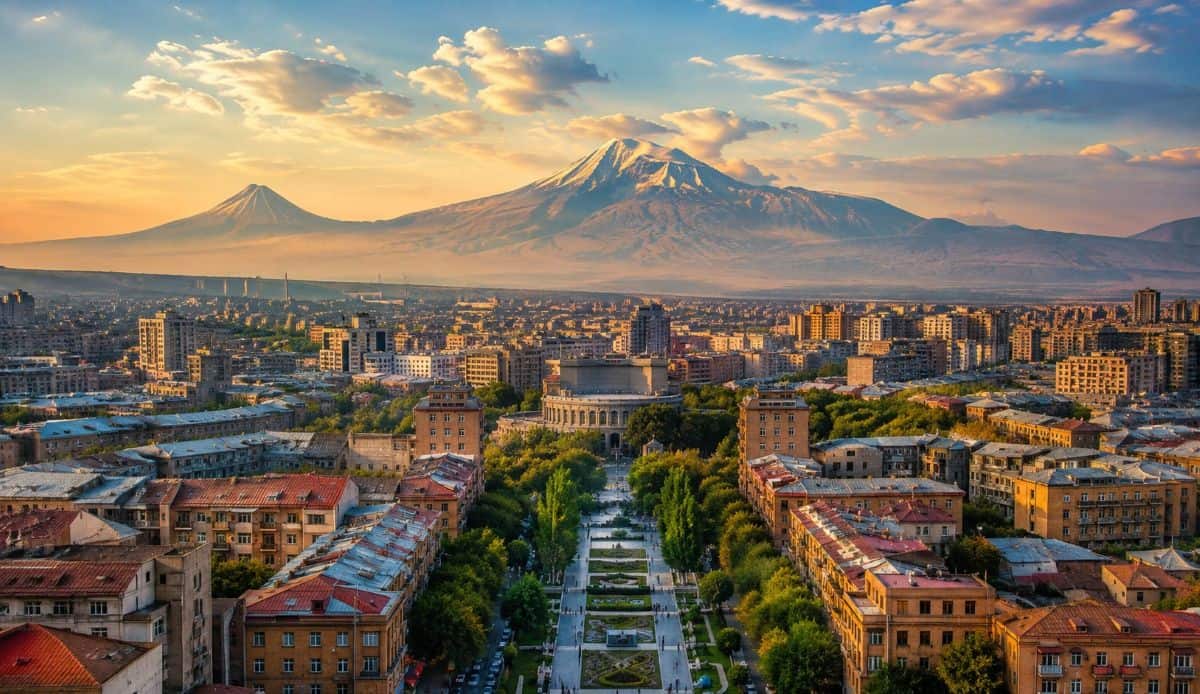
Image generated with Ai
Walking on stones that have carried the footsteps of nomads and travelers for centuries, one can almost hear the bouncing footsteps of travelers hopping from peak to peak. It almost creates a feeling of awe and wonder. Sights in Turkey grew by 14.8% in 2026 with 1,040,000 more visitors than the year before, so to counter the obsession with visitor numbers, national planners came up with the Tourism and Regional Infrastructure Project (TRIP) devoted to a total of €120 million to transform the focus from visitor numbers to visitor experience. The project seeks to improve seven of the most successful and active sectors, including Areni (the wine region), Gyumri (the arts region), and Dilijan (the woodland region). The drive and energy of the modern world combined with the history and culture of Armenia create an amazing place to visit. Combined with the experiences that Armenia has to offer, travelers have much choice. With the modern experiences that Armenia has to offer, dozens of untouched and unexplored regions of the country are waiting for travelers to discover them and reward the travel community.
Preserving Cultural Heritage in Emerging Eco-Tourism Hubs
Advertisement
Reports reveal that civil engineering projects under the TRIP directive strictly adhere to modern, ecologically sound standards. Historical monuments located in Dvin and Goris are undergoing methodical restoration designed to resist environmental wear while seamlessly hosting higher volumes of sightseers. Furthermore, structural initiatives integrate renewable power sources, advanced waste treatment, and efficient water management systems across all construction phases.
Industry observers emphasize that this stringent dedication to ecological balance ensures that the pristine wilderness of regions like Yeghegis and Dilijan remains fully safeguarded for upcoming generations. Sustainable travel advocates can traverse ancient monastic landmarks, alpine trails, and local organic vineyards with absolute peace of mind. By placing equal weight on environmental management and commercial expansion, national authorities have laid down a forward-looking paradigm for eco-friendly travel throughout the Caucasus.
Advertisement
Building Sustainable and Climate-Resilient Regional Infrastructure
A primary mandate of the TRIP program involves equipping provincial municipalities with climate-resilient and environmentally sustainable public works. Specialized construction efforts prioritize safeguarding ancient monuments while spreading tourist traffic away from congested urban zones like Yerevan. By enabling year-round tourism potential across varied ecosystems, state managers protect fragile natural environments while securing steady economic yields for rural communities.
This unwavering commitment to ecological preservation assures international guests that they will encounter untouched countryside and meticulously maintained heritage sites. Standardized conservation measures ensure that heightened visitor numbers will not damage sensitive ecosystems in districts such as Yeghegis or Dilijan. Furthermore, environmentally conscious visitors can engage in meaningful excursions, confident that their spending supports local climate adaptation and habitat protection.
Financial Framework, Public-Private Partnerships, and Economic Forecasts
Advertisement
Advertisement
Financial disclosures confirm that the funding mechanism for the €120 million TRIP initiative relies on a structured international collaboration. The undertaking is largely sustained by a €96.4 million credit facility from the World Bank (IBRD), paired with €24.1 million in direct government co-financing. Beyond physical civil works, this financial package allocates direct grants for small regional enterprises, destination marketing campaigns, and formal Public-Private Partnerships (PPPs). Economists calculate that this fiscal framework will generate 20,000 new jobs across regional hospitality sectors while supplying approximately $750 million to public revenues by 2030.
Financial strategists state that this co-funded structure offers exceptional market certainty for international commercial stakeholders and domestic entrepreneurs alike. By embedding Public-Private Partnerships (PPPs) into destination management, local enterprises in communities like Jermuk and Dilijan obtain invaluable technical support and capital funding. Consequently, international commercial operators can build cooperative ventures with empowered local suppliers to form high-caliber hospitality networks. This cooperative framework ensures that capital outlays produce enduring economic value across central metropolitan areas like Yerevan and rural zones like Yeghegis.
Expanding Transit Networks and Regional Flight Connectivity
Alongside streamlined entry policies, substantial enhancements to civil aviation facilities are driving direct international flight access into key regional destinations. Upgraded aerial corridors now link prominent European and Middle Eastern metropolitan airports directly to domestic flight hubs. This expansion of commercial aviation capacity drastically shortens transit times and eliminates unnecessary connections for long-distance international travelers.
Logistics experts note that improved flight networks serve as a catalyst for growth across the broader commercial hospitality market. Short-haul weekend travelers from nearby territories can effortlessly plan trips to Yerevan or Dilijan, while long-haul tourists can seamlessly incorporate the nation into broader multi-country itineraries. As commercial airlines continuously add new flight frequencies, international accessibility is projected to reach unprecedented highs throughout 2026 and the coming years.
Enhancing Global Accessibility Through Visa Relaxations and Direct Flights
To guarantee smooth entry procedures for international visitors, state border authorities implemented notable policy revisions during the first half of 2026. Officials temporarily broadened visa-free entry privileges to citizens from 113 countries who maintain valid residence permits from the EU/Schengen area, the U.S., or GCC states. Simultaneously, civil aviation agencies secured new direct air connections to boost overall international transport linkages. These synchronized administrative improvements establish the travel industry as an essential engine of broader national economic performance.
This marked simplification of border controls yields widespread advantages for frequent international travelers, corporate executives, and overseas residents. Long-term permit holders based in GCC states, the EU/Schengen area, and the U.S. can now execute impromptu travel plans with minimal bureaucratic delay. Consequently, global airlines and commercial hospitality businesses are observing rising demand for cross-border routes connecting Western Europe and the Middle East with the Caucasus. This heightened ease of access significantly lowers logistical barriers for foreign guests eager to discover the historical wealth of Gyumri and Dvin.
Redefining Experience-Based Travel Across Diverse Geographic Zones
By emphasizing premium, low-density travel journeys, state planners are establishing a new benchmark for sustainable sector growth in Eastern Europe. The intentional focus on specialized regional experiences permits visitors to construct tailored itineraries aligned with specific personal passions. Whether taking part in historic grape harvesting practices in Areni or seeking specialized thermal therapies in Jermuk, travelers enjoy highly memorable and authentic encounters.
This structured model protects cultural sites while maximizing the financial capital retained by local residents. Small business owners, regional historical guides, and independent craftspeople in destinations such as Gyumri and Goris gain direct financial advantages from incoming international guests. Ultimately, this approach proves that modern destination management can successfully reconcile rapid economic expansion with strict heritage protection.
Strategic Objectives of the 2026–2030 Boutique Tourism Model
According to the official 2026–2030 Tourism Development Strategy, state planners have formally committed to a “boutique tourism” orientation. Instead of pursuing mass tour group volumes that risk overstraining municipal services, the policy centers on high-value, experience-rich travel. The country capitalizes on its manageable geographic footprint, deep historical heritage, celebrated culinary arts, vintage winemaking techniques, and striking alpine terrain. The official roadmap aims to attract 3 million international visits annually by 2030, while driving an estimated $3.8 billion in total tourist expenditure.
This transition toward curated, boutique travel fundamentally transforms how foreign guests experience the Caucasus. Overseas visitors can look forward to personalized, sustainable excursions designed around individual interests, far removed from the heavy crowds seen in traditional European hotspots. For the global travel industry, this strategic shift creates profitable avenues for niche tour coordinators, eco-resort operators, and boutique hotel developers. Furthermore, prioritizing experience-oriented travel guarantees that economic revenues flow straight to regional artisans, winemakers in Areni, and mountain villages in Yeghegis.
Comprehensive Expansion Plan for Armenia’s Strategic Regional Hubs
Authorities are leveraging recent visitor growth by executing the ambitious €120 million Tourism and Regional Infrastructure Project (TRIP). Financial resources are dedicated toward advancing seven selected regional centers across the country: Goris, Areni, Jermuk, Yeghegis, Dvin, Gyumri, and Dilijan. Each designated hub will develop specific tourism niches, including wine, spa and wellness, adventure, cultural, educational, and ecotourism. By upgrading regional transit corridors, public plazas, and municipal infrastructure, state planners intend to redirect tourist traffic away from Yerevan and directly into regional communities.
The deliberate creation of these specialized geographic hubs provides immense benefits for the international travel market. Outdoor adventurers, history scholars, and wellness travelers will find modern, efficient facilities set against ancient backdrops like Dvin or pristine natural reserves like Dilijan. Furthermore, international guests receive unparalleled opportunities to experience authentic regional lifestyle customs without sacrificing modern comfort. As upgraded transportation links and revised hospitality amenities materialize in communities like Gyumri and Goris, global travel enthusiasts can build diverse vacation itineraries that combine luxurious relaxation in Jermuk with world-class viticulture in Areni.
Transforming the Hospitality Landscape Through High-Value Investments
The ongoing structural evolution of Armenia highlights a decisive change in how emerging destination markets generate international travel interest. Official planners structured the €120 million Tourism and Regional Infrastructure Project (TRIP) to thoroughly elevate local accommodations, public spaces, and transport services. By injecting capital straight into provincial facilities, government planners ensure that financial development reaches well beyond Yerevan, forming a resilient and well-diversified national travel economy.
This widespread physical modernization provides foreign travelers with a smooth blend of contemporary conveniences and unspoiled historical settings. Guests exploring the archeological sites of Dvin or the forested highlands of Dilijan will benefit from improved power grids, renovated town centers, and modernized roadway connections. Moreover, these provincial enhancements encourage longer stays, allowing international visitors to fully immerse themselves in regional heritage without encountering logistical delays.
A modern-day invitation to global travelers
This project will have nothing to do with statistics, loans, or commonplace economic graphs. This project will be a renaissance of the human soul, a preservation of the past and the beautiful, and a peaceful country’s opening to the world. After getting lost in the foggy paths of Dilijan, after enjoying good old wine in Areni, and if you happen to encounter traces of history in old Gyumri, you will know there is no place like Armenia.
When this country wins this battle, it will mean that the aspirations of the born-in-2030 nation have repaired the spirit of the wanderer and touched their soul. By avoiding mass tourism and opting for sustainable and experience-based tourism, the nation keeps its old treasures and the spirit of the mountains and its generosity will never run out. Those who travel to see, experience and especially those who travel to experience the authentic old world will have us awaiting their arrival.
Advertisement
Tags: armenia, Europe, tourism updates, Travel News
Advertisement
Advertisement













Saturday, September 5, 2026

Friday, September 4, 2026
Saturday, September 5, 2026

Saturday, September 5, 2026

Thursday, September 3, 2026

Wednesday, September 2, 2026

Saturday, September 5, 2026

Saturday, September 5, 2026


