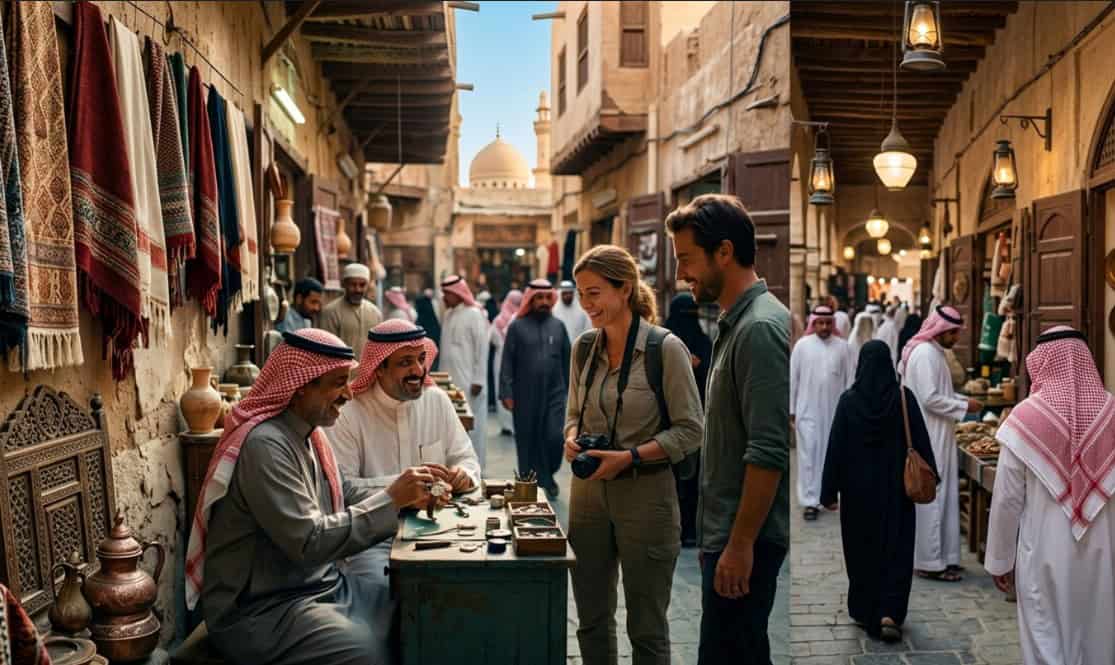
Image generated with Ai
The Middle East has attracted high-end watchmaking tourism in recent years. Western countries have royals, but nowhere is as wealthy as the Middle East. With Saudi Arabia and the UAE, rich collectors buy royal watches. Saudi Vision 2030 and the UAE Tourism Strategy 2031 mean that Saudi Arabia and the UAE have a chance to showcase tax-free luxury shopping, access to auctions and exhibitions, and the timepieces of their royal history. Saudi Arabia and the UAE have the chance to have a better non-oil economy and attract more people with new ideas of luxury travel. This goes beyond just giving people the chance to buy expensive timepieces.
The intersection of high-end horology and luxury travel has given rise to a completely new demographic of international travellers. Global vintage watchmaking tourism is no longer a niche concept but a highly structured economic driver across the Gulf Cooperation Council (GCC). For decades, the Middle East was primarily viewed as a consumer market for new luxury goods. However, as global appreciation for horological history has matured, the region has successfully repositioned itself as a custodian of rare, historically significant timepieces.
Advertisement
Historically, the most exquisite timepieces in the Arab world were shielded from public view, existing solely within the private vaults of royal families and state dignitaries. Today, the transition from private collecting to public exhibition is fuelling a massive influx of high-net-worth collectors. Dedicated horological events, bespoke vintage boutiques, and high-profile auction previews have transformed cities like Dubai, Abu Dhabi, and Riyadh into essential stops on the global luxury circuit. Collectors no longer travel merely to purchase; they travel to immerse themselves in a broader horological culture that pairs world-class hospitality with unprecedented access to the secondary watch market.
The backbone of this vintage renaissance is the region’s profound historical connection to bespoke watchmaking. In the realm of high-end collecting, royal provenance sits at the absolute pinnacle of desirability. Throughout the mid-to-late 20th century, regional leaders such as King Abdulaziz of Saudi Arabia, King Hussein of Jordan, and Sheikh Zayed of the UAE commissioned highly exclusive timepieces from heritage brands like Rolex, Patek Philippe, Breitling, and Cartier.
Advertisement
These watches were never intended for public retail circulation. Instead, they featured national emblems, military insignias, and Arabic signatures, designed specifically for diplomatic gifting, state protocol, and the honouring of strategic allies. As of 2026, these royal-issued watches have become the holy grail for international collectors. The pursuit of these specific assets drives specialised horological tourism, bringing global buyers to the Middle East where these pieces periodically surface through specialised dealers and exclusive auction houses.
As the demand for rare watches surges, both Saudi Arabia and the UAE have actively facilitated the physical and regulatory infrastructure required to support this booming industry. By fostering an environment conducive to luxury commerce, both nations have solidified their dominance in the luxury watch sector.
The Kingdom of Saudi Arabia is experiencing a retail renaissance, directly aligned with its overarching economic diversification goals. A key indicator of this growth is the establishment of internationally renowned pre-owned watch specialists within the Kingdom. For instance, the expansion of prominent dealers like The 1916 Company into Riyadh provides regional and international clients with unprecedented access to rare, authenticated vintage watches.
This physical infrastructure is vital. Ultra-high-net-worth individuals require secure, luxurious environments to inspect multi-million-dollar timepieces. By integrating high-end vintage watch boutiques into Riyadh’s expanding luxury retail districts, Saudi Arabia is successfully capturing the lucrative demographic of travelling collectors who previously would have flown to Geneva or Hong Kong for such acquisitions.
Meanwhile, the United Arab Emirates continues to break its own records. Dubai and Abu Dhabi have long been recognised as global hubs for retail, but their evolution into centres for the secondary and vintage watch market is staggering. By 2026, the UAE features a highly concentrated luxury ecosystem, boasting 18 official Rolex showrooms across the Emirates—including 11 in Dubai alone.
This retail density is supported by unprecedented wealth migration. In 2024, approximately 7,000 millionaires relocated to the UAE, representing a nearly 49% increase from the previous year. This massive concentration of local wealth establishes a robust baseline of inventory and liquidity, which in turn attracts international dealers, auction houses, and tourists seeking to participate in one of the world’s most active and dynamic secondary markets.
The exponential growth of this sector is not accidental; it is the direct result of carefully calibrated government strategies aimed at elevating the region’s global tourism profile.
Under the ambitious framework of Saudi Vision 2030, the Kingdom is rapidly developing transformative megaprojects that serve as ideal backdrops for luxury retail and horological tourism.
By embedding luxury retail pavilions within these historic and natural wonders, the Saudi Tourism Authority ensures that visiting watch collectors receive a holistic, uniquely Arabian luxury experience.
The UAE Tourism Strategy 2031 shares a similar ethos, aiming to aggressively boost the tourism sector’s contribution to the national GDP. Recognising that luxury shoppers yield significantly higher economic value than transient tourists, the UAE has heavily promoted its status as a tax-free haven for high-end goods. In 2024, Dubai welcomed 18.74 million visitors, a substantial portion of whom cited luxury retail—particularly watches and jewellery—as a primary motivator for their travel. The strategy explicitly supports the hosting of global luxury summits, auctions, and horology weeks, ensuring that the UAE remains top-of-mind for the world’s most affluent tourists.
To truly understand the scale of global vintage watchmaking tourism in the GCC, one must look at the verified economic data. The figures reported in recent years highlight a shift in global luxury gravity towards the Middle East.
Data published by the Federation of the Swiss Watch Industry presents a clear picture of the region’s dominance. In the first half of 2025 alone, the UAE led all Gulf countries in Swiss watch imports, spending over USD 770 million. To put this in perspective, the UAE accounted for a staggering 58% of the total imports by the five major Gulf nations (UAE, Saudi Arabia, Kuwait, Qatar, and Bahrain), which collectively imported USD 1.33 billion worth of Swiss timepieces in that six-month period.
Saudi Arabia firmly held the second-place ranking, with half-year imports totalling USD 212.3 million. Despite global economic headwinds that saw flat growth in global Swiss watch exports overall, the Middle Eastern premium segment has remained remarkably resilient, heavily buoying the international market.
The internal market valuations are equally impressive. The UAE luxury watch market was valued at approximately USD 1.61 billion in 2024 and is projected to surge to USD 2.21 billion by 2030, driven by a compound annual growth rate (CAGR) of 5.21%. Mechanical watches—the lifeblood of vintage and high-end collecting—dominate this space, commanding a 70% market share due to the regional appreciation for precise, traditional manufacturing techniques.
Similarly, the Saudi Arabia luxury watch retail market is on a steady upward trajectory, valued at USD 270.11 million in 2024 and projected to reach USD 318.52 million by 2030. Furthermore, independent Swiss watchmakers are seeing unprecedented success in the region; brands that previously struggled to move single-digit inventory are now selling dozens of highly complex pieces—often exceeding USD 240,000 each—to travelling collectors and local connoisseurs alike.
The seamless operation of a high-value vintage watch market requires sophisticated policy frameworks. Both nations have implemented robust regulations to protect buyers while incentivising cross-border commerce.
One of the primary drivers of horological tourism in the UAE is the highly favourable tax environment. International tourists are naturally inclined to make multi-million-dollar vintage purchases in Dubai or Abu Dhabi, where tax-free purchasing significantly reduces the overall acquisition cost.
Furthermore, consumer confidence in the pre-owned market has been radically strengthened by official brand interventions. The rollout of Certified Pre-Owned (CPO) programmes by major houses like Rolex ensures that vintage and secondary market watches come with official certificates of authenticity. This regulatory and brand-supported safety net is crucial for international tourists who are transferring vast sums of wealth for heritage pieces.
Looking toward the immediate future, policy shifts such as the development of unified GCC tourist visas are poised to revolutionise the sector. Much like the Schengen visa in Europe, a unified system allows travelling collectors to attend an auction in Dubai on a Friday, and fly to Riyadh for a private vintage dealer viewing on a Sunday, all under a single travel authorisation. This frictionless movement of high-net-worth individuals effectively merges the Saudi and Emirati luxury markets into a single, highly accessible mega-market for international tourists.
The gravitational pull of the region’s wealth and tourism infrastructure has fundamentally altered the operational strategies of the global horology industry.
Recognising the sheer volume of Swiss watch exports and vintage trades occurring in the GCC, prestigious international auction houses are heavily expanding their physical footprints in Dubai and Riyadh. Gone are the days when Middle Eastern collectors had to telephone bids into Geneva or London. Today, auction houses are bringing the world’s most valuable timepieces directly to the region for exclusive viewing events. These events are heavily marketed to international tourists, creating bespoke travel opportunities centred entirely around the auction calendar.
Beyond pure commerce, the cultural impact of events like Dubai Watch Week cannot be overstated. Founded as a platform to celebrate the art of horology, it has grown into one of the most important events on the global watchmaking calendar. Uniquely focused on education, heritage, and independent watchmaking rather than purely retail, Dubai Watch Week attracts the industry’s most revered watchmakers, international journalists, and hardcore collectors. Events of this magnitude transition the region from a point of sale to a global centre of horological culture, cementing its status as a premium tourism destination.
While selling luxury watches is inherently a retail activity, the economic ripple effects of global vintage watchmaking tourism are vast and deeply integrated into national diversification strategies.
For both Saudi Arabia and the UAE, reducing reliance on hydrocarbon revenues is the cornerstone of their future economic survival. The luxury tourism sector is a highly efficient vehicle for non-oil GDP growth. High-net-worth tourists arriving for vintage watch acquisitions do not merely buy watches; they charter private jets, book ultra-luxury hotel suites in developments like Diriyah or The Palm Jumeirah, dine at Michelin-starred restaurants, and utilise bespoke concierge services.
This influx of high-value capital supports a broad ecosystem of highly skilled jobs. From specialised watchmakers trained in vintage restoration, to multi-lingual luxury retail consultants, secure logistics operators, and high-end hospitality staff, the horological tourism boom creates robust, future-proof employment opportunities for nationals and expatriates alike.
The normalisation of luxury horology as a pillar of regional tourism is fundamentally changing how visitors interact with the Middle East.
Travel and concierge agencies are now curating highly specialised itineraries designed specifically for the travelling watch connoisseur. A typical premium package might include a VIP tour of the latest heritage exhibitions in Dubai, private vault viewings of Middle Eastern royal provenance watches, followed by a serene retreat to the AMAALA wellness resorts on the Saudi Red Sea coast. This fusion of high-stress auction bidding with ultra-luxury relaxation represents the new gold standard in experiential travel.
For the broader public and business community, this trend elevates the baseline of customer service and architectural retail design. The boutiques being constructed in Riyadh and Abu Dhabi are not mere stores; they are architectural marvels featuring private lounges, horological libraries, and in-house mixologists. The standard of retail excellence demanded by the vintage watch market subsequently pushes the entire regional retail sector to innovate and improve.
The strategic importance of this sector is frequently highlighted by official trade bodies and government ministries, who view luxury retail tourism as a primary economic indicator.
Data from the Federation of the Swiss Watch Industry (FH) continues to validate the Gulf’s critical role in the global ecosystem, noting that premium segments in the Middle East have successfully offset global slowdowns in other regions. Meanwhile, entities like the Saudi Tourism Authority have explicitly outlined their mission to cultivate a culture of organisational excellence and foster partnerships with private sector players to elevate the Kingdom’s tourism assets. By endorsing the expansion of high-end retail within their mega-projects, official government bodies are publicly endorsing the luxury horology sector as a key pillar of their future economies.
As we move deeper into 2026, the trajectory for global vintage watchmaking tourism in Saudi Arabia and the UAE is overwhelmingly positive.
Looking ahead, the integration of advanced technology will shape the future of the secondary watch market. With the UAE and Saudi Arabia leading the world in AI and blockchain adoption, we anticipate the implementation of digital ledgers to track the provenance of vintage timepieces. This will provide international tourists with immutable proof of authenticity and ownership history, further derisking multi-million-dollar transactions. Furthermore, the pre-owned market inherently aligns with the growing global emphasis on sustainability—a core tenet of projects like The Red Sea, which is committed to a 30% net conservation benefit and runs entirely on renewable energy.
Ultimately, Saudi Arabia and the UAE are not merely adapting to the trends of the global luxury watch market; they are actively dictating them. By leveraging their rich history of royal watch commissions, investing trillions in world-class tourism infrastructure, and maintaining highly favourable economic policies, these nations have successfully captured the imagination of the global collecting community. The era of travelling to Europe for the finest vintage watches is rapidly evolving; today, the true connoisseur looks to the Gulf.
Saudi Arabia and the UAE are examples of how to preserve culture while creating new opportunities. With a combination of historical provenance and modern infrastructure, they have created a collection that attracts the world’s best watch collectors. Saudi Vision 2030, along with Dubai’s tax-free exhibitions, has given the Gulf region a monopoly on luxury watches. Vintage watchmaking tourism is a new and growing way to bring economic value to a region. With all the new tourism and auction houses, the region is set to redefine how the world values luxury travel.
Advertisement
Tags: Global Vintage Watchmaking Tourism, Luxury Watch Retail, Saudi Vision 2030, Swiss Watch Exports, UAE Tourism Strategy 2031
Advertisement
Advertisement












Thursday, September 3, 2026

Thursday, September 3, 2026

Thursday, September 3, 2026

Thursday, September 3, 2026

Thursday, September 3, 2026

Wednesday, September 2, 2026

Thursday, September 3, 2026

Thursday, September 3, 2026



