
Canada Aligned with US and Other Industry Leaders at IHIF 2026 in New York City This May to Spearhead the Future of the Global Hospitality Industry with New Opportunities, Insights and More

Published
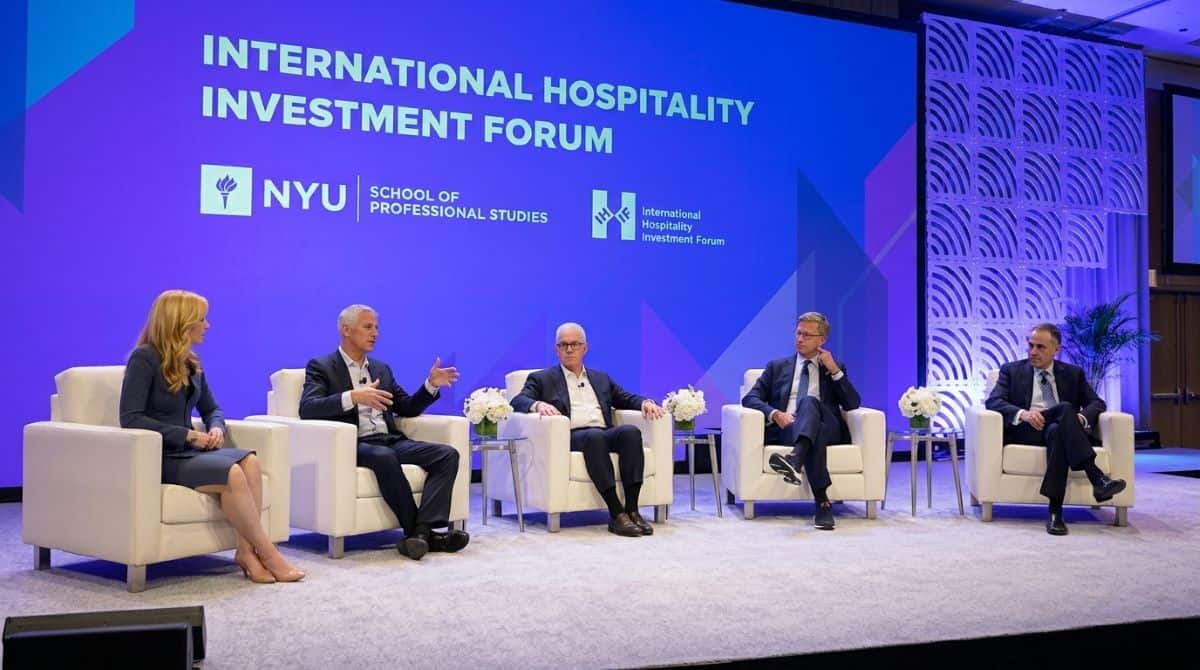
Hospitality industry leaders gathered with their international colleagues from US, Canada and beyond at the 48th Annual NYU International Hospitality Investment Forum (IHIF) in New York City to establish strategic priorities for investment and operations in the lodging industry. The conference drew more than 2,500 industry executives and 700-plus institutional investors managing $723 billion in combined assets under management (AUM), underscoring a shift towards asset-driven value creation, selective capital deployment and widespread artificial intelligence adoption. With official figures showing Canada’s visitor spending at $140.5 billion (with tourism GDP growing 2.5%) and revised CoStar/Tourism Economics projections pointing to a 2.8% RevPAR increase for US hotels, cross-border stakeholders are prioritising property improvement plans, non-rooms revenue optimisation and operational efficiency to navigate elevated debt costs and sustain long-term yield.
Executive Briefing: First-Hand Reporting from Manhattan
Reporting directly from the floor of the New York Marriott Marquis during the 48th Annual NYU International Hospitality Investment Forum (IHIF) 2026, our team at Travel and Tour World witnessed a defining moment in global hospitality capital markets. Over 2,500 industry executives and decision-makers gathered to evaluate cross-border deal structures, high borrowing costs, and shifting consumer behavior.
Advertisement
Advertisement
Surrounded by a lot of engaging discussions and ideas over three days. Our correspondent, Ms Sara Alhariri from TTW covered great grounds with industry leaders and innovators at IHIF. With AI defining every sector around the world, including the Hospitality Industry – in an exclusive interview Mr Daniel Hersey, Founder and CEO of Coletta stated, “So, hotels run on seven to fifteen different systems at any time. You have labor, you have tracking for work orders, you have all your rooms, your PMS, your RMS. Operational intelligence is kind of the bridge across all of those.”
Representing a portfolio of $723 billion in assets under management alongside 700-plus dedicated investors, delegates from Canada, the United States, and over 36 other nations came together under the event theme “Sharpening the Edge”. Based on our direct conversations with asset managers and brand executives on site, the core takeaway is clear: while deal-making is no longer fueled by cheap capital, disciplined underwriting and operational execution are unlocking substantial value across North American and international lodging markets.
Advertisement
Advertisement
The Cross-Border Nexus: Canadian Capital Aligning with US Lodging Growth
From our frontline coverage, one of the most compelling narratives at IHIF 2026 was the deep operational alignment between Canadian institutional investors and the United States lodging framework. Canadian pension funds, institutional equity groups, and private developers continue to treat US urban and resort real estate as a primary destination for foreign capital deployment, while American hotel groups expand their brand footprints across Canadian metropolitan markets.
This capital alignment is grounded in solid domestic economic data from official government channels. According to verified economic statistics published by Statistics Canada, the national tourism and accommodation sector remains a cornerstone of economic output. Total tourism spending across Canada expanded to $140.5 billion, marking a 2.8% year-over-year increase. Sector GDP expanded by 2.5%, easily outpacing Canada’s broader national economic growth rate of 1.7%. Official labor figures from the National Tourism Indicators confirm that travel and lodging support nearly 688,000 direct jobs, accounting for over 3.2% of total employment nationwide.
Advertisement
Advertisement
These strong domestic figures provide Canadian institutional players with the balance-sheet stability needed to co-invest alongside US counterparts. As inflation moderates and central banks begin to stabilize interest rates, cross-border joint ventures are prioritizing select-service scale, conversion opportunities, and high-yielding resort developments.
Five Key Industry Trends Observed at IHIF 2026

Through our interviews with panel speakers, investment chairs, and global CEOs at the forum, five primary operational shifts shaping hospitality portfolios can be identified:
1. The Redefinition of Luxury and Peak Rate Benchmarks
Average Daily Rates (ADR) across luxury properties have stabilized at record highs, with $1,000-per-night rates becoming common across prime North American markets. Our discussions revealed that these rate levels are not solely driven by extra guest services, but by elevated wage structures and construction replacement costs. While ultra-luxury assets backed by well-capitalized funds continue to secure financing, entry-level luxury properties face greater market pushback as travelers demand clearer value propositions.
2. Selective Capital Deployment and Strict Debt Underwriting
Liquidity remains active across commercial debt and equity markets, but lenders are applying strict underwriting standards. Debt providers are prioritizing steady cash flows, lower loan-to-value ratios, and experienced operating partners. Capital deployment is shifting toward properties with strong brand distribution systems or clear value-add profiles.
3. Shift from Ground-Up Development to Existing Asset Value Creation
High construction costs and long entitlement timelines have significantly slowed ground-up hotel development across major North American metropolitan areas. Consequently, asset management teams are focusing on optimizing existing properties. Strategic Property Improvement Plans (PIPs), dynamic food and beverage concepts, and converting underutilized square footage into revenue-generating space have become essential tools for boosting Net Operating Income (NOI).
4. Integration of Artificial Intelligence in Front and Back-of-House Operations
AI has transitioned from an experimental tool into core hospitality infrastructure. Operations teams are using machine-learning tools to streamline workforce scheduling, dynamic price setting, and predictive maintenance. At the same time, travel search behavior is shifting toward conversational AI platforms, requiring hotel brands to adapt their digital marketing strategies for algorithmic discovery.
Advertisement
Advertisement
In an exclusive interview, facilitated by our correspondent Ms Sara Alhariri from TTW, Mr Tom Inglis, Chief Growth Officer of Innvision Hospitality (Atlanta, Georgia) remarked, “I think everybody’s trying to adapt to use AI as best they can. In our industry, it’s still a very tactile industry. Touch, feel, and see the products. There are a lot of nuances within properties, especially when you start doing working on renovations. You open up a wall and you start finding plumbing that wasn’t supposed to be there. We’ve worked projects that have uncovered that. That’s something that AI isn’t quite capable of doing yet. On the interior design side, there are certain aspects where AI actually can help our interior design teams. Uh, but at the end of the day, it comes down to us being able to have a narrative based design that works directly with the property, the ownership groups, and the location itself. Something that takes time, effort, and energy on our part to do.”
5. Transitioning from Brand Recognition to Operational Performance
In the branded residential and mixed-use real estate markets, institutional buyers and developers are shifting focus. Rather than relying solely on brand recognition, investors are evaluating properties on operational execution, owner returns, and long-term asset management.
Real Estate Valuation and Financing Dynamics

During the financial panels covered by our editorial team, industry experts provided detailed breakdowns of valuation parameters and capitalization rates across property tiers:
| Lodging Segment | Capitalization Rate Range | Debt Availability & Market Focus |
| Trophy & Luxury Resorts | 5.0% – 5.5% | Strong international equity interest, conservative leverage ratios. |
| Select-Service & Upscale | 6.5% – 7.5% | High operating margins, positive leverage potential, stable cash flows. |
| Full-Service Midscale | 8.0% – 8.5% | Stricter debt underwriting, higher equity requirements, conversion focus. |
Because traditional bank financing remains cautious, alternative capital sources—including preferred equity, mezzanine loans, and C-PACE (Commercial Property Assessed Clean Energy) financing—are playing a larger role in funding renovations and energy-efficiency retrofits.
Economic Outlook and Cross-Border Travel Projections
Macroeconomic updates presented by CoStar and Tourism Economics at the event project continued steady growth for North American lodging fundamentals. Full-year forecasts project a 2.8% year-over-year increase in Revenue Per Available Room (RevPAR) for US hotels, driven by steady corporate travel and consistent group event demand.
These projections align with official data from the US National Travel and Tourism Office (NTTO) and Statistics Canada, which report steady growth in cross-border travel expenditures. International visitor spending across North America reached $34.9 billion over the past 12-month tracking cycle, providing strong fundamental support for institutional investments in gateway cities like Toronto, Vancouver, New York, and Miami.
Advertisement
Advertisement
Operational Strategies for Hospitality Leaders
To protect operating margins against rising labor and utility costs, Travel and Tour World recommends five focus areas based on our analysis of forum discussions:
- Real-Time Revenue Management: Utilizing dynamic algorithm models that evaluate competitor pricing, market compression, and booking velocity in real time.
- Labor Optimization Platforms: Deploying automated scheduling systems to align staffing levels with daily occupancy patterns, keeping labor costs in check.
- Space Optimization: Converting underutilized lobby corners and basement areas into co-working lounges, specialty retail hubs, or pop-up dining venues.
- Energy-Efficient Infrastructure: Investing in smart thermostat systems and energy-saving technologies to reduce utility bills and meet institutional ESG standards.
- Direct Booking Channel Growth: Strengthening loyalty programs and direct digital booking channels to reduce commission expenses paid to online travel agencies.
In conclusion, at the IHIF 2026 conference held in New York City in May, Canada joined the US and other major players in the global hospitality sector to help shape the future of the industry by introducing new opportunities and insights. In response to the need for navigating a tight debt environment, North American executives brought together institutional capital from different countries and set up common operational standards. The conference showed that genuine market leadership is achieved through disciplined underwriting, the use of technology to optimize assets, and strategic cross-border investments. Since global travel demand is still strong, this cooperative approach enables operators to unlock sustainable value, maximize the yields of their portfolios, and clearly influence the coming phase of international real estate growth.
Advertisement
