
Indonesia Haze Triggers Regional Travel Alert as Toxic Smoke Spreads Across Southeast Asia

Published
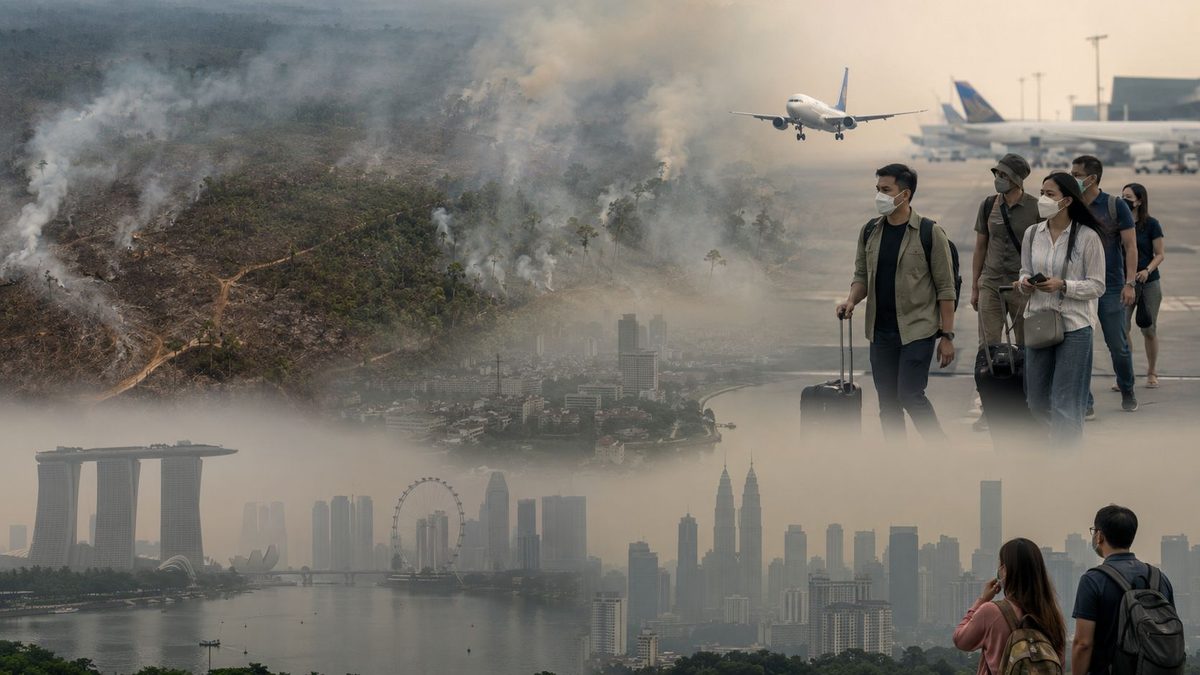
Image generated with Ai
Currently, Indonesia has an ongoing wildfire and haze crisis with outbreak wildfire cases in Sumatra, Java, and Kalimantan. Smoke covers parts of the regions and people and affects the visibility of many areas. Haze has crossed international borders and has reached Malaysia, Singapore, and the Philippines. Indonesia’s Health Ministry said smoke from wildfires has affected around 3.1 million people in 37 districts and cities. The Ministry sent 314 health workers to the affected 7 provinces. 6 of these provinces have activated the emergency preparedness of the disaster management system due to the prolonged dry season conditions. For travelers, this situation goes beyond the discomfort of the haze. The wildfires create a situation where the air quality, visibility, and flight activities, as well as all outdoor activities, must be monitored in all the affected regions.
Fires Are Expanding Beyond Borneo
Kalimantan remains the principal focus of Indonesia’s current fire emergency, particularly because Borneo’s geography makes smoke movement a regional concern. However, satellite monitoring also shows active fires elsewhere, including parts of Sumatra and Java.
Advertisement
Advertisement
The scale of the situation has prompted a stronger public-health response. Indonesia’s Health Ministry reported on 21 August that fires had directly exposed more than three million residents across 37 districts and cities.
The affected provinces include Jambi, Riau, South Sumatra, West Kalimantan, Central Kalimantan, South Kalimantan and East Kalimantan. Six had already entered disaster-emergency preparedness status.
Advertisement
Advertisement
The ministry also reported a sharp rise in respiratory infections in some locations. In Central Kalimantan, reported acute respiratory infection cases increased from 402 to 716 within one week. That represented a 78.1% increase.
The figures matter for tourism because many affected areas combine residential communities with airports, roads, ports, nature attractions and outdoor businesses.
Advertisement
Advertisement
Smoke does not respect administrative boundaries. Consequently, an itinerary that crosses several provinces can encounter very different air conditions within a single journey.
Southeast Asia Feels the Smoke
The regional dimension makes the present episode more significant for travel businesses. Smoke from Indonesian fires can move across maritime borders when atmospheric conditions support transboundary transport.
Advertisement
Advertisement
Singapore’s National Environment Agency continues to maintain dedicated haze monitoring and publishes 24-hour PSI and PM2.5 readings. Its latest regional outlook warns that prolonged dry conditions could keep hotspot activity elevated across parts of the southern ASEAN region.
The agency also identifies a continued risk of severe transboundary haze. Winds across the southern ASEAN region are forecast to move from southeast to southwest.
Malaysia faces a similar exposure, particularly in Borneo. Sarawak sits directly alongside Indonesian Kalimantan, creating a natural corridor for smoke movement when winds favour transport.
The Philippines can also experience regional haze, although conditions vary considerably with wind direction and atmospheric circulation. Palawan’s position places it relatively close to the Indonesian fire zone.
Advertisement
Advertisement
For international travellers, therefore, the crisis cannot be treated as an isolated Indonesian environmental story. It has become an ASEAN air-quality issue with direct relevance to tourism planning.
Dry Weather Is Raising Fire Risk
Weather conditions provide an important explanation for the persistence of the fires. Indonesia’s meteorological agency, BMKG, has warned about low rainfall and prolonged dry conditions in fire-prone areas.
South Sumatra offers a particularly clear example. BMKG’s regional climate assessment said rainfall during the third ten-day period of August remained in the low category across the province.
Large parts of the province had also experienced 31 to 60 consecutive days without rain. BMKG subsequently warned that rainfall during the first ten days of September could remain below normal.
That combination creates a combustible landscape. Dry vegetation provides readily available fuel, while limited rainfall reduces the ability of natural conditions to suppress fires.
BMKG’s monitoring also shows why satellite fire counts require careful interpretation. Hotspots identify thermal anomalies rather than automatically confirming large uncontrolled fires.
Advertisement
Advertisement
Cloud cover can obscure fire activity. Conversely, a hotspot does not necessarily indicate a fire of a size that threatens a populated area.
For travellers and tourism operators, the most useful approach is therefore to combine hotspot information with air-quality readings, weather forecasts, airport notices and local authority guidance.
What The Latest Data Shows
| Indicator | Latest available official information | Travel significance |
|---|---|---|
| People directly exposed to smoke | More than 3 million | Significant public-health pressure in affected destinations |
| Districts and cities affected | 37 | Impact extends beyond isolated rural fire zones |
| Provinces identified by Health Ministry | 7 | Several major Indonesian regions face exposure |
| Medical and health personnel deployed | 314 | Indicates substantial health-system mobilisation |
| Central Kalimantan ISPA cases | 402 to 716 in one week | Sharp short-term rise in respiratory illness |
| South Sumatra rain-free period | 31–60 days in many areas | Higher fire and haze risk |
| Singapore PSI “Unhealthy” threshold | 101–200 | Outdoor plans may require modification |
| Singapore PSI “Very unhealthy” | 201–300 | Stronger restrictions on prolonged outdoor exposure |
| Singapore PSI “Hazardous” | Above 300 | Travellers should substantially limit outdoor activity |
The Singapore thresholds offer a useful benchmark for travellers moving through the region. The country’s National Environment Agency classifies PSI from 101 to 200 as unhealthy, 201 to 300 as very unhealthy, and readings above 300 as hazardous.
The agency also tracks PM2.5 separately. Its public monitoring system provides regional readings and updates that travellers can consult before leaving accommodation.
Bali Remains a Different Travel Story
The current crisis should not automatically be interpreted as a blanket warning against travelling throughout Indonesia. The country’s geography is enormous, and air quality can differ sharply between regions.
That distinction matters particularly for Bali. The island remains one of Indonesia’s most important international tourism gateways.
Advertisement
Advertisement
Official BPS statistics recorded 6,948,754 direct foreign tourist arrivals in Bali during 2025, representing a 9.72% increase from 2024. International flights departing through I Gusti Ngurah Rai International Airport also rose 7.72% during the year.
The data demonstrates the scale of Bali’s tourism exposure. It also explains why travel advisers should avoid treating national fire reports as evidence of identical conditions everywhere.
At the same time, Bali should not be viewed in isolation. Travellers combining Bali with destinations elsewhere in Indonesia should check conditions separately for each leg.
A clear sky in Denpasar does not guarantee similar conditions in Kalimantan. Likewise, a haze episode in one province does not automatically mean Bali faces the same intensity.
The operational message for the industry is straightforward: sell the destination based on current local conditions, not broad national assumptions.
Airports And Outdoor Tourism Face Pressure
Haze creates several possible consequences for tourism, although the severity varies according to location and duration.
Advertisement
Advertisement
Reduced visibility can complicate road travel, especially on routes passing through smoke-affected districts. Outdoor attractions can become less appealing when skies turn grey and visibility deteriorates.
Nature tourism is particularly exposed. Trekking, river excursions, wildlife tours and open-air cultural experiences depend heavily on comfortable atmospheric conditions.
Hotels can also feel the effects. Guests may spend more time indoors, while properties may need to adjust outdoor programming.
Airlines and airports face another operational consideration. Dense smoke can reduce visibility and potentially affect flight operations when conditions become severe.
However, travellers should distinguish between possible disruption and confirmed disruption. A haze event does not automatically mean flights will be cancelled.
Passengers should therefore rely on airline and airport notifications before changing confirmed travel arrangements.
Advertisement
Advertisement
Tour operators can reduce risk by maintaining flexible schedules. Indoor alternatives, refundable arrangements and realistic transfer windows can protect both customers and operators.
Health Risks Matter More Than Sightseeing
The health dimension deserves greater attention than the visual inconvenience of smoky skies.
Fine particulate pollution can irritate the eyes, nose and throat. Prolonged exposure can also aggravate respiratory and cardiovascular conditions.
Singapore’s National Environment Agency advises people to minimise prolonged or strenuous outdoor activity when forecast air quality reaches unhealthy levels.
Its guidance becomes more stringent at higher pollution levels. Vulnerable people are advised to avoid or minimise outdoor activity when PSI exceeds 200.
The agency also states that N95 masks can reduce exposure for people who must remain outdoors for several hours during very poor air conditions.
Advertisement
Advertisement
Travellers should not treat masks as a substitute for reducing exposure. Moving indoors, closing windows during severe haze and limiting strenuous activity can provide additional protection.
People with existing health vulnerabilities should consider professional medical advice before travelling into heavily polluted areas.
Children also require particular care. Singapore’s guidance recommends minimising prolonged or strenuous outdoor activity when air quality becomes unhealthy.
For travel companies, these considerations increasingly form part of responsible destination communication.
Practical Advice For Travellers
| Travel situation | Sensible response |
|---|---|
| Booking a trip to affected Indonesian regions | Check local air-quality and fire information before departure |
| Travelling between provinces | Monitor each destination separately |
| Outdoor sightseeing | Reduce strenuous activity during poor air quality |
| Nature and adventure tours | Ask operators about visibility and cancellation policies |
| Flights | Check airline and airport status before travelling to the airport |
| Road transfers | Allow additional time if smoke reduces visibility |
| Hotel stays | Prefer properties with effective indoor air management |
| Sensitive travellers | Consider medical advice before entering heavily affected areas |
| Children travelling | Limit prolonged outdoor activity during unhealthy air |
| Singapore stopovers | Check PSI and PM2.5 readings before outdoor plans |
Travellers should also keep plans flexible. Haze conditions can change quickly with wind, rainfall and fire activity.
A clear morning can become smoky later if winds shift. Conversely, rainfall can rapidly improve local conditions without resolving fires elsewhere.
Advertisement
Advertisement
Tourism Businesses Need A Flexible Playbook
The crisis also offers a broader lesson for destination management. Climate-sensitive disruptions increasingly require tourism businesses to operate with greater environmental awareness.
Hotels can prepare indoor experiences before air quality deteriorates. Destination managers can communicate alternative attractions rather than simply advising visitors to stay indoors.
Tour operators can create flexible cancellation protocols for activities affected by poor visibility or unhealthy air.
Airlines, airports and tourism boards can also coordinate messaging. Consistent updates reduce confusion when travellers receive different information from different businesses.
This approach becomes particularly important for international markets. Visitors unfamiliar with Indonesia may interpret a regional haze report as a nationwide emergency.
Clear geographic communication can prevent unnecessary cancellations while still protecting travellers.
Advertisement
Advertisement
Indonesia’s Tourism Scale Raises Stakes
Indonesia’s tourism sector has considerable exposure to environmental disruption because its destinations span thousands of islands and highly varied climates.
Official national tourism statistics track international visitors by entry point, nationality and travel patterns. The data shows why disruption in one region does not necessarily translate into an equivalent national tourism shock.
Bali remains the country’s dominant international leisure gateway. Yet other destinations depend heavily on regional air links, domestic aviation and nature-based tourism.
This creates a two-speed tourism environment during haze events. Some destinations can continue operating normally while others face serious environmental pressure.
That distinction should shape travel advisories, airline communications and tour-product decisions.
For business-to-business travel sellers, it also creates an opportunity to move beyond generic warnings. Advisers can provide destination-specific information covering air quality, weather, transport and activity availability.
Advertisement
Advertisement
ASEAN’s Haze Problem Is Not New
Transboundary haze has repeatedly challenged Southeast Asian governments. The region’s experience shows that smoke can become an international tourism issue even when fires originate far from major visitor centres.
Singapore has maintained a dedicated haze-response framework for years. Its official guidance includes public-health thresholds, mask advice and preparedness measures.
The current episode also highlights the value of regional monitoring. Singapore’s haze portal publishes both current and historical pollution information, allowing travellers and businesses to compare conditions rather than relying on social-media impressions.
Indonesia’s BMKG similarly combines weather information with hotspot and smoke-distribution monitoring.
These systems are particularly valuable because fire location alone cannot determine travel risk. Wind direction, rainfall, atmospheric stability and distance from population centres all influence the final impact.
What Travellers Should Watch Next
The short-term forecast will depend on rain and wind patterns. BMKG has warned that low rainfall would allow the developmet of hotspots to continue in vulnerable areas of Indonesia.
Advertisement
Advertisement
Singapore’s regional outlook indicates that dry weather will continue over southern ASEAN. It has warned that the risk of severe transboundary haze will continue in areas that are affected by prolonged dry weather.
The next improvement will depend on more than firefighting. The strongest natural relief would be sustained rainfall in fire impacted areas.
Until then, travel decisions should not be based on news articles at the national level. Travelers should check the destination, route, and travel date to the greatest possible extent.
This advice also applies to companies in the travel industry. Decisions should be based on confirmed local conditions and official alerts.
This event should remind us of the great tourism geography of Indonesia. Here, a regional disruption can have varying impacts on different parts of the country. Destinations can remain fully operational, while other areas may have to put in some caution.
Flexibility is now the best travel strategy for visitors. Travel plans must be dynamic. This is especially important when traveling to a location that is considered risky. Keep yourself updated with local health advisories. For travel field operators, it is now more important than ever to give the public clear and accurate information regarding their destinations. The Indonesia haze episode is now a public health crisis and a test to see how prepared the Southeast Asia tourism field is to handle a crisis.
Advertisement
