
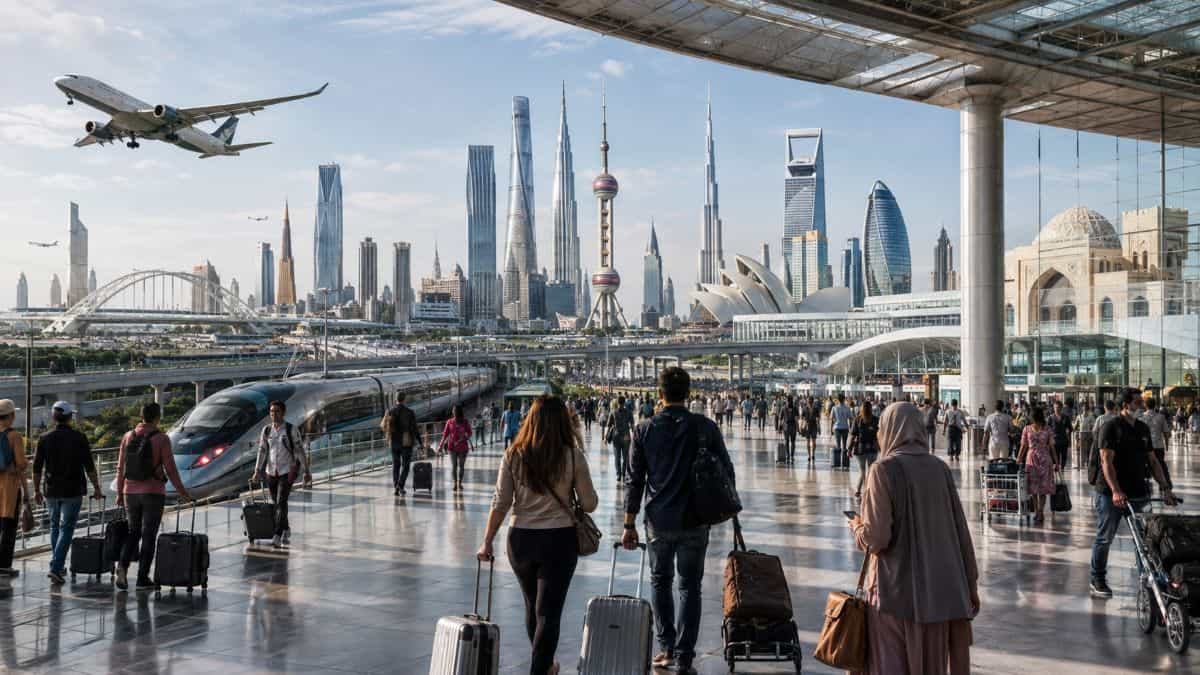
Image generated with Ai
Global Tourism Is About to Enter Its Most Competitive Era Yet and Travellers Could See Dramatic Changes. Investment is rising fast. Global Tourism Is About to Enter Its Most Competitive Era Yet and Travellers Could See Dramatic Changes as nations race to build airports, hotels, transport links and new destinations. The reason is simple. Governments want more visitors, more jobs and stronger tourism economies. The United States, China, India and Saudi Arabia are pushing major projects. Therefore, travellers could gain more routes, better infrastructure and wider destination choices as this new global tourism contest grows quickly over the next decade.
The United States remains central to this investment story. WTTC links its long-term position to strong domestic demand, infrastructure investment and major international events, including the FIFA World Cup 2026 and Los Angeles 2028 Olympic Games.
Advertisement
The U.S. Department of Commerce continues to implement the National Travel and Tourism Strategy, which treats inbound tourism and the country’s international competitiveness as economic priorities.
Aviation infrastructure is also receiving major investment. In May 2026, the U.S. Department of Transportation announced $523 million for airport infrastructure modernisation across 43 states. The federal Airport Terminal Program also made approximately $1 billion available for FY2026 competitive airport-terminal projects.
Advertisement
For travellers, destinations such as Los Angeles will be especially important as international events bring new attention to transport, airports and visitor infrastructure.
China has one of the most ambitious long-term tourism investment stories. WTTC projects that its Travel & Tourism investment pipeline could reach $402 billion by 2036.
That expansion now has strong policy backing. In July 2026, China’s State Council approved a plan to build the country into a strong tourism nation during the 15th Five-Year Plan period from 2026 to 2030. China is targeting 190 million inbound tourist visits annually by 2030 and $150 billion in annual inbound tourism spending.
Rail-tourism integration is another part of the strategy, potentially making it easier for visitors to move beyond major gateways and explore more destinations.
This creates opportunities for established destinations such as Beijing, Shanghai and Xi’an, while Hainan has a separate national goal of becoming a globally influential tourism and consumption destination by 2035.
India’s tourism growth is increasingly tied to connectivity and investment in destinations beyond its traditional gateways. WTTC identifies expanding transport links, destination development programmes and India’s investment environment as important parts of this growth story.
Official Indian government data show that 40 projects across 23 states worth ₹3,295.76 crore were sanctioned under the Special Assistance to States for Capital Investment initiative to develop iconic tourist centres to global standards.
India has also sanctioned 53 Swadesh Darshan 2.0 projects worth ₹2,208.31 crore, focused on sustainable and responsible destination development.
The investment reaches very different destinations. Projects include Gandikota in Andhra Pradesh, Bodh Gaya in Bihar, Dhordo in Gujarat and Nashik in Maharashtra.
Connectivity is another major piece. The Ministry of Tourism is coordinating with civil aviation authorities on 53 identified tourism routes intended to improve access to important and emerging destinations.
Saudi Arabia is using Vision 2030 to drive one of the world’s fastest-growing tourism investment programmes. WTTC points to major destination projects, investor-focused reforms and substantial public and private capital commitments behind the country’s expansion.
The transformation is also changing Saudi Arabia’s destination map. The official Vision 2030 platform highlights projects and destinations including AlUla, the Red Sea, Jeddah Central and Aseer, alongside other developments intended to broaden the Kingdom’s visitor economy.
Aseer, for example, is being developed under a dedicated strategy designed to establish the region as a leading tourism destination while supporting Saudi economic diversification.
WTTC’s numbers reveal a bigger shift. Tourism competition is increasingly becoming an investment competition.
The United States combines infrastructure with global events. China pairs national planning with a vast long-term investment pipeline. India is pushing tourism into more regional destinations through connectivity and destination development. Saudi Arabia is creating new tourism centres under Vision 2030.
Together, these four countries show how nearly $500 billion in Travel & Tourism investment is already helping reshape where visitors travel, how easily they reach destinations and what they can experience. With global Travel & Tourism projected to contribute $17.1 trillion by 2036, today’s infrastructure and destination investments could define the next decade of international tourism.
Global tourism is about to enter its most competitive era yet because major destinations are investing heavily in connectivity, infrastructure and visitor experiences. Travellers could see dramatic changes as airports expand, tourism centres develop and transport links improve. The United States is using infrastructure and global events. China is backing long-term tourism growth. India is improving destination access. Saudi Arabia is building new tourism hubs under Vision 2030. The result could be a wider travel map, stronger competition for visitors and more choices for travellers. Investment is therefore becoming the force that could define international tourism through the next decade.
Advertisement
Tags: destination development, future of travel, global tourism, Global Travel Trends, Tourism Infrastructure
Advertisement
Advertisement













Saturday, September 5, 2026

Friday, September 4, 2026
Saturday, September 5, 2026

Saturday, September 5, 2026

Thursday, September 3, 2026

Wednesday, September 2, 2026

Saturday, September 5, 2026

Saturday, September 5, 2026


