
Sydney Residents Brace for Rare Blue Micromoon Lighting Up the Skies

Published
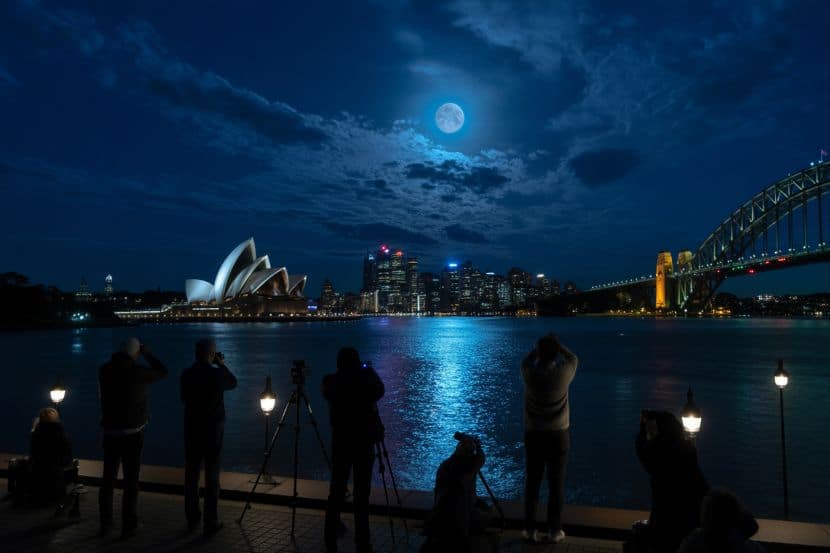
Stargazers across Australia are preparing for a spectacular celestial display this Sunday, May 31, as a rare blue micromoon will grace the night sky. The event combines two astronomical phenomena that don’t often coincide, giving skywatchers a unique opportunity to observe a slightly smaller yet strikingly bright full moon across the nation.
The phenomenon is expected to be visible in Sydney, Melbourne, Brisbane, Perth, and other major cities, providing a stunning spectacle for amateur astronomers, casual observers, and photographers alike. This particular blue micromoon is notable because it is the second full moon in the month of May, classified as a “blue moon,” and it coincides with a micromoon, occurring when the moon reaches its farthest point from Earth in its orbit.
Advertisement
Advertisement
Understanding the Blue Micromoon
A blue moon occurs when two full moons appear within a single calendar month, a rare occurrence due to the imperfect alignment of the lunar cycle with the Gregorian calendar. Despite its name, the moon will not appear blue. Instead, it represents the second full moon of May, a lunar rarity that sparks excitement among skywatchers.
The micromoon aspect occurs when the full moon reaches the apogee, the farthest point from Earth in its elliptical orbit. As a result, the moon appears slightly smaller—about 6% smaller than a typical full moon—and significantly less imposing than a supermoon, though still visually stunning. Binoculars can help highlight surface details, but the moon is perfectly visible to the naked eye, appearing as a bright and golden orb rising above the eastern horizon.
Advertisement
Advertisement
According to astronomers at the Sydney Institute for Astronomy, the blue micromoon will be tens of thousands of times brighter than the brightest stars in the night sky, creating a luminous spectacle for residents and tourists.
When and Where to Watch
The peak visibility varies by region across Australia:
Advertisement
Advertisement
- NSW, Queensland, Victoria, ACT, Tasmania: Moon reaches peak fullness at 6:45pm AEST.
- South Australia, Northern Territory: Micromoon peaks at 6:15pm ACST.
- Western Australia: Peak occurs at 4:45pm AWST.
For the best viewing experience, observers should find a dark, open area with an unobstructed eastern horizon. Near the horizon, the moon may glow a soft golden-orange during moonrise or shortly after sunset.
Tips for Skywatchers
- No telescope required: The full moon is visible with the naked eye, but binoculars enhance surface detail.
- Photography advice: Compare the moon against familiar objects to capture its subtle micromoon size.
- Timing matters: Observe shortly after moonrise for a golden hue caused by atmospheric scattering.
- Safety and comfort: Bring chairs, blankets, and insect repellent if observing from parks or rural areas.
- Weather monitoring: Check government weather services for clear skies to ensure optimal visibility.
Impacts on Tourism and Travel
This rare lunar event is expected to attract local and international visitors seeking unique astronomical experiences. Hotels, cafes, and observatories in Sydney, Melbourne, and other key locations may see increased bookings for the evening. Observatories and science museums could also run special night programs, offering educational talks about lunar cycles and astronomy.
Local tourism boards suggest pairing moon-watching with evening cruises, coastal walks, or national park visits for a combined natural and celestial experience. Observing from elevated areas such as Sydney’s coastal cliffs, Blue Mountains, or Brisbane’s Mt. Coot-tha enhances the panoramic sky view.
Astronomical Significance
While visually beautiful, the blue micromoon offers educational opportunities for understanding lunar cycles, the science behind apogee and perigee, and the dynamics of the Earth-Moon system. Observers can explore concepts such as the moon’s orbit, gravitational effects, and the historical significance of lunar phases in navigation and culture.
This event also highlights the rarity of double lunar phenomena, as the next blue moon will not occur until December 31, 2028, making this a special opportunity for astronomy enthusiasts.
Key Points for Observers
- Rare celestial event combines a blue moon and micromoon.
- Moon visible across Australia, peaking Sunday evening.
- Micromoon appears smaller but remains visually bright.
- Best viewed from open areas with unobstructed eastern horizon.
- Next blue moon will occur on December 31, 2028.
Step-by-Step Guide to Watching the Blue Micromoon
- Select a dark location: Avoid city lights for optimal contrast.
- Check the timing: Observe peak fullness times by state (AEST, ACST, AWST).
- Bring equipment if desired: Binoculars or a DSLR camera enhance details.
- Prepare for comfort: Chairs, blankets, and refreshments make observation enjoyable.
- Capture responsibly: Use tripod or stable surface for photos and videos.
- Combine with activities: Plan evening walks, star-gazing, or scenic viewing points.
Advertisement
