
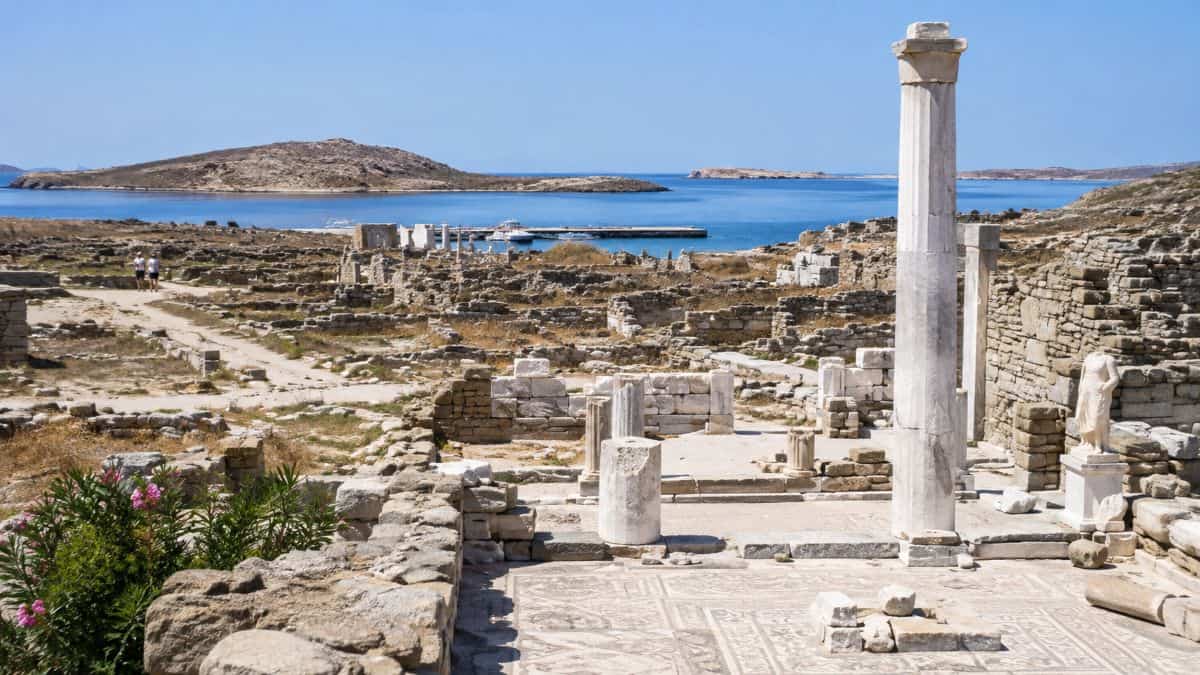
Image generated with Ai
Delos offers travellers an extraordinary opportunity to experience the Aegean through an archaeological landscape where religion, trade, art and everyday life once intersected. Situated among Mykonos, Rineia and Syros, the uninhabited island is closely associated with Apollo and Artemis and remains one of Greece’s most significant ancient sites. Recognised as a UNESCO World Heritage Site since 1990, Delos preserves an exceptional concentration of temples, sanctuaries, residences, public buildings and monuments within a compact island setting.
For visitors, exploring Delos is less like visiting a conventional museum and more like walking through an ancient city exposed beneath the open sky. A typical visit takes around two to three hours, although travellers interested in archaeology may wish to allow considerably longer. The climb towards Mount Kynthos, rising 113 metres above sea level, adds another dimension to the experience, providing sweeping views across the Aegean. From the Sanctuary of Apollo to the Theatre Quarter and the Sanctuary of Foreign Deities, the remains reveal how Delos developed from a sacred centre into a cosmopolitan Mediterranean community. Its archaeological evidence provides a valuable insight into the cultural diversity, commercial importance and sophisticated urban life of the ancient Aegean.
Advertisement
The archaeological journey begins at the Sanctuary of Apollo, the religious centre around which much of ancient Delos developed. The ruins of the Great Temple, the Temple of the Delians and the Temple of the Athenians demonstrate the island’s importance within the religious world of ancient Greece.
The scale of the surviving remains allows visitors to understand the significance attached to Delos as a sacred destination. Although centuries of natural and human change have transformed the landscape, the foundations and architectural fragments continue to communicate the grandeur of the sanctuary.
Advertisement
Mount Kynthos provides an important complement to the archaeological experience. The ascent is rewarding for travellers able to manage the uneven terrain, with the summit offering expansive views over the surrounding Aegean islands and reinforcing Delos’s distinctive relationship with the sea.
Beyond the principal sanctuary, the Sacred Way connects several important areas of the ancient settlement. The Treasuries of the Cities provide evidence of the offerings brought by Greek city-states, reflecting the religious prestige Delos acquired during antiquity.
One of the island’s most recognisable monuments is the Terrace of the Lions. The marble lions were dedicated to Apollo and formed a striking ceremonial feature of the sacred landscape. Their presence remains one of the defining visual symbols associated with Delos.
For modern visitors, this part of the archaeological site demonstrates how monuments were positioned not merely for practical purposes but also to create powerful religious and civic environments.
Delos was not solely a place of worship. Its residential quarters reveal the island’s broader economic and cultural importance, particularly during the Hellenistic period. The Foreign Quarters contain substantial houses associated with communities and merchants from different parts of the Mediterranean.
Greek, Italian, Egyptian and Syrian influences can be identified within the surviving residential environment, offering evidence of a multicultural population connected by commerce and maritime networks.
The House of Dionysus is particularly notable for its elaborate mosaic depicting Dionysus riding a panther. The House of the Masks contains further sophisticated mosaic decoration, including dolphin imagery, while the House of the Tritons features a composition depicting a female Triton accompanied by Eros.
These residences provide a rare glimpse into private life, wealth and artistic taste in the ancient Mediterranean. Their mosaics demonstrate the level of craftsmanship available to affluent residents and illustrate how artistic traditions travelled alongside people and trade.
The Sanctuary of Foreign Deities, located towards the northern part of Delos, provides some of the clearest evidence of the island’s multicultural character. The presence of religious traditions beyond the principal Greek cults reflects the movement of communities and ideas across the eastern Mediterranean.
This diversity is central to understanding Delos during the Hellenistic period. The island functioned within wider networks of commerce and migration, bringing together people whose cultural and religious backgrounds extended well beyond the Cyclades.
For travellers, the sanctuary adds historical depth to the visit by showing that ancient Mediterranean societies were interconnected rather than isolated.
The western side of Delos contains important public facilities that broaden the picture of life on the island. The Stadium, Gymnasium and Theatre demonstrate that the settlement supported sporting, educational, cultural and social activities alongside religious ceremonies and commercial exchange.
These structures also help visitors appreciate the scale and sophistication of ancient Delos. The island was effectively an urban community, with spaces designed for different aspects of public life.
Walking between these areas creates a sense of how closely religious institutions, private residences and civic facilities existed within the ancient settlement.
The island’s Archaeological Museum, established in 1904, houses discoveries spanning a long period of Greek history, from the Archaic era through Roman times. Its collections provide important context for understanding monuments encountered across the archaeological site.
A visit to the museum can therefore complement an outdoor tour, particularly for travellers seeking a deeper understanding of the sculptures, architectural fragments and decorative works associated with Delos.Visitor information Details Location Cyclades, Greece Status Uninhabited archaeological island Heritage recognition UNESCO World Heritage Site since 1990 Suggested exploration time Approximately two to three hours Highest point Mount Kynthos, 113 metres General admission €20 Ferry Ferry cost is separate from admission Main season hours 08:00–20:00 from 1 April to 30 October November hours 08:00–16:00 from 1 to 30 November Accessibility Accessible facilities are available, although archaeological terrain can be uneven
Travellers should prepare for an archaeological environment rather than a conventional urban attraction. Comfortable footwear, drinking water and protection from strong Aegean sunlight are particularly useful during warmer months.
Because much of the archaeological site is outdoors, weather conditions can significantly influence the experience. Visitors who want to climb Mount Kynthos should also consider the terrain and their own physical ability before beginning the ascent.
The island is currently uninhabited, which contributes strongly to its atmosphere. There are no modern streets, hotels or residential neighbourhoods competing with the archaeological landscape, allowing visitors to encounter the ruins in an unusually open setting.
Delos combines religious history, maritime commerce, multicultural settlement and ancient art within a remarkably concentrated archaeological landscape. Its temples illustrate sacred traditions, its merchant houses reveal international connections, while its public buildings demonstrate the complexity of urban life.
For modern travellers exploring the Cyclades, the island offers an experience that goes beyond conventional sightseeing. The combination of archaeological remains, panoramic Aegean scenery and the absence of permanent settlement creates an atmosphere that feels distinctly removed from contemporary life.
The result is a compelling journey through an ancient Mediterranean crossroads where worship, commerce, architecture and culture developed side by side.
1. Where is Delos located?
Delos is an archaeological island in the Cyclades, situated near Mykonos, Rineia and Syros in the Aegean Sea.
2. Why is Delos historically important?
Delos was an important religious centre associated with Apollo and Artemis and later developed into a major commercial and multicultural settlement.
3. Is Delos inhabited today?
No. Delos is currently uninhabited and functions primarily as an archaeological and heritage site.
4. How long does it take to explore Delos?
A typical visit takes approximately two to three hours, although travellers interested in archaeology may spend longer exploring the site.
5. What is the highest point on Delos?
Mount Kynthos is the island’s highest point, rising approximately 113 metres above sea level.
6. What can visitors see at the Sanctuary of Apollo?
The area contains major remains including the Great Temple, the Temple of the Delians and the Temple of the Athenians.
7. What is the Terrace of the Lions?
The Terrace of the Lions is a celebrated monument featuring marble lion sculptures dedicated to Apollo.
8. Why are the residential quarters important?
The residences demonstrate Delos’s multicultural character and contain sophisticated mosaics and evidence of wealthy private life.
9. Does Delos have a museum?
Yes. The Archaeological Museum of Delos was founded in 1904 and contains discoveries dating from the Archaic period to Roman times.
10. What should travellers consider before visiting Delos?
Visitors should prepare for extensive outdoor walking, uneven archaeological terrain, strong sunlight during warmer months and the need to arrange separate ferry transportation.
Advertisement
Advertisement
Advertisement













Saturday, September 5, 2026

Friday, September 4, 2026
Saturday, September 5, 2026

Saturday, September 5, 2026

Thursday, September 3, 2026

Wednesday, September 2, 2026

Saturday, September 5, 2026

Saturday, September 5, 2026


