
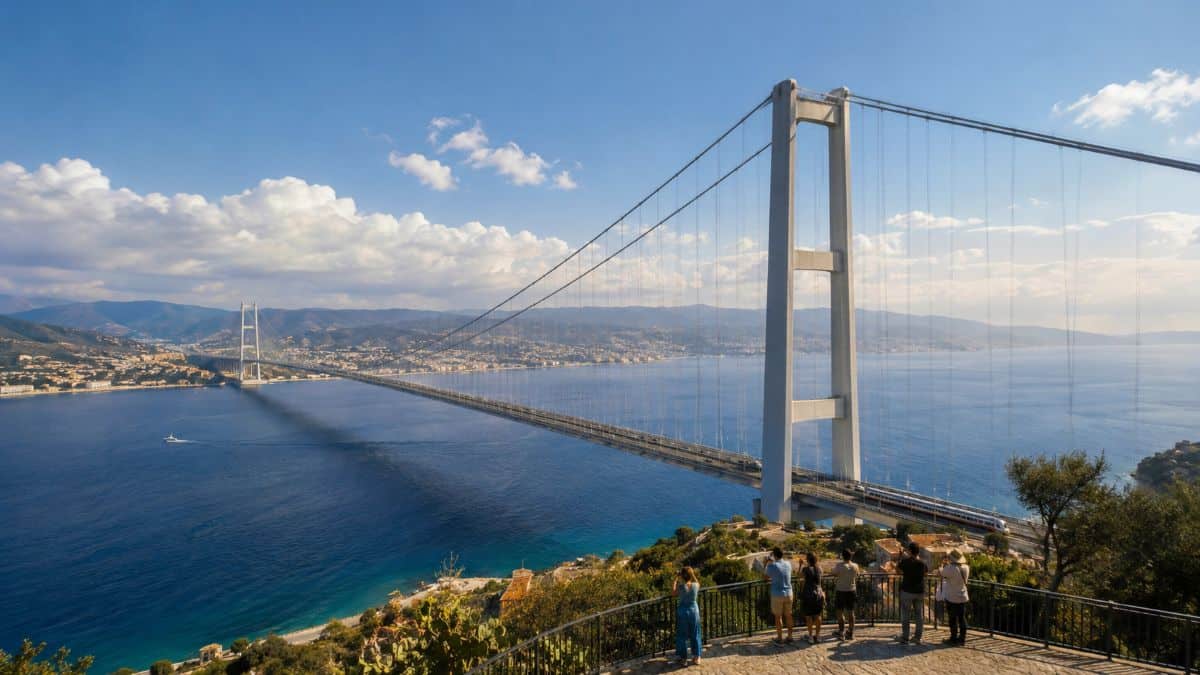
Strait of Messina Bridge in Italy; This is a giant road and rail link that will join Sicily to Calabria on mainland Italy and on an official timetable the bridge should open to traffic in 2034. This project will be crucial to travellers, train passengers, tourism companies, transport and freight companies who travel from Sicily or continental Europe. The cost of this project is an estimated 13.5 billion; a sum which has come from Italian Infrastructure and Transport Ministry. If built, the 3.3 mile longest span of this suspended bridge would make it the worlds longest single-span bridge but not the longest bridge of any type.
The bridge project remains in an active approval and technical-review phase rather than being a completed scheme awaiting a fixed opening day. In August 2026, the Superior Council of Public Works issued a positive technical opinion while attaching observations that engineers must address during the executive design process.
Advertisement
The project company, Stretto di Messina S.p.A., said on 15 August that these additional technical studies should not change the estimated €13.5 billion cost or the current 2034 opening objective. The Italian government has also maintained public funding of €13.5 billion for the project from 2026.
That timetable represents an important update for travellers following earlier official material that referred to construction completion around 2032. The current project-company target therefore provides the more relevant date for future travel planning.
Advertisement
Advertisement
The complete Strait of Messina Bridge structure will measure approximately 3,666 metres between expansion joints. Two enormous towers will rise to about 399 metres, while the deck will measure roughly 60 metres across.
The bridge will provide three road lanes in each direction, including normal traffic, overtaking and emergency lanes. It will also carry two railway tracks, creating a fixed rail connection between Sicily and mainland Italy for the first time.
Official planning gives the bridge capacity for about 6,000 vehicles every hour and as many as 200 trains per day. Around 40 kilometres of associated road and railway infrastructure will connect the crossing with transport networks on both sides of the Strait.
On the Calabria side, the network will connect towards Villa San Giovanni, Reggio Calabria and the Mediterranean motorway. In Sicily, connections will feed into the Messina–Catania and Messina–Palermo motorways, alongside railway infrastructure serving Messina.
Engineering requirements take particular importance because the Strait of Messina sits in a highly seismic region.
The project specifications state that the bridge has been designed to withstand an earthquake measuring 7.1 magnitude and winds reaching approximately 216 kilometres per hour. Engineers have also used aerodynamic testing to manage movement and maintain operational stability in difficult weather conditions.
These specifications reflect the area’s geological history, including the devastating 1908 Messina earthquake. They will remain central to the detailed engineering work before major construction of the suspended crossing moves ahead.
For travellers, the biggest change would come from replacing a compulsory sea crossing with a continuous road or railway journey between Sicily and mainland Italy.
Today, motorists and railway passengers rely heavily on ferry services across the Strait. A permanent bridge could simplify multi-city Italian journeys and improve connections between Sicilian destinations and the rest of the national rail and motorway network.
The planned passenger-car toll currently sits at approximately €4 to €7 for each crossing. The project company has also indicated a lower effective price for some same-day return journeys, although final tariffs closer to opening could still change.
Travellers should therefore treat today’s toll figures as planning estimates rather than guaranteed 2034 prices.
The bridge could in time modify travel patterns and introduce a greater volume of tourism into Sicily by simplifying for visitors coming from the North and Centre of Italy, not crossing by plane. A road trip that includes Calabria and Sicily, and thus also Messina, Catania and Palermo, may be far simpler; railway services into the island will skip ferry journey on Sicily – connecting cities with main Italian railway lines – and link southern Italian tourist destinations that are often missed when planning conventional routes as Rome-Florence-Venice.
The tourism business, however cannot take 2034 as definite certainty: further authorizations, final design, works and normative necessities need to be completed before travel over the Strait by train and car is possible. Project has been developed much from an early stage proposal, and, supported by state funds and engineering analysis and following with procedures needed to gain the next authorization, Strait of Messina bridge may be seen, at this moment, as one of Europe’s future connections to observe.
Advertisement
Advertisement
Advertisement













Saturday, September 5, 2026

Friday, September 4, 2026

Saturday, September 5, 2026

Saturday, September 5, 2026

Thursday, September 3, 2026

Wednesday, September 2, 2026

Saturday, September 5, 2026

Saturday, September 5, 2026


