
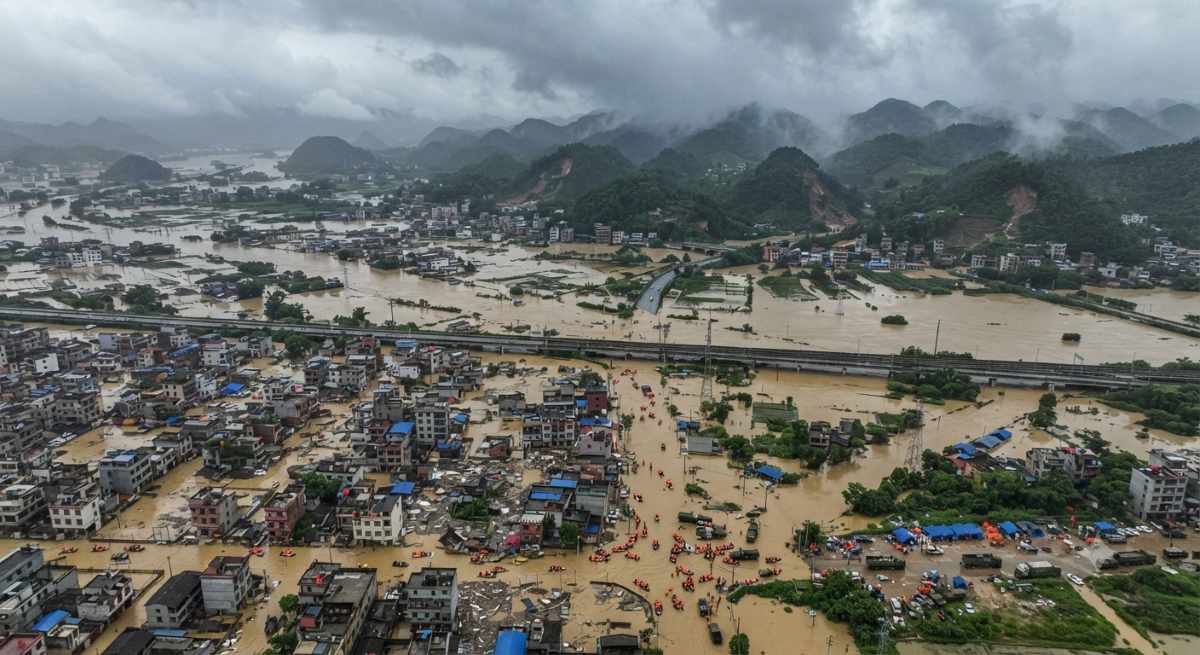
Image generated with Ai
The regional weather pattern across eastern and southern Asia has experienced extraordinary instability, marked by the arrival of Typhoon Narra. Operating as a powerful tropical system, the storm developed over the maritime zones of the South China Sea and the Beibu Gulf. Prolonged atmospheric moisture convergence allowed the system to stall over coastal waters, accumulating significant destructive potential before making a direct landfall.
The persistent weather disturbance unleashed torrential rainfall across the Guangxi Zhuang Autonomous Region, alongside neighboring sectors including Guangdong, Hainan, and Fujian. Rivers swelling beyond historical parameters triggered critical flood-alert conditions, outstripping safety thresholds previously recorded decades prior. Local hydrological agencies noted that accumulated precipitation totals shattered historical norms, creating an environment where drainage infrastructure became completely overwhelmed by immense volumes of surface water run-off.
Advertisement
Mobility networks throughout the affected provinces have suffered extensive paralysis, altering transport schedules and stranding numerous commuters. Passenger train services across several key railway corridors in southern China were officially suspended to mitigate risks associated with track destabilization, potential mudslides, and submerged signaling equipment. Major provincial highways, regional roads, and arterial routes experienced severe blockages due to localized inundation and earth slips, effectively cutting off access to mountainous tourist destinations and remote townships.
Advertisement
Airports in the immediate zone reported significant flight delays and cancellations as visibility dropped and crosswinds intensified during the height of the storm. Commercial establishments, hospitality venues, and scenic tourism sites in high-risk zones were ordered to close indefinitely, forcing visitors to remain confined within designated municipal or hotel safe zones until weather alerts are officially downgraded.
Navigating the region safely requires strict adherence to updated transportation advisories and emergency protocols issued by local administrative bodies.
The tourism and transportation sectors are facing mounting operational pressures due to the frequency of extreme weather events during the current seasonal cycle. Analysts within the disaster management and hospitality industries indicate that modern infrastructural resilience is being tested by increasingly potent meteorological phenomena. Supply chains supporting regional tourism, local hospitality providers, and transit operators are absorbing financial losses driven by sudden cancellations and emergency asset relocations.
Authorities and commercial stakeholders are prompted to re-evaluate risk management frameworks, incorporating real-time hydrological tracking and automated early-warning mechanisms directly into travel booking applications. Furthermore, the economic footprint of these disruptions highlights an urgent need for sustainable adaptation strategies within regional urban planning to protect both residents and transient populations from recurring climate vulnerabilities.
Advertisement
Advertisement
Emergency response mechanisms activated by regional governments involve multi-tiered protocols designed to safeguard human life and property. Disaster relief operations have mobilized specialized rescue corps equipped with heavy-duty vehicles, inflatable watercraft, and medical deployment teams to assist isolated communities.
Evacuated residents and stranded visitors are accommodated in public schools and community centers converted into staging hubs, outfitted with baseline necessities, continuous health screenings, and hot provisions. Travellers seeking real-time updates are advised to monitor official broadcasts from the China Meteorological Administration and consult respective embassy travel advisory portals for border status updates, visa extensions, and revised transport schedules.
Emergency response strategies deployed during this weather event reflect a marked evolution compared to protocols utilized during historical disasters such as the severe floods of 2008 or earlier regional storms. Contemporary disaster management relies on proactive, preventative mass evacuations executed well in advance of peak river surges, contrasting with older reactive recovery models.
While past weather crises often resulted in delayed rescue operations due to communication blackouts in remote counties, current institutional responses leverage advanced satellite communication networks, pre-positioned rescue machinery, and digitized multi-level emergency tiers (such as Level 3 and Level 1 flood control activations). These modernized regulatory frameworks demonstrate an enhanced institutional capacity to mitigate fatalities, coordinate public safety resources efficiently, and minimize systemic vulnerabilities across vulnerable transport corridors.
Advertisement
Tags: china, climate, disaster, disruption, emergency evacuation
Advertisement
Advertisement













Saturday, September 5, 2026

Friday, September 4, 2026

Saturday, September 5, 2026

Saturday, September 5, 2026

Thursday, September 3, 2026

Wednesday, September 2, 2026

Saturday, September 5, 2026

Saturday, September 5, 2026


