
Bavaria Moves Closer to Hydrogen Rail With New DB Regional Trains

Published
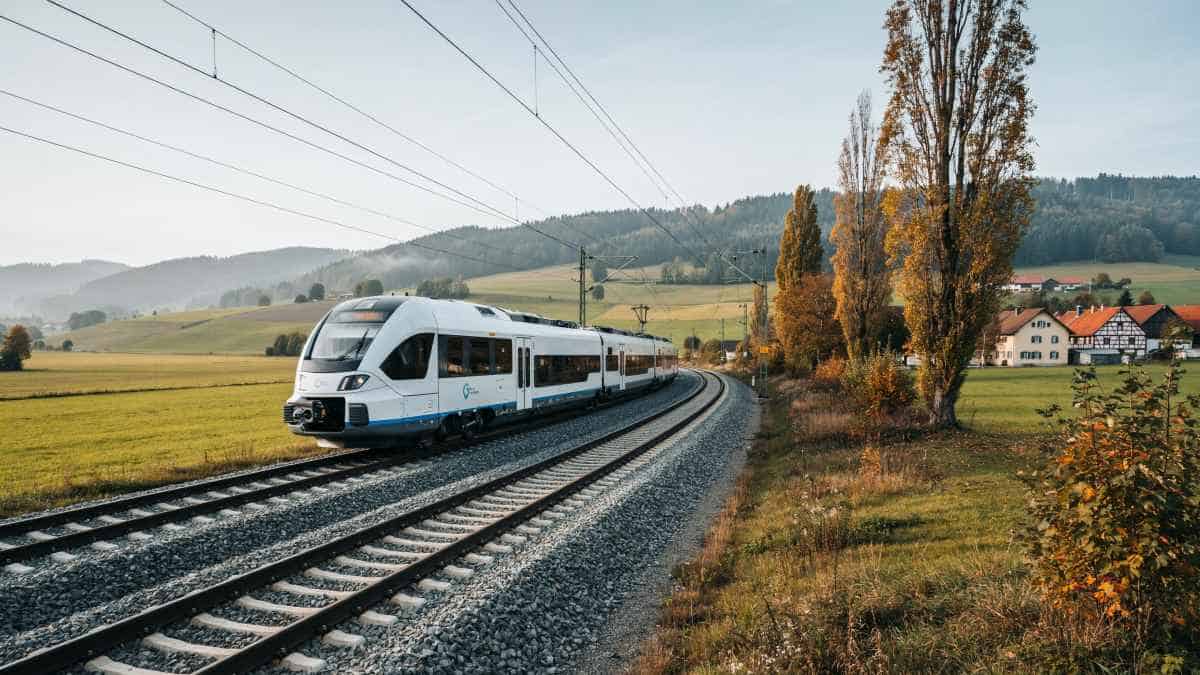
Image generated with Ai
The state of Bavaria is getting ready to deploy hydrogen-powered regional trains on one of its non-electrified rail lines, which can be considered a milestone in Germany’s mission to decrease the use of diesel in regional lines. In July 2026, the Südostbayernbahn from Deutsche Bahn and Siemens Mobility unveiled Mireo Plus H trains in Mühldorf. This includes three hydrogen-powered trains, which are still under test and driver training. Passenger train operations are to start by December 2026 on the Mühldorf-Burghausen line in Upper Bavaria.
Mühldorf Becomes a Hydrogen Rail Hub
The project is centred on Mühldorf, where DB Energie is developing the hydrogen infrastructure required to support the new trains.
Advertisement
Advertisement
A dedicated hydrogen refuelling station is being built at the location and will be supplied by an electrolysis facility powered by electricity from renewable sources. This means the hydrogen used by the trains is intended to be produced locally using renewable electricity rather than relying on conventionally produced hydrogen.
The arrangement is particularly relevant for non-electrified railway lines, where conventional diesel trains remain an important part of regional passenger transport.
Advertisement
Advertisement
Rather than waiting for complete overhead electrification, hydrogen trains provide another potential option for replacing diesel-powered rolling stock.
Three Mireo Plus H Trains for Regional Passengers
Siemens Mobility is supplying three Mireo Plus H trains for the Südostbayernbahn network.
Advertisement
Advertisement
The trains are based on Siemens’ Mireo platform and use hydrogen fuel-cell technology. During operation, the trains generate electricity onboard from hydrogen, allowing them to run without direct emissions from diesel combustion. DB describes the vehicles as locally emission-free and specifically suited to non-electrified routes.
The three trains are being introduced as part of the Linienstern Mühldorf 2025+ transport contract.
The Bavarian Railway Company, known as BEG, commissioned the use of the hydrogen trains as part of regional passenger transport planning for the state. Siemens is responsible for supplying the vehicles, while Südostbayernbahn will operate them.
Mühldorf to Burghausen
The confirmed passenger route is Mühldorf–Burghausen, running through southeastern Bavaria.
The railway serves communities in a region with important industrial, residential and tourism connections. Burghausen is particularly known for its historic old town and the Burghausen Castle complex, while Mühldorf functions as a regional rail hub.
For travellers, the hydrogen trains will therefore enter an existing regional transport system rather than creating a new international corridor.
Advertisement
Advertisement
The service is also separate from Germany’s long-distance rail network. Passengers travelling onward from Bavaria can connect with broader DB and Austrian railway services, including connections towards Salzburg and other Austrian destinations.
What Makes the Hydrogen Supply Different
One of the most notable parts of the project is not simply the trains but the infrastructure supporting them.
DB Energie plans to produce the hydrogen at Mühldorf through electrolysis using renewable electricity. The company will also operate the hydrogen refuelling station required by the trains.
This creates a relatively contained production and transport system.
Instead of transporting hydrogen over long distances to the railway, the fuel can be generated close to where the trains are based and refuelled. The approach also allows the railway operator to integrate hydrogen production and train operations within the same regional infrastructure project.
Building on Bavaria’s Earlier Hydrogen Trial
The Mühldorf project is not Bavaria’s first experience with hydrogen passenger trains.
Advertisement
Advertisement
In November 2024, Bavaria’s first hydrogen train entered passenger service as part of a 30-month test programme involving the Bavarian Railway Company, Siemens Mobility and Bayerische Regiobahn. The Mireo Plus H has operated on selected services in the Ammersee-Altmühltal and Ostallgäu-Lechfeld networks, including routes between Augsburg and Füssen and between Augsburg and Peißenberg.
That earlier programme allowed operators to gather practical experience with hydrogen-powered regional rail, including the interaction between the train and its refuelling infrastructure.
The new Mühldorf fleet moves the technology closer to regular scheduled operation.
Funding Supports the Transition
The project is also receiving public financial support.
According to Deutsche Bahn, the acquisition of the three hydrogen trains is receiving €4.4 million under Germany’s programme supporting alternative propulsion systems in rail transport. A further €3.8 million is being provided for the hydrogen refuelling infrastructure.
The funding includes support connected to Germany’s recovery programme and European recovery funding.
Advertisement
Advertisement
Such investment reflects the challenge of replacing diesel trains on routes where conventional electrification may not be economically or technically practical in the short term.
Not Yet a Cross-Border Alpine Corridor
Despite descriptions of the project as a new Bavaria-to-Austria hydrogen corridor, the verified DB announcement does not establish such a service.
The confirmed deployment is the Mühldorf–Burghausen route, and passenger operation is planned for December 2026. The project therefore should not currently be described as a commissioned cross-border hydrogen service reaching Austria or as a complete replacement for diesel trains across Alpine routes.
That distinction is important for travellers planning journeys between Germany and Austria.
Regional rail connections across the border already exist, including services around Salzburg and the Außerfern region, but the newly announced Mühldorf hydrogen fleet is a separate domestic Bavarian operation.
A Potential Model for Non-Electrified Rail
Bavaria’s importance as a project revolves around the practicality of its approach to solving the problem of railways, which affects many parts of Europe. Currently, most regional lines do not have electrification, and diesel trains are expensive to run. There is ongoing evaluation of battery trains, hydrogen trains, and many other alternative sources of energy. Bavarian Mühldorf project incorporates the use of hydrogen trains with renewable energy for electrolysis and refuelling facilities in one regional line. By December 2026, when the three Mireo Plus H trains will start operating on a passenger schedule, the line will offer another practical test of hydrogen as an alternative in regions without conventional electrification.
Advertisement
