
Belgium, France and More Spark Urban Culture Festivals Battle to Win the Next Generation of Travellers

Published
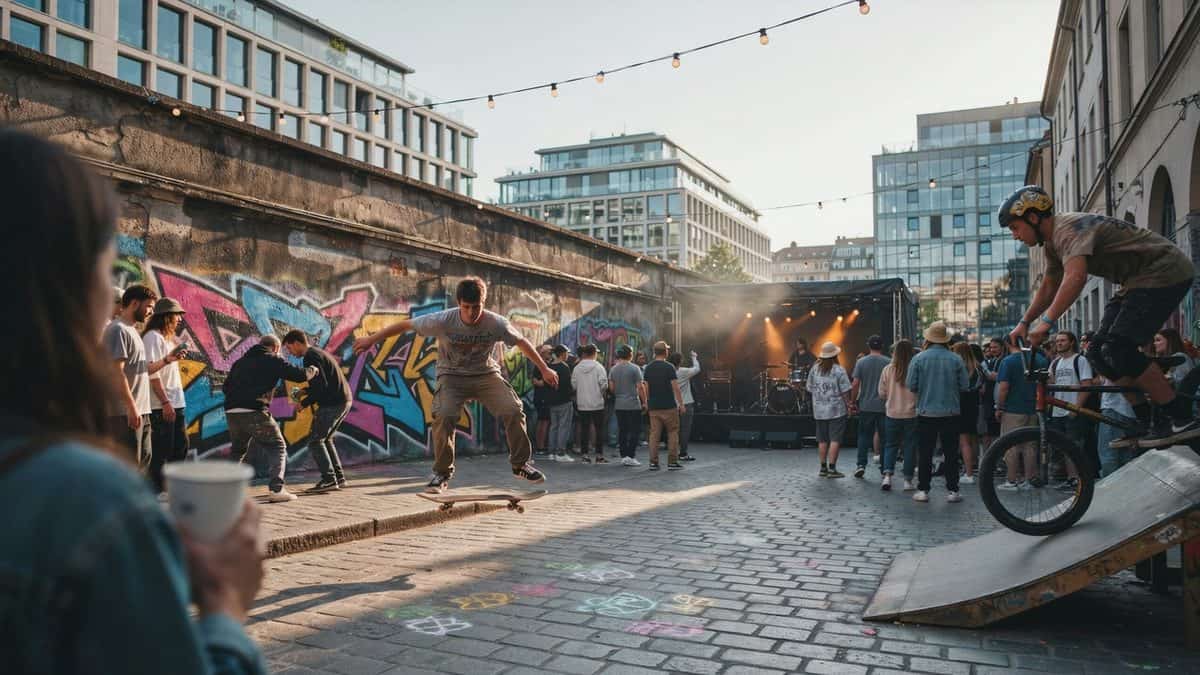
Image generated with Ai
Greece, Belgium, France, Croatia and Spain Turn Urban Festivals Into Powerful Tourism Magnets in 2026
Greece, Belgium, France, Croatia and Spain are building a striking European tourism trend around urban culture, combining live music, graffiti, skateboarding, BMX, parkour, breaking and other action sports with city-based visitor experiences.
The trend reaches an unusual peak in September 2026, when Thessaloniki Street Mode in Greece, Brussels Urban Sessions in Belgium and Trajectoire in France take place across essentially the same weekend. Croatia’s Pannonian Challenge has already demonstrated the model in Osijek, while Spain’s massive O Marisquiño has shown how urban sports can translate into international participation, large crowds and extraordinary hotel demand.
Where and when are these major European urban festivals taking place in 2026?
The five events stretch from June through September and occupy very different destination settings, from a Greek former slaughterhouse and a Belgian landmark park to Vigo’s Atlantic beachfront. Their common feature is the deliberate mixture of sport, culture and entertainment.
| Country | Festival | Place | 2026 dates | Latest attendance or scale information |
|---|---|---|---|---|
| Greece | Street Mode Festival | Old Municipal Slaughterhouse, Thessaloniki | 12–13 September | Upcoming; organiser describes festival as attracting thousands |
| Belgium | Brussels Urban Sessions | Parc du Cinquantenaire, Brussels | 11–13 September | Upcoming; nearly 31,000 spectators attended the 2024 edition |
| France | Trajectoire | Skatepark, Saint-Girons, Ariège | 11–13 September | New urban-culture festival; no verified attendance total yet |
| Croatia | Pannonian Challenge | Skate Park beside Copacabana Beach, Osijek | 12–13 June | Around 100 competitors from 18 countries; packed spectator stands reported |
| Spain | O Marisquiño | Samil Beach and central Vigo | 6–9 August | 150,000-plus forecast; organisers later reported attendance above 2025, but no exact final total yet |
Why is 11–13 September becoming an important weekend for European urban tourism?
The most remarkable element is timing. Brussels Urban Sessions runs from 11 to 13 September, France’s Trajectoire begins on 11 September for three days, while Thessaloniki Street Mode takes place on 12 and 13 September.
Advertisement
Advertisement
Three European destinations will therefore be presenting variations of almost the same tourism product during one weekend.
Yet they are not copies. Thessaloniki emphasises street culture and music. Brussels gives greater prominence to elite BMX and action sports. Saint-Girons combines competitions with a smaller community-oriented street festival.
Advertisement
Advertisement
Together, however, they demonstrate how urban sport has moved beyond conventional competition and into destination programming capable of attracting spectators, athletes, young travellers and cultural visitors.
What will Greece offer travellers at Thessaloniki Street Mode Festival?
Thessaloniki’s 14th Street Mode Festival will take place on 12 and 13 September 2026 at the Old Municipal Slaughterhouse, also known as Labattoir.
Advertisement
Advertisement
The programme combines concerts with graffiti, street dance, BMX, skateboarding and a nationwide parkour competition. Two music stages will operate while other street-culture activities take place around the venue. A thrift area and late-night after-parties further extend the experience beyond sport.
Street Mode’s own programme also confirms parkour and freerunning competitions, street-dance performances, an all-styles battle and a major graffiti jam. The organisers describe the graffiti gathering as Greece’s longest-running event of its kind.
The festival is therefore closer to an urban-cultural weekend than a conventional concert.
Why could Street Mode matter to Thessaloniki tourism?
Street Mode arrives at a particularly interesting time for Thessaloniki’s visitor economy.
Advertisement
Advertisement
International arrivals through Thessaloniki Airport grew strongly during 2025, while hotel performance has been more restrained. During the first half of 2026, Thessaloniki hotel occupancy was 2.6% lower year-on-year, although average daily room rates increased by 3.3% and RevPAR still recorded marginal growth.
That makes event-led demand particularly relevant.
A festival capable of attracting visitors during September can generate demand for accommodation, transport, restaurants, nightlife and other city services while diversifying Thessaloniki beyond its traditional historical, cultural and gastronomic visitor profile.
No verified 2026 Street Mode attendance number can exist yet because, as of 29 August, the event is still two weeks away.
How is Belgium turning Brussels Urban Sessions into a citywide attraction?
Belgium will stage the fifth Brussels Urban Sessions from 11 to 13 September 2026 at Parc du Cinquantenaire.
The programme combines BMX Freestyle, skateboarding, parkour and 3×3 basketball with street art, music, demonstrations and introductory sessions for visitors. The event is promoted by Visit Brussels as Belgium’s largest urban-sports festival.
Advertisement
Advertisement
Brussels has also extended the festival beyond its main September dates.
Three free “Takeover” events were scheduled across the capital before the main festival: basketball at Place du Congrès on 30 May, BMX at Tour & Taxis on 13 June and skateboarding at the Ursulines skatepark on 4 July.
This effectively turns one festival into a multi-month urban activation campaign.
How large could Brussels Urban Sessions become?
A useful historical benchmark comes from 2024.
According to Brussels media reports, almost 31,000 spectators attended that edition. The festival subsequently moved to the much more prominent Parc du Cinquantenaire, strengthening its visibility within the Belgian capital.
The organisers are again describing the 2026 edition as an event expected to bring international athletes, sports communities and thousands of spectators together.
Advertisement
Advertisement
Its tourism setting is substantial.
Brussels recorded 9.63 million overnight stays in 2025, only 1.7% below the record level of 2024. Hotel occupancy stood at approximately 75%, while the city’s museums and attractions attracted around 6.6 million visitors during the year.
Urban Sessions therefore operates inside one of Europe’s most established city-tourism markets.
What is France doing differently with Trajectoire in Saint-Girons?
France provides the smallest but arguably one of the most interesting comparisons.
The Trajectoire festival will run for three days beginning 11 September 2026 at the Saint-Girons skatepark in Ariège, placing it directly alongside Brussels and Thessaloniki on the European urban-event calendar.
Trajectoire emerged following the successful inauguration of the Saint-Girons skatepark in October 2025.
Advertisement
Advertisement
Its programme includes skateboarding, BMX and scooter competitions, an introduction to breaking, Best Trick contests, open-mic sessions, concerts and artistic stalls.
Unlike the established festivals in Greece, Belgium, Croatia and Spain, Trajectoire represents a more local destination testing how new sports infrastructure can become the foundation for a recurring cultural event.
Could Trajectoire help tourism in the wider Ariège region?
Saint-Girons does not receive visitor volumes comparable with Brussels or Vigo, making the tourism potential of specialist events proportionally more important.
Official French statistics show that Ariège recorded around 218,000 hotel nights in 2025, an increase of 3.8%, while campsites generated approximately 593,000 overnight stays, up 6.1%. International travellers accounted for 10.9% of hotel nights and 21.3% of camping nights.
Trajectoire could therefore complement the region’s nature and outdoor tourism with a younger urban-sports audience.
However, there is not yet enough evidence to claim a measurable tourism impact from the festival itself. Its 2026 attendance will be particularly important because this is the event’s first major benchmark.
Advertisement
Advertisement
What has Croatia already achieved with Pannonian Challenge in Osijek?
Croatia provides a much more mature example.
The 27th Pannonian Challenge was staged in Osijek on 12 and 13 June 2026, centred on the skatepark near Copacabana Beach beside the Drava River.
The regional tourism authority describes Pannonian Challenge as Southeast Europe’s largest extreme-sports and urban-culture festival. Its formula includes BMX, skateboarding, inline and scooter competitions alongside breakdance, graffiti workshops and contemporary music.
Around 100 competitors representing 18 countries participated in the 2026 edition. Reports following the event described packed spectator stands during the competition, although no verified aggregate spectator figure has yet been publicly released.
That distinction is important. Athlete numbers should not be confused with festival attendance.
How does Pannonian Challenge strengthen Osijek as a destination?
Pannonian Challenge has operated for more than two decades and has become part of Osijek’s international identity.
Advertisement
Advertisement
Osijek-Baranja County recorded 151,937 tourist arrivals and 304,729 overnight stays in 2025. Arrivals increased 10.7%, while overnight stays climbed 14.8% compared with the previous year, according to Croatia’s official statistics office.
The county and city governments explicitly connect Pannonian Challenge with Osijek’s positioning on the European sporting map.
This matters because urban events allow inland Croatian destinations to build tourism identities that differ fundamentally from the country’s globally recognised Adriatic coastal proposition.
Rather than competing with Dubrovnik or Split on beaches and heritage, Osijek can use sport, music and youth culture to build its own destination proposition.
Why is Spain’s O Marisquiño the most powerful tourism example?
Spain demonstrates what the concept can become at scale.
The 26th O Marisquiño took place from 6 to 9 August 2026 at Samil Beach and locations across central Vigo.
Advertisement
Advertisement
The programme featured eight sporting disciplines and was expected to bring 1,500 professional and amateur athletes from more than 30 countries, alongside roughly 60 artists. Vigo City Council provided more than €1.3 million in support for the event.
Pre-event forecasts put attendance above 150,000 people.
After the festival, organisers reported that the 2026 edition exceeded 2025 attendance and achieved stronger audience retention throughout the weekend. However, an exact audited final attendance figure has not yet been published in the reliable sources reviewed.
Did O Marisquiño actually affect hotel demand in Vigo?
This is where Spain provides the clearest tourism connection.
Vigo reported 100% hotel occupancy on the Friday and Saturday of O Marisquiño weekend, although other major concerts and cultural events were also taking place, meaning the occupancy result cannot responsibly be attributed to O Marisquiño alone.
The broader destination was already performing strongly. Vigo recorded more than one million travellers during 2025, according to municipal reporting based on Spanish National Statistics Institute data.
Advertisement
Advertisement
The O Marisquiño weekend nevertheless demonstrates how coordinated sport, music and cultural programming can contribute to exceptionally high urban visitor demand.
It also provides the clearest model for Thessaloniki, Brussels, Saint-Girons and Osijek to study.
Have any of these festivals confirmed their 2027 dates yet?
As of 29 August 2026, no reliable official source reviewed has confirmed exact 2027 dates for Street Mode, Brussels Urban Sessions, Trajectoire or Pannonian Challenge.
O Marisquiño is slightly different.
Its organisers have already indicated that the festival will return in 2027, and discussions are underway over a potential three-year sponsorship covering the 2027, 2028 and 2029 editions. Exact 2027 dates, however, have not yet been formally confirmed.
Claims online that assign specific 2027 dates to these festivals should therefore be treated cautiously unless they come from organisers, tourism authorities or municipal event calendars.
Advertisement
Advertisement
The next significant news phase will begin when final 2026 attendance statistics and 2027 calendars are released.
Why are urban-culture festivals becoming increasingly important for European tourism?
These events reveal a broader transformation in city tourism.
Travellers, particularly younger audiences, increasingly build trips around experiences rather than simply landmarks. Skateboarding, BMX, street art, hip-hop, parkour and breaking provide cities with highly visual, shareable and participatory experiences.
They also activate spaces that conventional tourism campaigns may overlook.
Thessaloniki uses the Old Municipal Slaughterhouse. Brussels transforms Cinquantenaire Park. Saint-Girons turns a new skatepark into an event venue. Osijek uses its riverside skate infrastructure. Vigo connects Samil Beach with its historic centre.
This is destination branding through lived urban culture rather than traditional advertising.
Advertisement
Advertisement
The tourism opportunity lies in extending stays, filling accommodation, encouraging local spending and giving travellers a reason to visit on specific dates.
Could Greece, Belgium and France create Europe’s defining urban-tourism weekend?
The September calendar makes that possibility particularly compelling in 2026.
From 11 to 13 September, Brussels and Saint-Girons begin their urban festivals. One day later, Thessaloniki joins them. Thousands of athletes, artists, spectators and street-culture followers will consequently be participating in closely related events across three European countries during effectively the same 72-hour period.
Croatia has already demonstrated that a long-running urban festival can strengthen a regional city’s international sporting identity. Spain has gone further, using O Marisquiño to attract huge crowds while Vigo records exceptional summer hotel demand.
Taken together, the five destinations point towards an emerging tourism category where city branding, youth travel, live entertainment and action sports increasingly overlap.
The real story after September will therefore be measurable impact.
Advertisement
Advertisement
Attendance totals, visitor origins, hotel occupancy, spending, international athlete participation and confirmed 2027 dates will reveal whether these festivals are simply popular local gatherings or whether they are developing into a durable European urban-event tourism network capable of influencing when, why and where younger travellers move across the continent.
Advertisement
