
Spain Alongside Germany and More Set for €130 Million EU Anti-Drone Boost to Protect Airports and Borders

Published
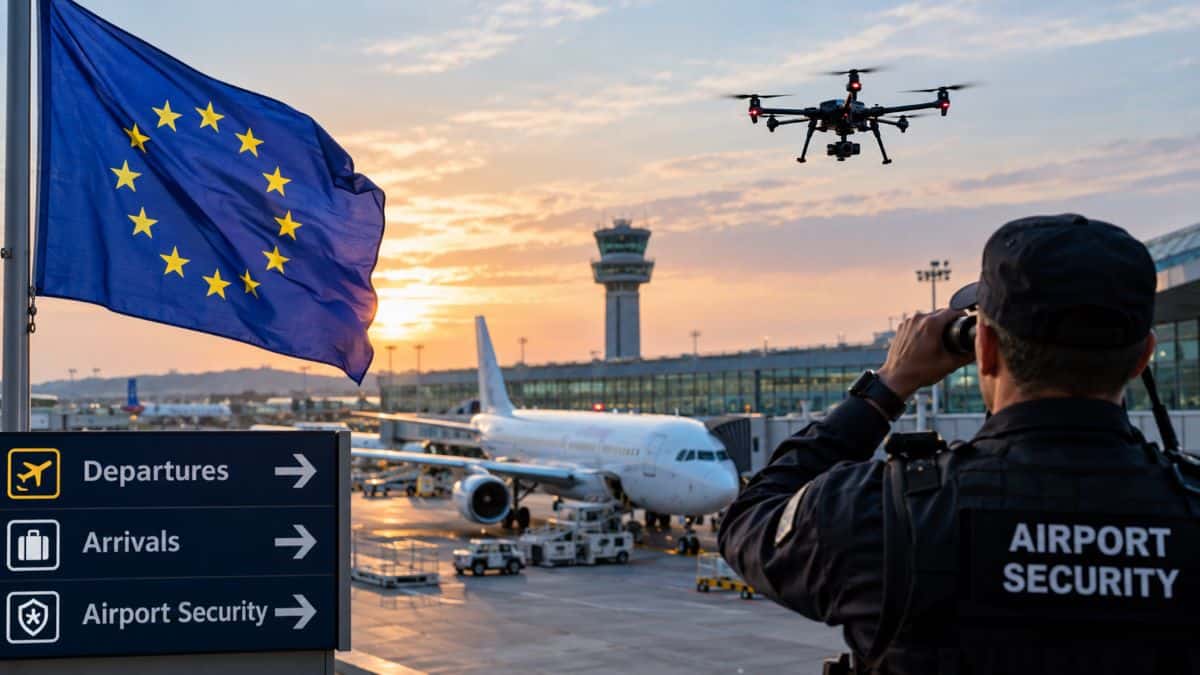
Spain, Germany, France, Greece and Poland are among 16 EU countries included in a €130 million drone-security funding increase, alongside Norway. The programme supports external borders, ports and eligible airports, with funding available until 31 December 2029. It introduces neither new tourist entry rules nor airport closures.
For travellers, the important question reaches beyond runway security: can better preparedness stop one interruption from derailing an entire holiday?
Advertisement
Advertisement
What the EU Anti-Drone Funding Actually Buys
The top-up was announced on 1 October 2026. The Commission’s 13 October notice explains its coverage and delivery.
It adds to €250 million announced in December 2025 and €169 million made available during 2026 for surveillance drones and related equipment, including equipment for Frontex. Those published amounts total €549 million. This is neither an airport-only budget nor confirmation that the money has been spent.
Advertisement
Advertisement
Through the Border Management and Visa Instrument, support covers surveillance, IT, training and cooperation against unauthorised drones, hybrid threats and cross-border crime.
The potential travel benefit is stronger decision-making, not simply more equipment beside runways.
Advertisement
Advertisement
Airport Funding: Why Being Busy Does Not Guarantee an Award
The underlying funding call prioritises land and maritime borders. Only international airports formally notified as border-crossing points qualify. National border authorities retain ownership and responsibility for funded equipment. Eligible specific-action projects may receive up to 90% EU co-financing.
A revealing detail changes how airport figures should be read. The call identifies passenger flows across the EU’s external borders as a determining factor for airport funding. It also considers previous complex border pressures. Total airport traffic is not the same measure.
The implication is straightforward: a large domestic or intra-Schengen operation does not, by itself, establish funding eligibility or an allocation. An airport’s border role matters alongside its scale.
Spain, Germany, France and Greece: The Passenger Stakes
Official operator figures illustrate the volume of journeys passing through these gateways:
| Airport or network | Reporting period | Passengers and annual change |
|---|---|---|
| Aena’s Spanish network | September 2026 | 31,671,269; up 4.2%. |
| Frankfurt Airport, Germany | September 2026 | Around 6.1 million; up 1.6%. |
| Fraport’s 14 Greek airports | September 2026 | Around 5.7 million; up 4.2%. |
| Paris Charles de Gaulle and Paris-Orly, France | August 2026 | 10,080,930; down 3.2%. |
Spain’s January–September total reached 257,214,868 passengers, up 4.1%.
These figures describe passenger activity, not drone disruption. Different months and airport portfolios also prevent a like-for-like country comparison.
Advertisement
Advertisement
For passengers, the relevant distinction is between the size of an operation and the quality of its contingency arrangements. A busy airport needs a credible recovery process, not just a reassuring funding headline.
Poland’s Security Spending Is Not an Airport Deployment Map
Poland’s January 2026 SAN announcement covered 18 counter-drone batteries, with an order worth approximately PLN15 billion net. The government said financing would come mainly through the EU’s SAFE defence programme.
That military investment is separate from the civilian border-management top-up. It cannot establish which passenger terminals have new systems in service.
This distinction helps readers avoid a misleading shortcut: a country can announce substantial defence spending without that announcement proving an operational upgrade at the airport on their ticket.
Drone Sightings: A Safety Pause Is Not Proof of an Attack
Germany’s air navigation provider, DFS, recorded 225 drone-related obstructions in 2025, compared with 161 in 2024. It cautioned that improved detection could partly explain the increase in reports.
EASA’s established airport guidance distinguishes accidental unauthorised flying from deliberate disruption and more serious criminal activity.
Advertisement
Advertisement
DFS also explains that controllers may withhold take-off and landing clearances after sightings, potentially causing delays, diversions or cancellations.
The sensible test is whether the response was justified and safely managed—not whether aircraft continued flying at any cost. More recorded sightings alone cannot establish more hostile attacks.
Counter-Drone Technology Must Work Beyond the Demonstration
The Commission’s Joint Research Centre uses its Geel living laboratory to test counter-drone technology in realistic settings. Its work includes detection, identification and integration with traffic-management systems. Developing the site into an EU Counter-Drone Centre of Excellence remains a further step.
For travel operations, this points to an important implementation test. Detection equipment must fit the decisions and responsibilities of the people using it.
A successful trial should not be treated as evidence that every airport is ready. The useful questions concern trained teams, tested procedures and clear responsibility when an alert interrupts normal operations.
The Hidden Holiday Risk: Your Next Booking
Imagine landing too late for an island ferry after an airport suspension. Flights may restart while your route to the hotel remains broken. This hypothetical journey shows why airport recovery does not necessarily restore your itinerary.
Advertisement
Advertisement
Before travelling:
- Check connections: Establish whether onward flights share one reservation.
- Review deadlines: Check amendment terms for ferries, transfers and accommodation.
- Keep evidence: Save airline messages, booking terms and essential contacts.
Plan for a usable alternative, not simply the next available seat.
EU Passenger Rights: Compensation Is Not the Same as Care
Where EU air passenger rules apply, a security-related cancellation does not automatically remove every airline obligation. The EU’s guidance distinguishes three protections.
| Passenger protection | What it means |
|---|---|
| Refund or rerouting | A choice between reimbursement and alternative transport under the applicable conditions. |
| Care while waiting | Meals and, where necessary, accommodation while awaiting rerouting at the earliest opportunity or a return flight. |
| Compensation | May not be payable if the airline proves extraordinary circumstances caused the disruption despite all reasonable measures. |
These protections have different conditions; a compensation exemption does not automatically remove assistance or rerouting obligations.
Ask the operating airline for its explanation and available options before arranging replacement travel. Keep receipts for necessary, reasonable expenses when assistance is not provided.
The practical priority is understanding the difference between getting home, receiving support while waiting and claiming additional compensation.
Advertisement
Advertisement
What Would Make Europe’s Investment Worthwhile for Travellers?
The Commission’s funding notice does not identify airport-by-airport awards, national allocations or commissioning dates. Travellers therefore cannot use it to confirm protection at a specific departure point.
A better passenger-centred benchmark would track three outcomes: a reliable safety assessment, timely instructions and a workable onward journey.
Spain and its fellow participants have an opportunity to strengthen border security. The tourism value should emerge through completed projects and demonstrated improvements. Success is not merely detecting a drone. It is protecting people while helping them recover a journey that still works
| Key priority | What it means for travellers |
|---|---|
| Clear funding details | The notice does not list individual airport awards, national allocations or dates when systems will operate. |
| Reliable safety decisions | Authorities should assess risks carefully and prioritise passenger safety. |
| Timely travel updates | Passengers need clear instructions about disruption and their next steps. |
| Workable onward journeys | Recovery should help travellers reach their destination, not simply restart flights. |
| Measurable results | Judge success by completed projects, demonstrated safety improvements and effective journey recovery—not drone detection alone. |
In conclusion, Spain alongside Germany and more European partners, is set for support through the €130 million EU anti-drone boost to protect eligible airports and borders. Better surveillance, training and coordination aim to strengthen security against unauthorised drones. For travellers, the investment’s value will depend on reliable safety decisions, clear updates and workable onward journeys. Funding alone does not guarantee fewer cancellations or immediate protection at every airport. The real measure of success is safer travel and effective support when disruption interrupts a holiday.
Advertisement
