
Returning Antiquities Put Athens Back in Focus for Cultural Travellers

Published
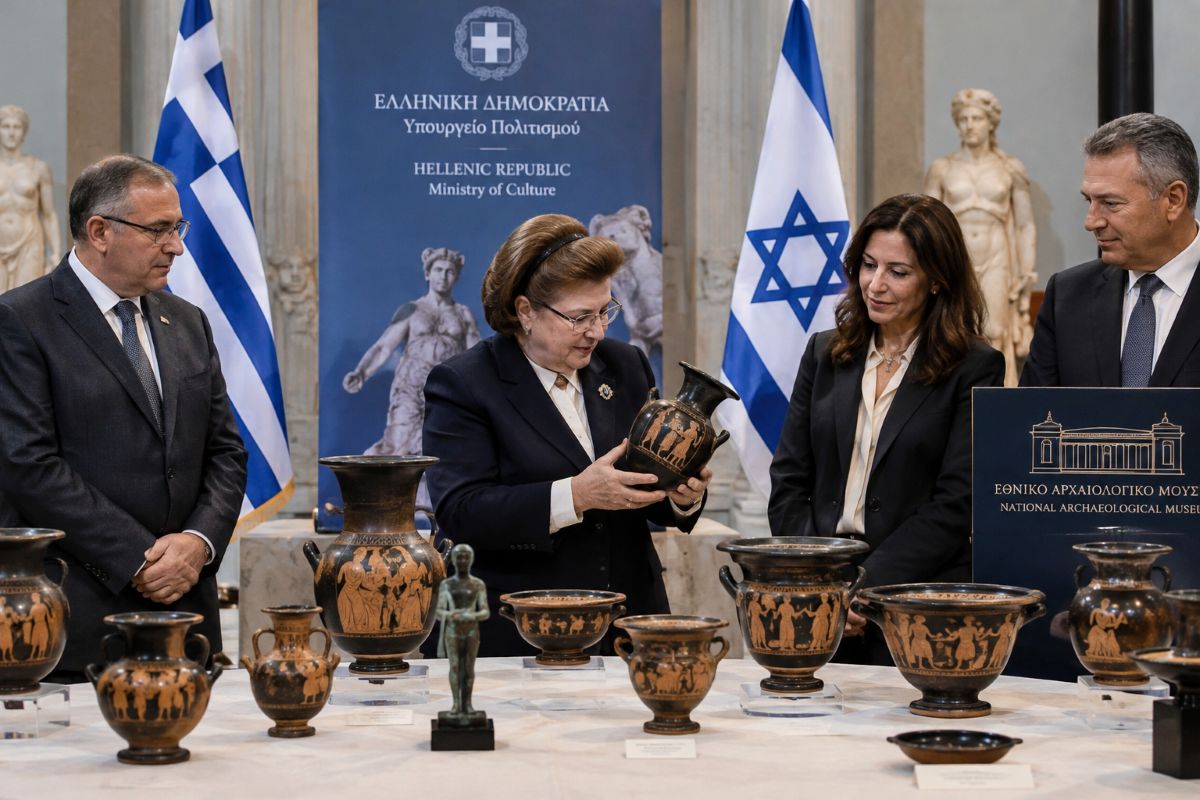
Returning Antiquities Put Athens Back in Focus for Cultural Travellers because the return of 22 Greek artefacts from Israel strengthens the city’s heritage story and gives visitors another reason to engage with its museums, archaeology and ancient identity. Athens remains one of Europe’s leading cultural destinations, but this repatriation adds fresh relevance to how travellers experience Greek history in context. As Returning Antiquities Put Athens Back in Focus, the value goes beyond the objects themselves. Cultural Travellers increasingly seek authentic connections with destinations, and restored heritage can deepen that experience by linking artefacts with the civilisation, landscape and institutions from which they originated.
What Exactly Did Israel Return to Greece?
The newly returned collection contains 22 cultural objects from different periods and production centres of ancient Greece.
Advertisement
Advertisement
According to the Greek Ministry of Culture, the group includes 15 Attic vessels, consisting of 11 black-figure vessels, three red-figure vessels and one black-glazed example. Six additional vessels come from Corinthian workshops and date to the Archaic period. The final object is a bronze statuette depicting a female figure. Its authenticity has not yet been conclusively established and requires further scholarly examination.
| Returned object type | Number | Official detail |
|---|---|---|
| Attic vessels | 15 | 11 black-figure, 3 red-figure, 1 black-glazed |
| Corinthian vessels | 6 | Archaic-period pottery |
| Bronze female figurine | 1 | Further authentication required |
| Total | 22 | Returned from Israel to Greece |
The Attic vessels date to the Archaic and Classical periods, while the Corinthian material belongs to the Archaic era.
Advertisement
Advertisement
How Were the Antiquities Recovered?
The objects were not returned through a routine museum exchange.
The Greek Ministry of Culture says they were identified and seized by the Israel Antiquities Authority’s Unit for the Prevention of Antiquities Robbery. Greek authorities state that all 22 objects had been illegally removed from Greece before eventually being recovered in Israel.
Advertisement
Advertisement
That makes the transfer a formal repatriation of cultural property.
Greek cultural-property policy treats repatriation as particularly important when objects have been illegally excavated, stolen, exported without authorisation or otherwise removed in violation of Greek, European Union or international cultural-property law.
Advertisement
Advertisement
The distinction matters because provenance is central to archaeology. When an artefact is removed illegally, scholars can lose information about the location where it was found, the objects discovered alongside it and the wider historical setting that gives it meaning.
Why Is This Return Historically Important?
The handover is the first known return of antiquities from Israel to Greece, according to the Greek Ministry of Culture.
Its significance is therefore greater than the number of objects involved.
First, 22 antiquities have physically returned to their country of origin.
Advertisement
Advertisement
Second, the case creates a new bilateral precedent between Greece and Israel for tackling the illegal antiquities trade.
Greek officials say specialists from the two countries are already exchanging expertise, identification methods and working practices aimed at tracing cultural property and preventing future trafficking.
Culture Minister Lina Mendoni has emphasised international cooperation, mutual trust and respect for law as essential elements in protecting cultural heritage.
For Greece, the handover strengthens a strategy that increasingly depends on cooperation between national archaeological authorities, prosecutors, customs agencies and museums rather than relying only on isolated legal cases.
How Much Cultural Property Has Greece Recovered Recently?
The latest official figures show that the Israel return is only one part of a much larger campaign.
Between 2021 and 2026, Greece says 425 cultural objects were returned through its cooperation framework with the United States and related enforcement work. Of those, 98 objects were returned directly under provisions of the bilateral memorandum between Greece and the United States.
Advertisement
Advertisement
Another 15 Greek antiquities were returned by Manhattan prosecutors on 21 September 2026, taking the number returned through Manhattan District Attorney decisions since 2022 to 179 objects.
Recent Greek repatriation figures
| Repatriation initiative | Official number |
|---|---|
| U.S.-related returns, 2021–2026 | 425 |
| Returned directly under memorandum provisions | 98 |
| Manhattan DA returns since 2022 | 179 |
| Manhattan return in September 2026 | 15 |
| Israel return in October 2026 | 22 |
These figures show that Greece is pursuing repatriation through several channels simultaneously.
What Else Is Greece Bringing Back From Abroad?
The October Israel handover follows another major development involving Bulgaria.
At the end of September 2026, Greece and Bulgaria signed a memorandum covering the return of 48 historical and ecclesiastical relics linked to monasteries and churches in northern Greece. Those objects had been transferred to Sofia in 1917 during the First World War.
The relics were scheduled to remain temporarily on display at Thessaloniki’s Museum of Byzantine Culture before returning to their respective religious institutions.
Although the Bulgarian case differs legally and historically from the Israeli antiquities, both demonstrate Greece’s broader objective: restoring cultural material to its original historical or institutional setting.
Advertisement
Advertisement
This approach extends beyond archaeological artefacts to religious, historical and artistic objects whose movement abroad occurred under very different circumstances.
Why Is the United States So Important to Greece’s Campaign?
The United States is one of Greece’s most important partners in cultural-property enforcement.
The two countries have operated a bilateral memorandum on cultural heritage since 2011, and the agreement was renewed in October 2026 through 2031.
Greek authorities say the framework has helped strengthen:
- controls against illegal antiquities trafficking;
- customs cooperation;
- archaeological enforcement;
- identification and recovery of stolen objects;
- coordination with U.S. prosecutors and institutions.
The 425 objects returned during 2021–2026 demonstrate the scale of that cooperation.
Compared numerically, the 22 objects returned from Israel are a much smaller group. Diplomatically, however, the Israel case is important because it opens a separate repatriation relationship with another country and potentially broadens Greece’s international enforcement network.
Advertisement
Advertisement
How Does This Connect With the Parthenon Sculptures Debate?
The returned objects are unrelated to the Parthenon Sculptures, but both issues sit within Greece’s wider cultural-property policy.
The Greek Ministry of Culture distinguishes between objects removed illegally and cultural treasures whose removal may raise broader legal, historical or ethical questions.
The Parthenon Sculptures remain the best-known example of the second category.
Greece argues that major architectural and sculptural elements should be reunited with their original monument where possible because separating them weakens the integrity and historical understanding of the whole.
There has already been limited progress. In 2022, the Vatican agreed to return three Parthenon fragments that had been held in the Vatican Museums since the nineteenth century.
The Israel repatriation therefore strengthens a broader diplomatic message even though it involves a completely different group of objects.
Advertisement
Advertisement
How Is Greece Handling Privately Held Collections?
Greece is not relying solely on police seizure or government-to-government transfers.
A separate agreement covers 161 Cycladic antiquities from a private collection in New York. The arrangement involves the Greek Ministry of Culture, the Museum of Cycladic Art, the Metropolitan Museum of Art and the Institute of Ancient Greek Culture in Delaware.
This demonstrates three different tools Greece now uses:
- law-enforcement recovery of illegally trafficked objects;
- diplomatic agreements between governments;
- negotiated arrangements with museums and private collections.
The Israel case combines the first two approaches. Israeli antiquities authorities identified and seized the objects, while the eventual handover occurred through formal bilateral cooperation.
That flexibility is increasingly important because antiquities can move through private sales, museums, auction houses and multiple jurisdictions before their origin becomes clear.
Why Do the 22 Returned Objects Matter Archaeologically?
The composition of the group provides insight into two major centres of ancient Greek ceramic production.
Advertisement
Advertisement
Attic pottery, produced around Athens, was widely distributed throughout the ancient Mediterranean. The returned group includes black-figure, red-figure and black-glazed examples, representing important stages in Athenian ceramic production.
The six Corinthian vessels represent another historically important workshop tradition dating to the Archaic period.
For archaeologists, however, the importance is not simply artistic.
Provenance can reveal where an object was originally buried or used, how it related to nearby finds and what those relationships reveal about ancient society.
When artefacts are illegally excavated, that context can be lost permanently.
This is why antiquities trafficking damages not only ownership rights but also archaeological knowledge.
Advertisement
Advertisement
Comment From Anup Keshan, Founder and Editor-in-Chief of Travel And Tour World
“Israel’s return of 22 antiquities to Greece is significant because cultural heritage forms an essential part of how travellers understand destinations, history and identity. Repatriation can reconnect archaeological objects with the landscapes, museums and communities that give them meaning. Greece’s expanding cooperation with Israel, the United States, Bulgaria and major cultural institutions also shows that heritage protection increasingly requires international coordination. For tourism, responsibly preserved and properly contextualised antiquities strengthen museums and cultural destinations while giving visitors a more complete understanding of the past. Continued collaboration between governments, museums and enforcement agencies can therefore benefit both heritage protection and cultural tourism.”
Conclusion: Why Does Israel’s Return Strengthen Greece’s Wider Repatriation Push?
Israel Returns 22 Greek Antiquities as Greece Intensifies Global Push to Bring Cultural Treasures Home because the handover establishes a new bilateral precedent while adding to a much larger international recovery campaign.
The cause is illicit removal and trafficking of cultural property across borders. The answer is stronger cooperation between governments, archaeological authorities, prosecutors, museums and customs agencies. The reason this particular return matters is historic: it is the first repatriation of antiquities from Israel to Greece.
The 22 objects may be modest in number compared with Greece’s 425 U.S.-related returns, 179 Manhattan-linked recoveries, 48 relics connected with Bulgaria and 161 Cycladic antiquities under a separate agreement. Yet the Israel transfer expands the network through which Greece is attempting to restore cultural objects to their places of origin.
Advertisement
