
France Battery-Powered Trains Enter Service as Regional Rail Moves Toward Cleaner Future

Published
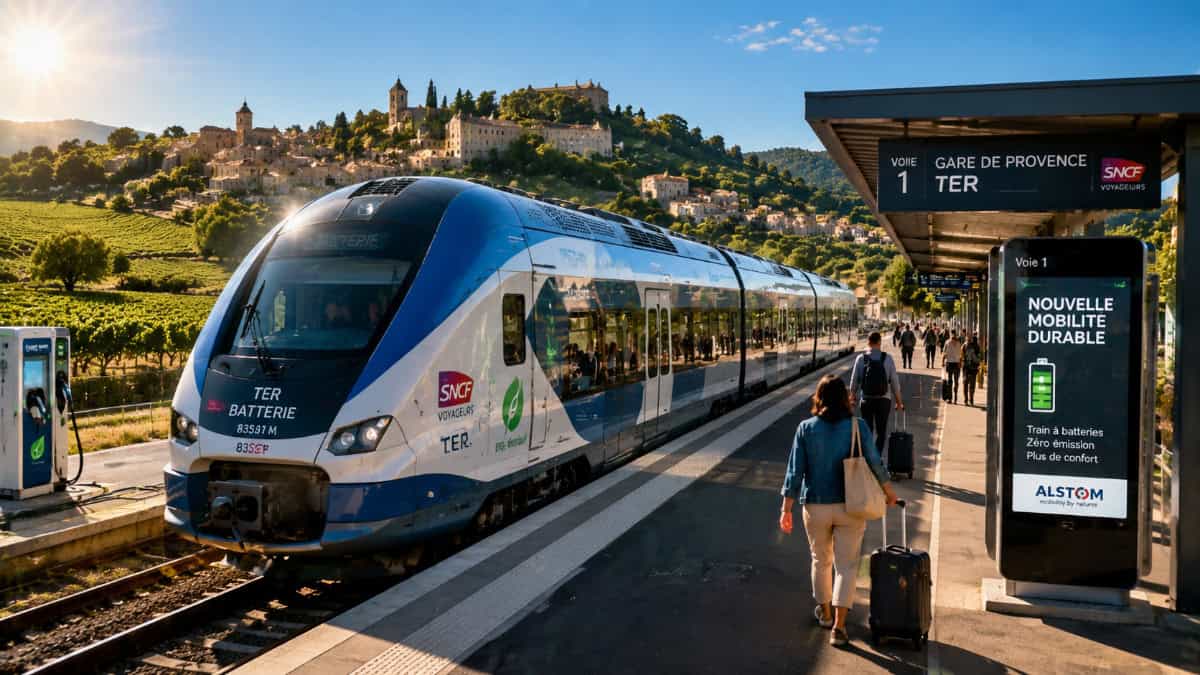
Image generated with Ai
Tests of the first battery-operated regional trains have already begun in France, becoming an important milestone in the efforts of the French nation to reduce the use of diesel fuel on railways where it is not feasible to electrify them. First tests on this issue started from July 2026 in the South Region on the Avignon-Carpentras line and on the Nîmes-Vauvert line in the region of Occitanie at the end of August 2026.
It is a part of a nationwide program which includes SNCF Voyageurs, Alstom and five French regions in order to find out whether lithium batteries will be able to become an alternative source of energy for such trains.
For the passenger, it is not just a new train but the opportunity to have a network of regional railways without the harm for the environment.
Why France Is Testing Battery-Powered Trains on Regional Routes
Railway electrification has long been considered one of the most effective ways to reduce emissions from passenger transport. However, installing overhead electric systems across every railway line requires significant investment and can be challenging on lower-density regional routes.
Advertisement
Advertisement
Battery-powered trains offer another option. Instead of relying entirely on diesel engines or requiring complete electrification, trains equipped with batteries can operate on sections where overhead power is unavailable.
Battery technology could provide a new solution for non-electrified rail lines
The French programme is designed to explore how battery trains can support:
Advertisement
Advertisement
- Cleaner regional passenger services.
- Reduced dependence on diesel-powered rolling stock.
- Continued operation on existing railway routes.
- Lower-emission transport connections for smaller communities.
- Future flexibility in rail modernisation.
The technology is especially relevant for regional networks where full electrification may not always be practical.
By testing trains under normal operating conditions, railway authorities can understand how the technology performs in everyday passenger service.
Advertisement
Advertisement
What Has Changed With France’s New Battery Train Programme
The current initiative is transforming existing regional trains rather than introducing completely new vehicles.
SNCF Voyageurs and Alstom are working on converting dual-mode trainsets by replacing diesel engines with lithium-ion battery systems. The objective is to create trains capable of operating electrically without requiring every route section to have overhead power.
The programme is testing converted trains in real passenger conditions
The main developments include:
- Battery-powered train operation beginning on the Avignon-Carpentras route.
- Testing of a battery train prototype on the Nîmes-Vauvert line.
- Collaboration between SNCF Voyageurs, Alstom and regional authorities.
- Evaluation of train performance outside laboratory conditions.
- Preparation for possible wider future deployment.
The real-world testing phase is important because railway technology must perform reliably under daily conditions, including passenger loads, weather changes and regular operating schedules.
Advertisement
Advertisement
How Battery Trains Could Change Regional Travel for Passengers
Regional rail plays a crucial role in connecting towns, cities and rural communities. Many passengers depend on these services for commuting, tourism and local mobility.
However, some regional lines still operate using diesel trains because electrification has not been completed.
Battery-powered trains could help close this gap by offering a cleaner alternative without requiring immediate large-scale infrastructure projects.
Travellers could benefit from quieter and cleaner journeys
Potential passenger advantages include:
- Reduced emissions from regional rail services.
- Lower noise compared with traditional diesel operations.
- Continued access to rail routes without full electrification.
- More sustainable connections between smaller destinations.
- Improved long-term environmental performance.
For travellers, the change may not appear as a dramatic visible transformation. Instead, the biggest difference could come through cleaner operations and improved sustainability behind everyday journeys.
How the Avignon-Carpentras and Nîmes-Vauvert Routes Support Rail Innovation
The selected routes in the South Region and Occitanie provide important testing environments for battery technology.
Advertisement
Advertisement
The Avignon-Carpentras service became the first route to receive commercial battery train operation, while the Nîmes-Vauvert route has been used for prototype testing.
These regional lines represent the type of railway where battery technology could potentially offer the greatest value.
Regional routes are becoming testing grounds for future mobility
The projects are examining:
- How batteries perform during regular operations.
- How trains manage energy use.
- How existing infrastructure can support cleaner rolling stock.
- How passengers experience the new technology.
- Whether battery solutions can be expanded elsewhere.
The information collected from these routes will help determine where battery-powered trains may be suitable across France.
Why This Matters
The development of France battery-powered trains matters because it could influence the future of regional mobility in France and beyond.
Many countries face the same challenge: reducing transport emissions while maintaining connections on railway lines that cannot easily be electrified.
Advertisement
Advertisement
Battery technology provides another option alongside other solutions such as hydrogen and hybrid systems.
The project could influence future transport decisions
The wider impact includes:
- Supporting France’s railway decarbonisation goals.
- Helping regional lines move away from diesel dependence.
- Providing new options for sustainable public transport.
- Supporting innovation in existing rail fleets.
- Creating lessons for other countries considering similar technology.
The project also highlights a broader shift in transport strategy. Instead of relying on one solution, railway operators are exploring different technologies depending on route conditions.
France’s Battery Train Trials Reflect a Wider Rail Transformation
The French programme is part of a wider movement across the rail industry, where operators are searching for cleaner alternatives while maintaining reliable passenger services.
Rail remains one of the most efficient forms of mass transport, but reducing emissions from older diesel fleets remains an important challenge.
Future rail networks may combine multiple clean technologies
The next generation of regional rail could include:
Advertisement
Advertisement
- Battery-powered trains on suitable routes.
- Electrified lines where infrastructure investment is possible.
- Hydrogen-powered solutions for specific operations.
- Hybrid systems during transition periods.
- More energy-efficient railway management.
SNCF has identified battery technology as one part of its wider approach to reducing the environmental impact of regional trains.
The success of these trials could help shape decisions about future train investments.
What Travellers Should Know
Passengers should understand that battery-powered trains are currently being introduced as part of a testing programme. Wider availability will depend on the results of these operational trials and future decisions by railway authorities.
The technology is being evaluated gradually to ensure reliability before larger-scale expansion.
Before Travelling
- Eligibility: Passengers can use services operating on participating routes under normal regional rail ticket rules.
- Booking conditions: Travel arrangements continue through standard SNCF regional services.
- Destinations: Current testing involves routes in the South Region and Occitanie.
- Availability: Battery train services remain limited during the trial phase.
- Official advice: Travellers should check SNCF and regional transport information before departure.
The introduction of battery trains is a gradual transition, not an immediate replacement of all diesel services.
Frequently Asked Questions
Where are France’s first battery-powered trains operating?
The first commercial battery train service began on the Avignon-Carpentras route, while testing is also taking place on the Nîmes-Vauvert line in Occitanie.
Advertisement
Advertisement
Who is developing France’s battery-powered regional trains?
The programme involves SNCF Voyageurs, Alstom and five French regions working together to test battery-powered TER trains.
Why are battery trains being tested?
They are being evaluated as a possible cleaner alternative for railway routes where full electrification is difficult.
Are all French trains being replaced with battery technology?
No. Battery trains are one of several solutions being explored for different types of railway routes.
Will passengers notice changes when using battery trains?
Passengers may experience quieter and cleaner journeys, although the main benefits are related to reducing emissions from rail operations.
Closing Update
The testing of battery-powered trains in France represents a significant milestone towards adopting cleaner methods of regional transportation. With the tests being conducted on real passenger services, the companies involved are able to gather some crucial data on how battery trains can contribute towards the future of rail transport.
If the testing proves to be a success, it will serve as an ideal model for upgrading the regional rail networks without compromising connections to communities which lack electrification infrastructure.
Advertisement
