

Midway Atoll Airport Under Threat as $100 Million Repairs Put US-Asia Air Routes at Risk

Published
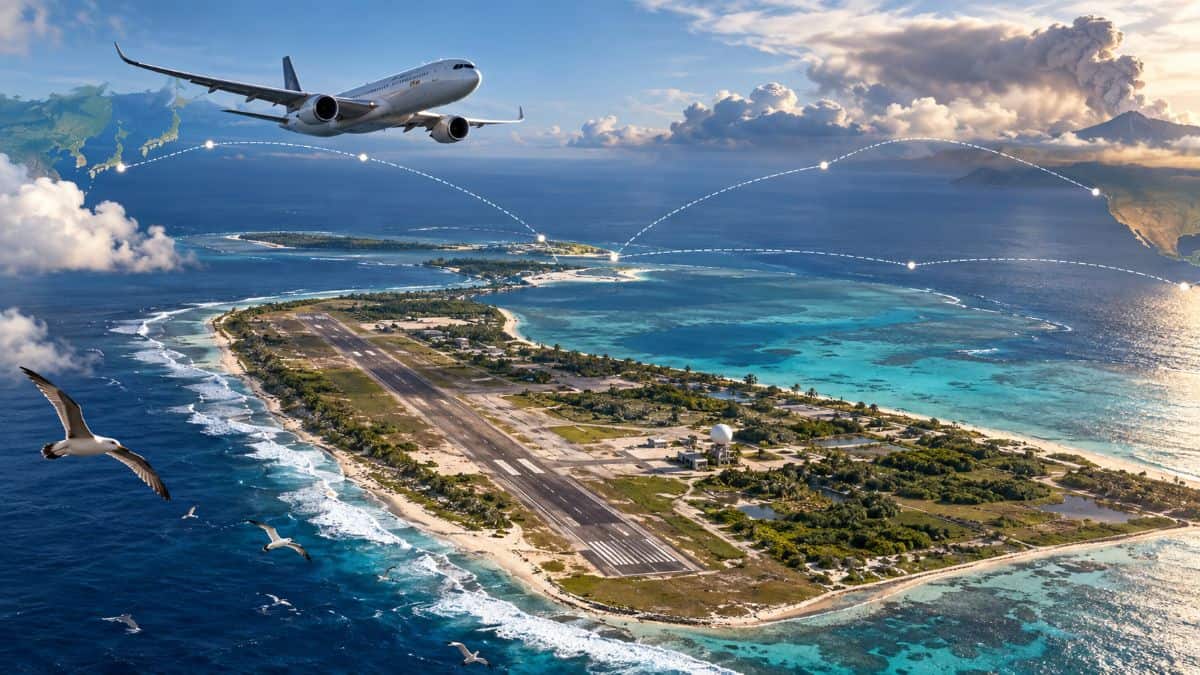
Thousands of Pacific flights could face higher operating costs if Midway Atoll Airport loses its role as an emergency diversion point. The remote Henderson Field requires more than $100 million in infrastructure repairs, according to the aviation industry submissions surrounding the Federal Aviation Administration’s review. Although the airport has no scheduled commercial service, airlines factor it into flight planning across the North-Central Pacific. United Airlines says Midway is considered a potential diversion airport for more than 8,000 of its flights annually. Across carriers, the figure reaches about 44,000 flights a year. Losing the airfield could force longer routings, additional fuel consumption and, potentially, route reductions. For travellers, the issue is therefore less about visiting Midway and more about the hidden infrastructure supporting long-haul connectivity.
Why This Remote Runway Matters
Henderson Field sits on Midway Atoll, more than 1,300 miles northwest of Honolulu. It forms part of the remote aviation safety network across the Pacific. The airfield does not operate as a conventional passenger airport. Instead, it provides a crucial safety option when aircraft need somewhere to land during an emergency.
The Federal Aviation Administration is examining the future operational importance of the airfield. Its July 2026 notice sought information about Midway’s role in trans-Pacific operations and the consequences if it could no longer serve as an ETOPS alternate. The agency said the infrastructure would require major rehabilitation within three to five years.
The issue is significant because modern long-haul flying depends on carefully calculated diversion options. Airlines must demonstrate that aircraft can reach an appropriate alternate airport following certain failures or emergencies. Consequently, an airport can have enormous commercial value without handling a single scheduled passenger.
Advertisement
Advertisement
| Midway Atoll Aviation Factor | Current Situation |
|---|---|
| Location | More than 1,300 miles northwest of Honolulu |
| Airport | Henderson Field |
| Airport code | MDY/PMDY |
| Scheduled commercial service | None |
| Annual United flights using Midway in planning | More than 8,000 |
| Annual flights across carriers | About 44,000 |
| Recent diversions cited by FAA | At least 11 commercial and military flights |
| Estimated repair requirement | More than $100 million |
| Infrastructure outlook | Major rehabilitation needed within 3–5 years |
The $100 Million Infrastructure Problem
The financial challenge sits at the heart of the debate. Midway’s runway and supporting infrastructure operate in one of the world’s most isolated environments. Repair work therefore carries a different logistical burden from conventional airport projects.
The infrastructure requirements include runway milling and repaving. Seawall repairs also form part of the broader rehabilitation need. Those works matter because the airfield must remain capable of supporting emergency operations in a demanding oceanic environment.
Advertisement
Advertisement
The airport currently receives federal support from aviation and wildlife agencies. However, the annual funding cited in the current debate remains far below the scale of the projected rehabilitation programme.
That creates a difficult policy question. Maintaining the airfield requires substantial public investment for an airport that does not generate conventional commercial passenger traffic. Yet abandoning it could shift costs towards airlines, passengers and wider aviation operations.
The FAA’s July notice did not amount to a final closure decision. Instead, the agency requested evidence about Midway’s operational, economic and safety value. The comment period was later extended from September 8 to September 22, 2026.
Airlines Warn of Wider Network Costs
United Airlines has offered one of the clearest estimates of the potential commercial consequences. The carrier says it relies on Midway as a potential diversion point for more than 8,000 flights every year.
United also estimates that roughly 44,000 flights across all carriers incorporate Midway into ETOPS planning. That does not mean 44,000 aircraft land there. Instead, the airport forms part of the safety calculations behind those services.
The distinction is crucial for travellers. A diversion airport can influence whether an airline considers a particular route operationally feasible. Removing one option can therefore affect flight planning long before an aircraft actually needs to divert.
Advertisement
Advertisement
United has estimated that losing Midway could add more than $21.75 million in annual costs to its operations. The carrier warned that some costs could ultimately reach passengers through fares and rates.
The airline also highlighted the impact of longer flight times. Additional routing can require more fuel, potentially increasing operating costs and reducing the flexibility available to carriers.
| Potential Effect of Losing Midway | Likely Aviation Impact |
|---|---|
| Fewer diversion options | Greater operational exposure |
| Longer alternative routes | Higher fuel consumption |
| Additional flight time | Higher aircraft operating costs |
| More complex flight planning | Greater dispatch requirements |
| Higher airline costs | Potential fare pressure |
| Route economics deteriorating | Possible service reductions |
North Pacific Routes Face Extra Pressure
The timing makes the Midway question particularly important for international aviation. Airlines already face a more constrained operating environment across parts of the North Pacific.
United has pointed to the continuing effect of Russian airspace restrictions. Those restrictions have altered long-haul routings and reduced access to some potential diversion options.
Midway therefore provides redundancy when other airports cannot safely perform the same function. Severe weather can affect northern routes. Volcanic ash can also make airports unusable. Military activity, rocket launches and temporary airspace restrictions can create similar problems.
Alaska Airlines has also highlighted Midway’s importance. The carrier says it uses the atoll as an alternate for more than 2,000 flights between Honolulu and Asia each year.
Advertisement
Advertisement
The airline also considers Midway for Seattle-to-Asia operations when other alternatives become unavailable. That includes circumstances involving volcanic ash or rocket launches.
The wider lesson is straightforward. Pacific aviation depends on a network of alternatives rather than a single preferred route. Removing one remote option can make the entire system less flexible.
What ETOPS Means for Travellers
ETOPS can sound like an obscure technical aviation term. For travellers, however, it has a direct connection with the availability of long-distance air services.
The system developed around the need to operate twin-engine aircraft safely across areas where suitable airports are widely separated. Airlines must account for potential diversion requirements when planning flights beyond established thresholds.
Today, the broader ICAO framework uses Extended Diversion Time Operations, or EDTO, although ETOPS remains widely used in industry terminology. These rules cover operational planning, alternate airports, aircraft reliability and maintenance considerations.
Midway’s importance comes from its location. It occupies a strategically useful position in an enormous expanse of ocean where alternative airports can be scarce.
Advertisement
Advertisement
If one alternate disappears, airlines may still operate. However, they may need to redesign routes or satisfy different operational requirements. Some aircraft and routes could face tighter constraints than others.
The Traveller Impact Is Mostly Indirect
Travellers should not expect an immediate wave of cancellations because of the Midway debate. The FAA has not announced a closure, and airlines continue to operate their existing networks.
The more realistic concern is long-term network economics. If carriers must consistently fly longer routes or carry additional fuel, costs rise. Airlines then decide whether those costs can be absorbed, passed through fares or avoided by changing schedules.
For passengers, the effects could emerge gradually. Some routes could become more expensive. Certain schedules might require additional flying time. In less commercially attractive markets, carriers could reconsider frequencies or routes.
However, the outcome would vary by airline, aircraft type and route. Not every trans-Pacific service depends on Midway in the same way.
This is why travellers should avoid interpreting the current review as an immediate threat to every Asia-Pacific flight. The issue is fundamentally about future operational resilience.
Advertisement
Advertisement
Midway Is More Than an Airport
Midway’s importance extends beyond commercial aviation. The atoll forms part of the Papahānaumokuākea Marine National Monument and hosts the Midway Atoll National Wildlife Refuge.
The U.S. Fish and Wildlife Service describes Henderson Field as an ETOPS runway that can support emergency landings for aircraft crossing the Pacific. The agency also identifies airfield operations as critical to refuge logistics.
Midway supports a small resident community involved in conservation and refuge operations. The wider atoll also provides habitat for millions of seabirds and other marine wildlife.
The refuge recorded 589,623 Laysan albatross nests in 2026, according to the latest wildlife monitoring information. It also recorded 28,246 nesting black-footed albatrosses.
That ecological significance adds another dimension to the infrastructure question. The runway supports aviation safety while also supporting the logistical requirements of an internationally important conservation site.
Emergency Diversions Show Its Value
The strongest argument for maintaining Midway is not the number of aircraft that land there. It is the consequences when an aircraft actually needs it.
Advertisement
Advertisement
The FAA has cited at least 11 commercial and military diversions during the period referenced in its review. Earlier US Fish and Wildlife Service records also document significant emergency events involving commercial aircraft.
Those incidents demonstrate the difference between ordinary airport utilisation and strategic aviation value. An airport can sit quiet for years yet remain indispensable when an aircraft develops a serious problem thousands of miles from major population centres.
Airlines for America has made the same argument in its regulatory submission. The group said emergency infrastructure should be judged against the consequences of low-probability events, rather than routine landing volumes.
That principle explains why Midway has attracted such intense industry attention despite having no scheduled passenger network.
What Happens If Midway Loses Status
Several alternatives could theoretically reduce the dependence on Midway. Airlines could adjust routes, identify different diversion airports or modify flight planning.
Yet alternatives are not always interchangeable. Guam, the Marshall Islands and other Pacific locations can themselves face weather, operational or geographic limitations.
Advertisement
Advertisement
A volcanic eruption illustrates the problem. If ash affects one diversion airport, the aircraft needs another viable option. Similarly, tropical cyclones can restrict operations around parts of the western Pacific.
The loss of Midway would therefore reduce redundancy. It would not automatically ground 44,000 flights, but it could make some operations more expensive or complex.
That distinction should remain central to the public debate.
What Travellers Should Watch Next
For passengers, the most important development is the FAA’s eventual decision on the future of Henderson Field. The September 22 comment deadline has passed, leaving the agency to assess submissions from airlines, aviation organisations and other stakeholders.
Travellers should also watch for any airline announcements involving Pacific route planning. Changes would probably emerge through schedules, routing adjustments or operational notices before they appeared as broad fare increases.
There is no current basis to advise passengers to avoid Pacific flights because of the Midway review. Instead, the issue should be understood as a long-term aviation infrastructure decision.
Advertisement
Advertisement
For the travel industry, however, the case is more immediate. It highlights how remote infrastructure can underpin major international markets without appearing on passenger itineraries.
Why This Decision Matters Globally
The Midway debate exposes a hidden layer of modern travel. Passengers see airports, aircraft and destinations, but they rarely see the emergency network supporting flights between them.
Henderson Field illustrates that hidden architecture. Its runway can remain empty while still influencing thousands of flight plans every year.
The question now facing US aviation authorities is whether the strategic value of that runway justifies the scale of investment required. For airlines, the answer is strongly tied to safety, network flexibility and operating costs.
For travellers, the outcome could eventually appear through longer flights, higher fares or fewer route options. None of those consequences is guaranteed. Yet the industry’s warnings explain why an isolated runway in the central Pacific has become a global travel story.
The debate is therefore not really about an airport without passengers. It is about the infrastructure that allows passengers to cross the world’s largest ocean with greater confidence.
Advertisement
