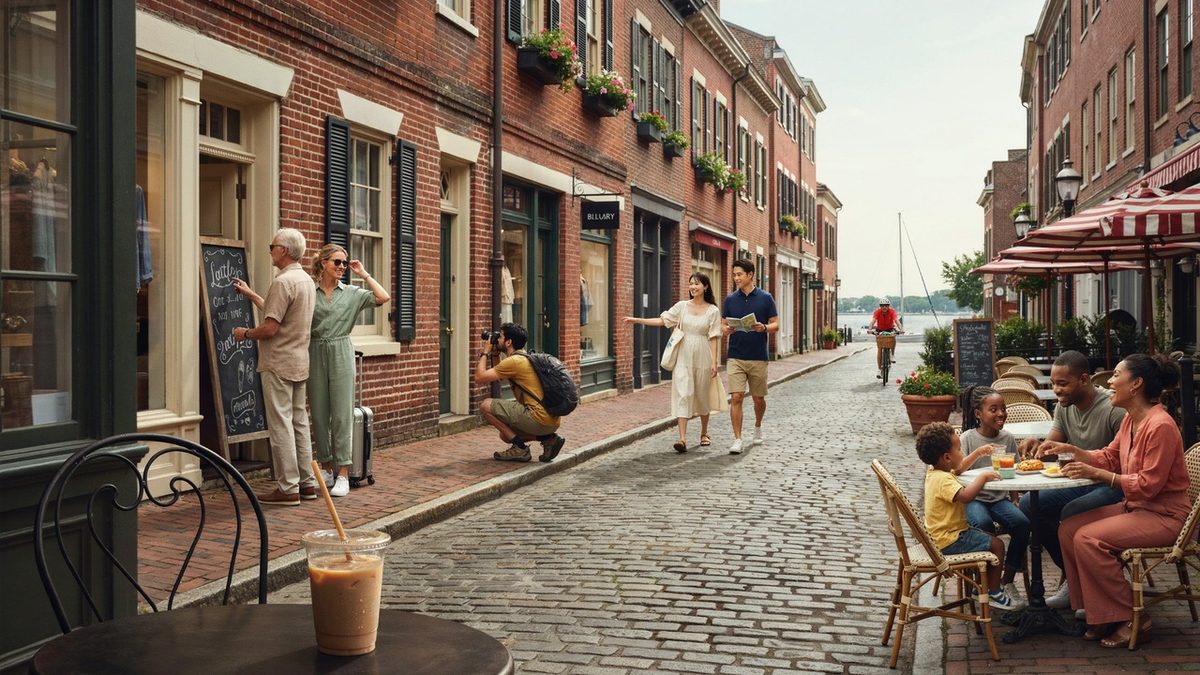
Image generated with Ai
Waynesboro joins Alexandria and more Virginia cities as surging tourism drives visitor spending higher, helping local businesses pocket more cash while strengthening jobs, taxes and community economies.
Waynesboro joins Alexandria and more Virginia cities as surging tourism delivers a powerful visitor spending boost. As travellers spend more, local businesses are pocketing more cash. Meanwhile, rising demand is strengthening jobs, tax receipts and community economies across Virginia.
Waynesboro recorded nearly $93 million in visitor spending in 2025, while Alexandria has also demonstrated the substantial economic value of tourism. Furthermore, Virginia welcomed a record 46.6 million domestic and international overnight visitors. As a result, tourism generated billions in spending and more than $2.6 billion in state and local tax revenue. This growth shows why tourism remains a crucial economic force for Virginia.
“Virginia tourism is powering our local economies — supporting jobs, strengthening small businesses, and investing in our communities. When Americans from across our country and visitors from across the globe come to Virginia, they immediately understand why our beautiful Commonwealth is a world-class destination,” said Governor Abigail Spanberger. “With this record-breaking year for tourism, Virginia households saved an average of more than $1,000 in state and local taxes. We’re continuing to build on this momentum and showcase everything our Commonwealth has to offer.”
Advertisement
Advertisement
Virginia’s tourism industry has reached another major milestone, with visitors spending a record $36.2 billion across the Commonwealth in 2025. The latest figures show sustained growth in travel demand, while tourism continues to support businesses, jobs and public services throughout the state.
According to figures announced by Governor Abigail Spanberger on August 11, visitor spending increased 3.1%, or $1.1 billion, compared with the previous year. It marks the fourth consecutive year of growth for Virginia’s visitor economy.
The Commonwealth also welcomed a record 46.6 million domestic and international overnight visitors, nearly one million more than the previous year.
Travellers spent approximately $99 million every day in Virginia, compared with $96 million daily in the previous year. Dining, recreation and other experience-based activities were among the strongest contributors as travellers increasingly prioritised meaningful experiences.
Advertisement
Advertisement
The economic benefits extend well beyond hotels and attractions. Tourism directly generated more than $2.6 billion in state and local tax revenue, helping fund schools, public safety, transportation and other essential services.
The industry also helped the average Virginia household save approximately $1,020 in state and local taxes.
Meanwhile, tourism directly supported nearly 232,000 jobs, an increase of more than 2,700 jobs year on year. These positions generated approximately $10.6 billion in wages and salaries for Virginians.
| Metric | 2024 | 2025 | Change | What it means |
|---|---|---|---|---|
| Visitor spending | $35.1 billion | $36.2 billion | +$1.1B / +3.1% | Record annual visitor spending |
| Daily visitor spending | $96 million | $99 million | +$3M per day | Travellers spent more each day across Virginia |
| Overnight visitors | 44.7 million | 46.6 million | Nearly +1 million | Second consecutive annual visitation record |
| State & local tax revenue | $2.5 billion | More than $2.6 billion | Increase | Tourism generated additional public revenue |
| Tourism-supported jobs | More than 229,000 | Nearly 232,000 | +2,700+ | Employment expanded with tourism demand |
| Wages & salaries | — | $10.6 billion | — | Direct tourism employment generated substantial labour income |
| Average household tax benefit | About $990 | $1,020 | +$30 | Visitor-generated taxes reduced the tax burden on the average household |
| Leisure share of overnight visitation | — | 90% | — | Leisure travel remained the principal tourism driver |
Leisure travel remained the dominant force behind Virginia’s tourism expansion, accounting for 90% of overnight visitation.
Central Virginia led the Commonwealth in hotel demand growth, followed by the Shenandoah Valley and Virginia Mountains. Notable gains were reported in Staunton/Harrisonburg, Richmond, Roanoke and Charlottesville.
Virginia’s tourism momentum has continued into 2026. Through June, hotel demand increased 3.1%, compared with 1.8% nationally. Hotel revenue climbed 6.4%, highlighting continued strength in both leisure and business travel.
The Commonwealth is also implementing a new Statewide Strategic Tourism Plan, launched in April 2026, designed to provide a coordinated, data-driven framework for tourism growth over the next decade.
Rita McClenny, President and CEO of the Virginia Tourism Corporation, said the fourth consecutive record demonstrates the resilience of Virginia’s tourism industry.
Locality-level tourism data is scheduled to become available in September 2026, providing a more detailed picture of how individual Virginia communities are benefiting from the record visitor economy.
Waynesboro provides one of the clearest examples of how tourism growth is translating into local economic activity.
The city recorded nearly $93 million in visitor spending during 2025, representing an 8.2% increase compared with the previous year. The spending supported approximately 925 tourism-related jobs and generated $4.4 million in local tourism-related taxes.
The city has attributed its continued tourism performance to investment in destination marketing, signature events, public art and visitor amenities.
The Visit Waynesboro app, along with the Rockfish Gateway and Downtown tourism districts, forms part of the city’s strategy to make it easier for travellers to discover attractions, businesses and experiences.
Stephanie Duffy, Assistant Director of Economic Development & Tourism for Waynesboro, described the growth as a reflection of the city’s appeal and the work undertaken by tourism partners and local businesses.
The significance extends beyond visitor numbers. When travellers spend money in restaurants, accommodation providers, shops, attractions and recreational businesses, that expenditure circulates through the local economy.
Virginia’s tourism economy delivered another record-breaking performance in 2025, with visitor spending reaching $36.2 billion and communities across the Commonwealth benefiting from stronger demand for travel, dining, recreation and experiences.
The latest figures from the Virginia Tourism Corporation (VTC) show that visitor spending increased by 3.1%, or approximately $1.1 billion, compared with 2024. The result marks the fourth consecutive year of tourism growth in Virginia, reinforcing the importance of travel to the state’s economy and local communities.
One of the communities benefiting strongly from this expansion is Waynesboro, where tourism-generated visitor spending approached $93 million in 2025.
Waynesboro recorded particularly strong growth during the year, with visitors spending nearly $93 million in the city. That represents an 8.2% increase from the previous year.
The increase has translated into tangible economic benefits for the community. According to the City of Waynesboro, tourism supported approximately 925 local jobs in 2025.
Tourism-related activity also generated around $4.4 million in local taxes, providing additional financial support for the city and demonstrating how visitor spending can extend beyond hotels, restaurants and attractions.
Stephanie Duffy, Assistant Director of Economic Development & Tourism for Waynesboro, said the continued expansion reflects the city’s growing appeal as a destination and the contribution of tourism partners, businesses and the wider community.
“This continued growth is a strong reflection of Waynesboro’s appeal as a destination and the hard work of our tourism partners, local businesses, and community,” Duffy said.
She added that the impact extends beyond visitors, helping strengthen local businesses, support employment and contribute to the broader vitality of Waynesboro.
Waynesboro officials attribute part of the city’s tourism performance to continued investment in destination marketing and visitor infrastructure.
The city has expanded its tourism marketing campaigns while investing in signature events, public art and visitor amenities designed to encourage travellers to spend more time in the community.
Among the initiatives highlighted by city officials are the Visit Waynesboro app, the Rockfish Gateway tourism district and the Downtown tourism district.
Such investments are increasingly important as destinations compete for travellers looking for experiences rather than simply accommodation.
Dining, recreation and other experience-based activities were among the areas contributing significantly to Virginia’s broader tourism growth in 2025.
For communities such as Waynesboro, the strategy is not simply about attracting visitors. It is also about creating reasons for those visitors to stay longer, explore more businesses and return in the future.
Waynesboro’s performance forms part of a much larger statewide tourism story.
Virginia welcomed a record 46.6 million domestic and international overnight visitors in 2025, according to the Virginia Tourism Corporation.
Those travellers collectively generated approximately $99 million in visitor spending every day across the Commonwealth. That daily spending figure increased from roughly $96 million in the previous year.
The scale of the spending highlights tourism’s role as a major economic engine for Virginia.
Travellers contribute to the economy through accommodation, restaurants, attractions, retail, transportation and recreational activities. However, the latest figures also point towards the growing importance of experience-driven tourism, with dining, recreation and other activities helping fuel visitor expenditure.
The benefits of Virginia’s tourism industry extend beyond businesses that directly serve travellers.
Tourism generated more than $2.6 billion in state and local tax revenue during the year, helping provide funding that supports communities throughout the Commonwealth.
The economic contribution also creates savings for residents.
According to the reported tourism figures, the industry’s tax contribution helped the average Virginia household save approximately $1,020 in state and local taxes.
That means the economic value of tourism is not limited to visitors and tourism businesses. Residents can also benefit when visitor-generated tax revenue helps support essential public services without placing the entire burden on local taxpayers.
The revenue contributes towards areas including schools, public safety, transportation and other essential services.
Employment represents another major part of Virginia’s tourism success.
The state’s tourism industry directly supported nearly 232,000 jobs in 2025, an increase of more than 2,700 jobs compared with the previous year.
Those positions generated approximately $10.6 billion in wages and salaries for Virginians.
The figures demonstrate the industry’s significance as an employer across a wide range of sectors. Tourism supports jobs in hotels and restaurants, but its economic footprint also reaches transportation, entertainment, recreation, retail and other businesses that benefit from visitor demand.
For smaller communities, this employment impact can be particularly important because tourism provides opportunities for local businesses and workers while attracting spending from outside the area.
Rita McClenny, President and CEO of the Virginia Tourism Corporation, said the fourth consecutive year of record tourism growth demonstrates the resilience of the state’s visitor economy.
“For the fourth year in a row, we’re celebrating another record, and that kind of sustained growth speaks to the strength and resilience of Virginia’s tourism industry,” McClenny said.
She noted that travellers are continuing to discover destinations and experiences across the Commonwealth, while tourism partners are developing experiences capable of encouraging repeat visits.
Virginia’s tourism performance is also entering 2026 with additional momentum. McClenny said hotel performance was already outpacing the national level in 2026, giving the state reason to expect another strong year.
Waynesboro’s 8.2% increase in visitor spending illustrates how statewide tourism growth can translate into meaningful local economic gains.
The nearly $93 million spent by visitors, 925 tourism-supported jobs and $4.4 million in tourism-related taxes show the direct and indirect value of attracting travellers to a destination.
Meanwhile, Virginia’s $36.2 billion statewide visitor spending record demonstrates the extraordinary scale of the industry’s contribution.
As destinations continue investing in marketing, events, public spaces, digital visitor tools and distinctive experiences, competition for tourism spending is likely to remain intense.
For Virginia, however, the latest numbers suggest that those investments are generating measurable returns. With record visitor spending, millions of overnight guests, billions in tax contributions and hundreds of thousands of supported jobs, tourism is continuing to strengthen both the Commonwealth’s economy and the communities that welcome its visitors.
Alexandria has also demonstrated the substantial economic value generated by tourism.
Government tourism-impact data has previously placed visitor spending in Alexandria at approximately $826 million, with tourism supporting thousands of jobs and producing significant tax revenue for the city.
The destination benefits from its proximity to Washington, D.C., historic character, waterfront, restaurants, independent businesses and cultural attractions.
Old Town Alexandria remains a particularly important visitor draw, offering a walkable environment where tourism spending can reach multiple sectors during a single trip.
The Alexandria example also demonstrates why visitor spending should not be viewed simply as hotel revenue. A visitor who stays overnight may simultaneously spend money on dining, transport, shopping, entertainment and attractions.
That broader spending footprint makes tourism particularly valuable to urban destinations.
Virginia Beach occupies a different position within Virginia’s tourism landscape.
Its coastal setting gives the city a strong leisure-tourism identity, with beaches, resorts, restaurants, entertainment, outdoor recreation and events attracting travellers throughout the year.
While a directly comparable 2025 city-wide visitor-spending figure should be distinguished from individual attraction or state-park economic-impact figures, Virginia Beach remains one of the Commonwealth’s most prominent tourism destinations.
The city’s tourism model is built around both seasonal and experience-based travel. Visitors are drawn not only by the Atlantic coastline but also by dining, recreation, entertainment and events.
This diversification matters because it can encourage travellers to extend stays and distribute expenditure across more businesses.
Richmond, Virginia’s capital, is another important component of the Commonwealth’s visitor economy.
The city combines history, museums, arts and culture, food, craft beverage tourism, outdoor recreation and sporting events. Its location also makes it accessible to visitors travelling between major population centres along the U.S. East Coast.
Government reporting has identified Richmond among the Virginia destinations showing standout hotel-demand gains.
Hotel performance is an important indicator because accommodation demand can influence spending across the wider visitor economy. Travellers staying overnight have more opportunities to spend on restaurants, attractions, shopping and entertainment than visitors making short stops.
Richmond’s tourism proposition is therefore increasingly based on combining its historic identity with contemporary experiences.
Roanoke offers another distinctive tourism proposition.
Located in Virginia’s Blue Ridge region, the city benefits from demand for outdoor recreation, scenic travel, cycling, hiking, cultural attractions and mountain experiences.
The Commonwealth has identified Roanoke among destinations experiencing notable hotel-demand gains.
That performance is significant because outdoor and experiential tourism can create economic connections between urban centres and surrounding communities.
A traveller visiting Roanoke for outdoor recreation may spend money on accommodation in the city, dine locally, purchase equipment or supplies, visit attractions and then travel into surrounding areas.
This creates a wider tourism ecosystem rather than concentrating visitor expenditure in a single attraction.
Charlottesville is another major tourism destination, with a visitor economy shaped by history, culture, food, wine, higher education and nearby attractions.
The city and surrounding region appeal to travellers seeking a combination of heritage and experiential tourism.
Charlottesville has also been identified by the Commonwealth among destinations recording standout hotel-demand gains.
Its tourism economy illustrates the increasing importance of multi-dimensional travel. Visitors are no longer necessarily choosing destinations for one attraction alone. Instead, they often combine food, culture, outdoor activities, historic sites and local experiences within the same trip.
For destination marketers, that creates an opportunity to package a city as an experience rather than simply a place to visit.
Harrisonburg is another destination benefiting from Virginia’s growing visitor economy.
Its position in the Shenandoah Valley gives it access to travellers interested in outdoor recreation, scenic landscapes, local food, culture and regional experiences.
Harrisonburg has been included among the Virginia destinations showing standout hotel-demand performance.
Its tourism opportunity also comes from its role as a base for exploring the wider region. Visitors can stay in the city while travelling to nearby natural and cultural attractions.
That model can be economically important because overnight accommodation generates a foundation for additional visitor expenditure.
Staunton brings a strong heritage and cultural dimension to Virginia’s tourism landscape.
The city is recognised for its historic architecture, arts, theatre, independent businesses and connection to the wider Shenandoah Valley.
Staunton has also been identified alongside Harrisonburg as a destination experiencing notable hotel-demand gains.
Its tourism model demonstrates the value of preserving and promoting distinctive local character.
For visitors, historic streets, cultural institutions, restaurants and independent businesses can collectively form the destination experience. For the local economy, that means tourism spending can reach numerous businesses rather than being concentrated in one large attraction.
Chesapeake adds another dimension to Virginia’s tourism network.
The city benefits from its location in the Hampton Roads region and its connections to coastal, maritime, outdoor and regional travel.
While a directly comparable 2025 city-wide visitor-spending figure should not be presented without the relevant locality dataset, Chesapeake’s position within the wider Hampton Roads tourism market gives it access to substantial visitor flows.
The destination also demonstrates why Virginia’s tourism economy cannot be understood solely through its best-known attractions.
Regional connectivity, accommodation, dining, outdoor recreation and access to neighbouring destinations all contribute to the overall visitor economy.
Government economic-impact research also illustrates the role airports can play in supporting visitor economies in Virginia communities.
Earlier Virginia Department of Aviation analysis identified significant economic activity associated with visitor-related airport use in Manassas and Leesburg.
Manassas generated more than $11 million in economic output associated with airport activity in the cited study, while Leesburg generated more than $5 million.
These figures should not be confused with city-wide tourism visitor spending, particularly because they come from an earlier aviation economic-impact assessment. Nevertheless, they highlight an important relationship between transportation infrastructure and tourism.
Airports can facilitate business travel, leisure travel, events and regional connectivity, creating economic activity beyond the aviation facilities themselves.
The statewide figures put the city-level numbers into perspective.
Virginia’s tourism industry generated more than $2.6 billion in state and local tax revenue in 2025.
The industry also supported nearly 232,000 jobs and generated approximately $10.6 billion in wages and salaries.
The economic contribution therefore extends beyond tourism companies. Tax revenues can support public services, including schools, public safety and transportation.
The Virginia Tourism Corporation has estimated that tourism helped the average Virginia household save approximately $1,020 in state and local taxes.
That is one of the strongest arguments for destination investment: visitors bring external spending into local economies, helping businesses while also contributing to public finances.
The city-by-city perspective is important because Virginia’s tourism economy is not uniform.
Waynesboro’s 8.2% increase demonstrates rapid growth in a smaller community. Alexandria represents the scale possible in an established urban destination. Richmond combines capital-city travel with culture and events, while Virginia Beach relies heavily on coastal and leisure tourism.
Roanoke, Charlottesville, Harrisonburg and Staunton show how heritage, outdoor recreation, culture and regional travel can support visitor economies outside Virginia’s largest metropolitan centres.
However, comparisons must be made carefully.
The Commonwealth’s 2025 locality-level tourism data is being released separately from the headline statewide figures. Older city-level studies, airport economic-impact reports and attraction-specific assessments should therefore not be presented as though they were directly comparable with Waynesboro’s 2025 visitor-spending figure.
That distinction is particularly important for accurate travel-industry reporting.
Virginia Tourism Corporation President and CEO Rita McClenny said the fourth consecutive year of record performance demonstrates the strength and resilience of the state’s visitor economy.
The Commonwealth is entering 2026 with further momentum, with hotel performance already reported as outpacing the nation.
For Virginia’s cities, the opportunity is increasingly about converting visitor interest into longer stays and broader local spending.
Marketing campaigns, signature events, public art, historic districts, outdoor attractions, restaurants, digital visitor tools and improved visitor infrastructure can all influence how travellers experience a destination and where they spend money.
The record $36.2 billion generated by visitors across Virginia in 2025 confirms that tourism is no longer simply an ancillary economic activity. It is a major contributor to employment, business revenue and public finances.
From Waynesboro’s nearly $93 million visitor-spending milestone to the established tourism economies of Alexandria and Virginia Beach, and the growing appeal of Richmond, Roanoke, Charlottesville, Harrisonburg and Staunton, Virginia’s tourism story is increasingly a story of local economic development.
As the Commonwealth continues publishing detailed locality-level results, the city-by-city picture should become even clearer. For now, the available government data already shows a consistent message: when Virginia attracts visitors, communities across the state have an opportunity to turn travel demand into jobs, business growth, tax revenue and stronger local economies.
The cause is straightforward: more travellers are choosing Virginia and spending across accommodation, dining, recreation, entertainment, retail and attractions. The answer is stronger local economic activity. Consequently, cities can capture more visitor spending, support additional tourism-related jobs and generate greater tax revenue. Waynesboro demonstrates this effect, recording nearly $93 million in visitor spending, up 8.2% year on year.
“Virginia’s record tourism performance is a powerful reminder that travel is far more than a leisure activity; it is a major economic engine. The $36.2 billion in visitor spending demonstrates how effectively destinations can translate traveller demand into jobs, business revenue and public-sector benefits. The record 46.6 million overnight visitors also underline Virginia’s growing appeal among domestic and international travellers. Particularly encouraging is the strength of experience-led travel, which is supporting restaurants, attractions, cultural venues and local businesses. With hotel demand continuing to outperform national growth in 2026, Virginia has an excellent platform for further expansion. Strategic investment and innovative destination marketing can help sustain this remarkable momentum.” says, Anup Kumar Keshan, Editor-in-Chief, TTW
Meanwhile, Alexandria and other Virginia cities benefit from established tourism ecosystems and continued visitor demand. The reason behind the wider surge includes destination marketing, signature events, public amenities, cultural attractions and experience-led travel. Together, these factors encourage visitors to stay longer, explore further and spend more locally.
Waynesboro joins Alexandria and more Virginia cities in benefiting from surging tourism and rising visitor spending. The latest figures underline how travel can put more cash into local economies while supporting businesses, workers and public services. Waynesboro’s nearly $93 million in visitor spending and 8.2% annual increase provide a compelling example of this momentum.
Meanwhile, Virginia’s record 46.6 million overnight visitors helped push statewide visitor spending to $36.2 billion in 2025. Furthermore, tourism generated more than $2.6 billion in state and local tax revenue and supported nearly 232,000 jobs. As cities invest in destination marketing, events, attractions, public art and visitor amenities, they are creating stronger reasons for travellers to visit and spend. Therefore, the tourism surge is becoming more than a travel success story. It is increasingly an economic growth engine, helping Virginia communities capture valuable visitor spending and convert it into lasting local benefits.
Advertisement
Advertisement
Advertisement













Wednesday, September 9, 2026

Wednesday, September 9, 2026
Thursday, September 10, 2026

Thursday, September 10, 2026

Wednesday, September 9, 2026

Wednesday, September 9, 2026

Thursday, September 10, 2026

Thursday, September 10, 2026