
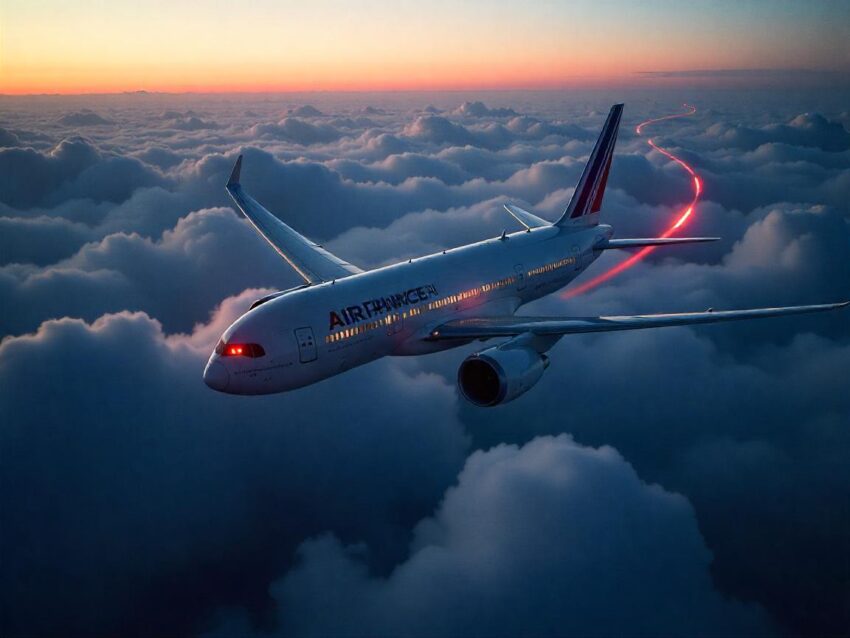
Image generated with Ai
Air France flight AF386 to Toronto declares emergency midair, circles to dump fuel, then returns to Paris—this was no ordinary transatlantic journey. What started as a routine takeoff from Charles de Gaulle quickly spiraled into a high-altitude scare. As the Boeing 777 soared toward cruising altitude, Air France flight AF386 encountered unexpected trouble, prompting pilots to declare an emergency midair. Within minutes, the aircraft began to circle over Normandy, dumping fuel in preparation for an urgent return. Then came the final decision—turn back to Paris. Passengers onboard felt the shift, unaware of just how critical the situation had become. Meanwhile, aviation trackers lit up, and industry eyes turned to the skies. Flight AF386 to Toronto had become the latest cautionary tale in a year of heightened airline scrutiny. Why did this emergency unfold? What forced the return to Paris? The answers raise questions that ripple across the global travel sector.
Air France AF386’s Emergency Return Sparks Global Safety Alarm: Why the Skies Are Under Scrutiny Again
In a tense turn of events, Air France flight AF386—an international route from Paris to Toronto—was forced to make an emergency return after declaring a general emergency mid-flight. The Boeing 777-300ER, one of the airline’s transatlantic workhorses, had only just reached cruising altitude when a technical fault altered its course and its mission. What began as a routine journey quickly evolved into a high-stakes safety maneuver. This single flight may now echo across the global aviation sector as a cautionary tale.
The aircraft took off from Paris Charles de Gaulle Airport (CDG) at 18:52 CEST, en route to Toronto Pearson (YYZ), expected to complete the 8-hour flight as scheduled. But while flying over Normandy, pilots descended the aircraft from 32,000 to 30,000 feet, then entered a holding pattern to burn fuel. The reason: a technical fault that triggered a general emergency declaration.
Advertisement
By 20:15 CEST, the decision was made—return to CDG. The aircraft landed on runway 27L without incident and docked at Terminal 2E around 21:10. No passenger injuries were reported, but the aircraft remains grounded pending technical assessment.
Emergency returns are designed into aviation protocol for a reason. The pilots’ swift actions, coordination with air traffic control, and adherence to safety protocol kept passengers out of harm’s way. But even though the outcome was successful, the situation underscores how one fault can throw an entire operation into uncertainty.
This was no minor turbulence or route delay. It was a scenario involving potential risk at 30,000 feet—one that demanded real-time decision-making under pressure.
An unscheduled landing, especially for a widebody aircraft like the 777-300ER, sends operational shockwaves. Schedules are impacted. Connecting passengers miss flights. Aircraft availability for other routes narrows. Crew rotations get thrown into disarray. Passengers with tight layovers are stranded. And the airline, already grappling with high summer loads, must reshuffle resources overnight.
Advertisement
Advertisement
Furthermore, airport authorities at CDG were forced to act fast. Emergency response teams were deployed, and slot availability for incoming and outgoing flights had to be recalibrated—all to accommodate one unexpected return.
What makes incidents like AF386 more than an operational footnote is the psychological effect on passengers. Travelers are already jittery after a year of headlines dominated by mechanical failures, airspace conflicts, and near-miss collisions.
Each emergency return chips away at public confidence. People begin to question: Are long-haul flights as safe as promised? Is aviation engineering keeping up with complex systems? Can we really fly with certainty anymore?
Air France acted promptly. The crew followed every safety directive. Still, the broader narrative is hard to contain once the word “emergency” hits live flight trackers and social media.
This latest incident must push aviation leaders to move from reaction to prevention. Technical glitches—even if minor—shouldn’t repeatedly lead to midair course reversals. Airlines need to evaluate:
Beyond internal reviews, industry regulators like the European Union Aviation Safety Agency (EASA) and the U.S. Federal Aviation Administration (FAA) may also accelerate audits of Boeing’s long-haul aircraft models. Multiple similar events from the same aircraft type raise unavoidable scrutiny.
As travel booms post-pandemic, airlines are under pressure to meet demand. Every grounded plane strains capacity. But rushing aircraft back into service after emergency returns without robust checks risks far worse consequences. The challenge now is balance—meeting global mobility demands while ensuring an uncompromising safety standard.
Air France must tread carefully. Every recovery step must be deliberate, visible, and reassuring to a passenger base that expects transparency as much as efficiency.
Flight AF386 returned safely. No injuries. No physical damage. But its legacy might linger. For passengers on board, the experience will likely remain etched into memory. For Air France, it adds to a year where multiple aircraft have encountered similar safety alarms. And for the broader industry, it’s yet another reminder that trust in air travel hinges on what happens behind the scenes—before wheels ever leave the ground.
In an age where news spreads faster than any aircraft can fly, the response to these incidents must match the speed of public concern. Investigate. Report. Fix. Communicate. Only then can airlines truly restore altitude—not just in the sky, but in reputation.
Advertisement
Tags: Air France, airline safety, Aviation Operations, Boeing 777-300ER, flight emergency, global travel risks, Normandy airspace, paris charles de gaulle, Toronto Pearson, Transatlantic Travel
Advertisement
Advertisement













Saturday, September 5, 2026

Friday, September 4, 2026

Saturday, September 5, 2026

Saturday, September 5, 2026

Thursday, September 3, 2026

Wednesday, September 2, 2026

Saturday, September 5, 2026

Saturday, September 5, 2026


