
Regent Turns Europe’s Solar Eclipse Into a High-Stakes Luxury Cruise Event as Southampton, Le Havre, Eidfjord and Helsinki Prepare for Partial Viewing, Iceland and Parts of Spain Lie in the Path of Totality, and the Southampton-to-Reykjavik Sailing Is Waitlisted

Updated
Published
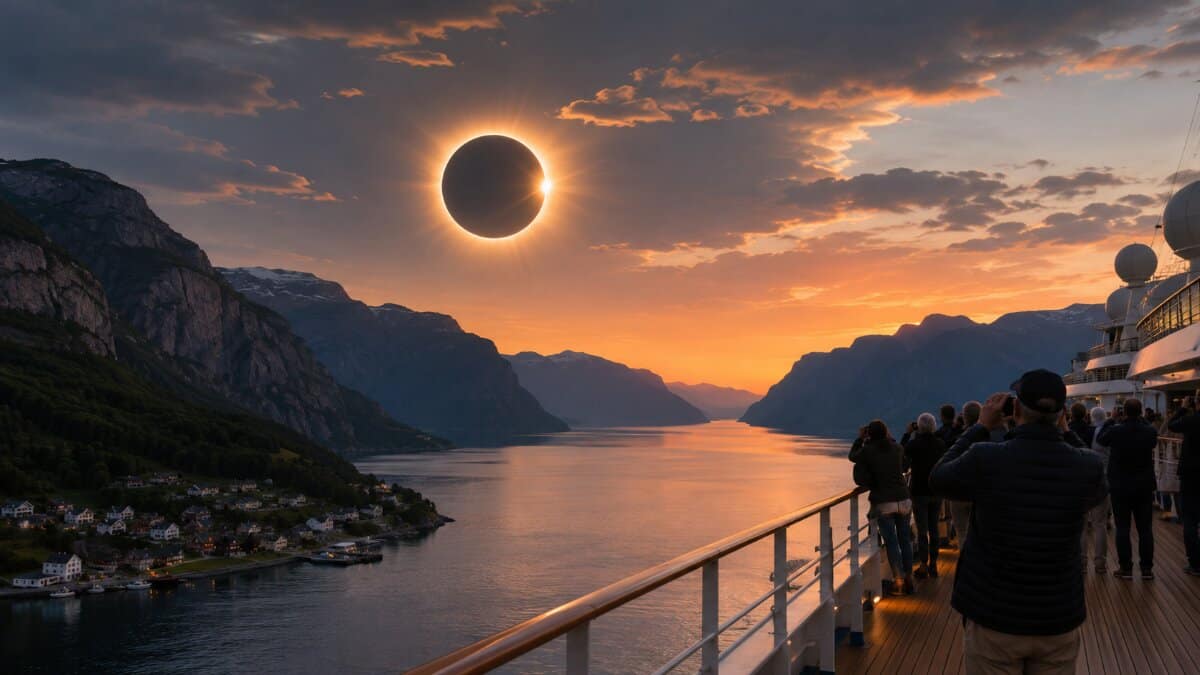
Regent Seven Seas Cruises is entering the final departure window for four European solar eclipse voyages scheduled around 12 August 2026. Current booking pages show wait-list pressure across the collection, including an overall waitlist for the Southampton departure. However, none of the four designated viewing locations lies inside the path of totality. Travellers will receive approximately 79.6 per cent to 92.75 per cent eclipse coverage in Finland, Norway, France and the United Kingdom, making precise product descriptions, eye protection and weather contingency planning essential.
Regent Eclipse Cruises Enter Their Most Critical Sales Window
Regent Seven Seas Cruises is moving into the operational phase of its 2026 Solar Eclipse Voyage Collection, with the first departure scheduled from Southampton on 31 July and the celestial event occurring across Europe on 12 August.
The four voyages combine Northern European, Scandinavian, Baltic, Norwegian fjord and Iberian itineraries with specialist astronomical programming. Regent has built the experience around open-deck viewing, expert-led enrichment, stargazing, solar glasses, themed food, eclipse-inspired drinks and onboard celebrations. The voyages range from eight to eighteen nights and operate aboard Seven Seas Mariner, Seven Seas Grandeur, Seven Seas Navigator and Seven Seas Voyager.
The latest booking snapshot adds urgency. Seven Seas Voyager’s eight-night Southampton-to-Reykjavik voyage is displayed as waitlisted. Multiple suite categories on Seven Seas Mariner and Seven Seas Navigator also carry wait-list status, while the entry Veranda Suite category on Seven Seas Grandeur is similarly listed. These indicators do not constitute a published fleet-wide occupancy figure, but they show restricted public inventory during the final weeks before departure.
Advertisement
Advertisement
The Crucial Traveller Detail: These Are Not Totality Voyages
The distinction between a total and partial solar eclipse is the most important fact for agents selling the 2026 collection.
NASA’s official eclipse map places the path of totality across Greenland, Iceland, northern Russia, the Atlantic Ocean, Spain and a small section of Portugal. Large areas of Europe, including the United Kingdom, France, Norway and Finland, will experience a partial eclipse. Only observers inside the narrow totality corridor will see the Moon completely cover the bright face of the Sun.
Advertisement
Advertisement
Regent’s own published percentages confirm that the four 2026 viewing locations sit outside that corridor. Coverage will range from approximately 79.6 per cent in Helsinki to approximately 92.75 per cent in Le Havre.
| Regent ship and voyage | Departure and duration | Designated viewing position on 12 August | Published coverage | Totality status |
|---|---|---|---|---|
| Seven Seas Mariner, Scandinavian Serenade | Southampton, 31 July, 18 nights | Helsinki, Finland | Approximately 79.6 per cent | Partial |
| Seven Seas Grandeur, Mighty Fjords and Nordic Grace | Reykjavik, 1 August, 14 nights | Eidfjord, Norway | Approximately 84.3 per cent | Partial |
| Seven Seas Navigator, Iberian Indulgence | Le Havre, 12 August, 12 nights | Le Havre, France | Approximately 92.75 per cent | Deep partial |
| Seven Seas Voyager, Royal Routes | Southampton, 12 August, eight nights | Southampton, United Kingdom | Approximately 92.53 per cent | Deep partial |
This does not make the voyages insignificant. Coverage above 90 per cent can produce a striking reduction in daylight, changing shadows and a dramatic late-day atmosphere. It does, however, remain physically different from totality, when the solar corona becomes visible and the bright solar surface is fully blocked.
Advertisement
Advertisement
The Iceland and Spain Route Paradox Creates a New Sales Risk
The most revealing feature of Regent’s route design is that several voyages are closely connected with Iceland and Spain, two of Europe’s principal totality destinations, but are not positioned there during the total phase.
Seven Seas Grandeur begins in Reykjavik on 1 August and visits three additional Icelandic ports before sailing towards Norway. By eclipse day, the ship is scheduled to remain in Eidfjord between 11am and 8pm, where Regent calculates approximately 84.3 per cent coverage.
Seven Seas Voyager departs Southampton on 12 August and subsequently sails through Scotland, the Faroe Islands and the North Atlantic. It reaches Heimaey on 19 August and Reykjavik on 20 August, one week after Iceland experiences totality.
Seven Seas Navigator begins its eclipse voyage in Le Havre and then heads south. It reaches La Coruña on 15 August, Vigo on 16 August and other Spanish ports later in the itinerary, after the total eclipse has crossed northern Spain on 12 August.
Advertisement
Advertisement
This geographical overlap can create confusion during search, comparison and retail conversations. An itinerary containing Iceland or Spain is not automatically a total-eclipse itinerary. The operational position of the ship at the specific eclipse time determines the experience.
Trade Analysis: Why the Totality Gap Matters Commercially
Regent is not selling a conventional port-to-port cruise with an incidental sky event. It has converted a fixed astronomical date into an all-inclusive luxury product with specialist content, ceremonies, cuisine and destination access. That structure allows the cruise line to monetise scarcity without redesigning every itinerary around the narrow totality corridor.
The model also reduces pressure on Icelandic and Spanish accommodation, roads and land-based viewing sites because passengers remain aboard managed vessels in other European locations. For travellers, the product offers controlled hospitality, open deck space and organised eye protection. For the cruise line, the eclipse differentiates existing capacity and gives older or smaller ships a high-value thematic identity.
However, the commercial premium increases the duty to describe the experience accurately. A traveller buying specifically for totality may regard 92.75 per cent coverage as a fundamentally different product, despite the apparently small numerical gap. The final fraction of exposed sunlight remains intensely bright, prevents the total phase and requires continuous certified eye protection.
Travel agents should therefore sell these voyages as luxury solar eclipse cruises with deep partial viewing. They should not describe them as total solar eclipse cruises, ships travelling through totality or guaranteed darkness experiences. Regent’s separate Mediterranean voyage in August 2027 is the collection’s published total-eclipse product, providing a useful comparison for clients whose primary objective is full totality.
Premium Cruise Demand Strengthens Event-Led Packaging
The inventory pattern fits a wider expansion in high-value cruise travel. Cruise Lines International Association recorded 37.2 million global ocean-going cruise passengers in 2025, the highest annual total reported by the organisation. Its 2026 industry material also identifies luxury cruising as the strongest growth area reported by travel professionals during 2025.
Advertisement
Advertisement
Event-led voyages give luxury operators another method of increasing differentiation. Unlike a standard destination itinerary, an eclipse voyage has a non-repeatable date, a precise geographical footprint and a strong emotional purchase trigger. It can attract established cruisers, astronomy enthusiasts, photographers and affluent travellers seeking rare experiences.
Regent adds value through inclusions rather than through eclipse viewing alone. Its published fares include shore excursions, speciality dining, drinks, Wi-Fi, valet laundry, gratuities, entertainment and enrichment. Higher suite categories also include additional hotel and service components, depending on the fare and booking conditions.
Current Regent Eclipse Inventory and Route Snapshot
| Voyage | Current public booking indication | Main itinerary markets | Included excursions displayed | Principal commercial implication |
| Seven Seas Mariner | Entry and several higher categories display wait-list status | United Kingdom, France, Belgium, Netherlands, Sweden, Denmark, Germany, Latvia, Finland and Estonia | Up to 77 | Long itinerary creates substantial destination spend but limited late availability |
| Seven Seas Grandeur | Entry Veranda Suite displays wait-list status | Iceland and Norway | Up to 43 | Fjord-based product combines scenery with eclipse enrichment |
| Seven Seas Navigator | Multiple categories display wait-list status | France, Spain, Portugal and Gibraltar | Up to 94 | Eclipse product doubles as a culinary and Iberian itinerary |
| Seven Seas Voyager | Voyage displayed as waitlisted | United Kingdom, Denmark and Iceland | Up to 86 | Shortest product has the clearest inventory constraint |
Fares and inventory remain dynamic and differ by sales market, currency, suite category and fare package. Agents must confirm live availability rather than relying on cached search results or previously published lead prices.
Weather Is Now the Largest Uncontrolled Variable
No cruise operator can guarantee a cloud-free sky. Regent’s booking terms preserve the ability to alter itineraries or ports because of prevailing weather or other operational causes. This is particularly relevant when the principal travel motivation depends on an event lasting only a limited period.
For Southampton, the United Kingdom Met Office outlook available on 20 July indicates that higher pressure is more likely across Britain during August, with generally settled and dry conditions favoured, particularly in southern areas. However, the same official guidance explains that local detail becomes substantially less dependable beyond five days because small atmospheric changes can alter later conditions. The present outlook therefore provides broad seasonal context, not a reliable eclipse-day cloud forecast.
Agents should begin monitoring national meteorological forecasts during the final seven to ten days. Travellers should understand that ship movement may provide some operational flexibility at sea, but vessels observing from a port call or scheduled departure location may have less freedom than a purpose-built eclipse-chasing expedition.
Advertisement
Advertisement
Partial Eclipse Viewing Requires Continuous Eye Protection
Eye safety represents a second distinction between Regent’s 2026 partial-eclipse sailings and a genuine totality voyage.
NASA states that direct observation remains unsafe throughout a partial eclipse unless viewers use proper solar-viewing glasses or a compliant handheld solar viewer. Ordinary sunglasses provide no protection. Cameras, binoculars and telescopes require special solar filters installed over the front of the optical system.
Because none of Regent’s four viewing locations enters totality, there will be no safe naked-eye phase. Passengers must continue using approved protection throughout the event. Regent’s planned distribution of branded solar glasses therefore forms a safety requirement as well as a commemorative inclusion.
Operational Takeaways for Travel Agents and Tour Operators
- Use precise terminology: Describe the voyages as partial or deep-partial solar eclipse cruises, not totality sailings.
- State the viewing percentage: Place Regent’s published coverage figure in confirmations, itineraries and pre-departure documents.
- Confirm live inventory: Several booking pages currently show wait-list conditions, but availability can change through cancellations or cabin releases.
- Separate route countries from viewing countries: Iceland and Spain appear in connected itineraries, but the ships will not be positioned there for totality.
- Prepare weather contingencies: Avoid guarantees concerning darkness, cloud cover, photography or unrestricted deck access.
- Explain eye-safety rules: Passengers must wear suitable solar viewers throughout these partial events.
- Review insurance wording: Ensure clients understand the treatment of missed natural phenomena, itinerary changes and weather-related disappointment.
- Protect pre-cruise logistics: Use flexible air and hotel arrangements where possible, particularly for Southampton, Reykjavik and Le Havre departures.
- Manage equipment expectations: Photographers should carry correctly fitted solar filters and avoid relying solely on supplied viewing glasses.
- Differentiate the 2027 product: Clients requiring actual totality should be directed towards products explicitly positioned inside the totality corridor.
Regent’s Eclipse Strategy Could Reshape Premium Themed Cruising
Regent’s 2026 collection demonstrates how cruise lines can convert astronomy, natural phenomena and fixed-date global events into premium travel products. The strongest commercial opportunity lies not only in the eclipse itself, but in combining a rare event with luxury accommodation, managed logistics, destination touring and specialist education.
The long-term lesson for the cruise industry is equally important. Event-based voyages can produce urgency, support premium pricing and extend demand across ships and itineraries that might otherwise compete mainly on destinations. Yet the more valuable the celestial promise becomes, the more accurately operators and intermediaries must communicate geography, probability and operational limitations.
For Regent, the August voyages will test whether deep partial viewing can deliver sufficient experiential value without entering totality. For the wider travel trade, they establish a clear standard: astronomical tourism must be sold through exact positioning, scientifically correct language and transparent risk management, not simply through proximity to famous eclipse destinations.
Advertisement
