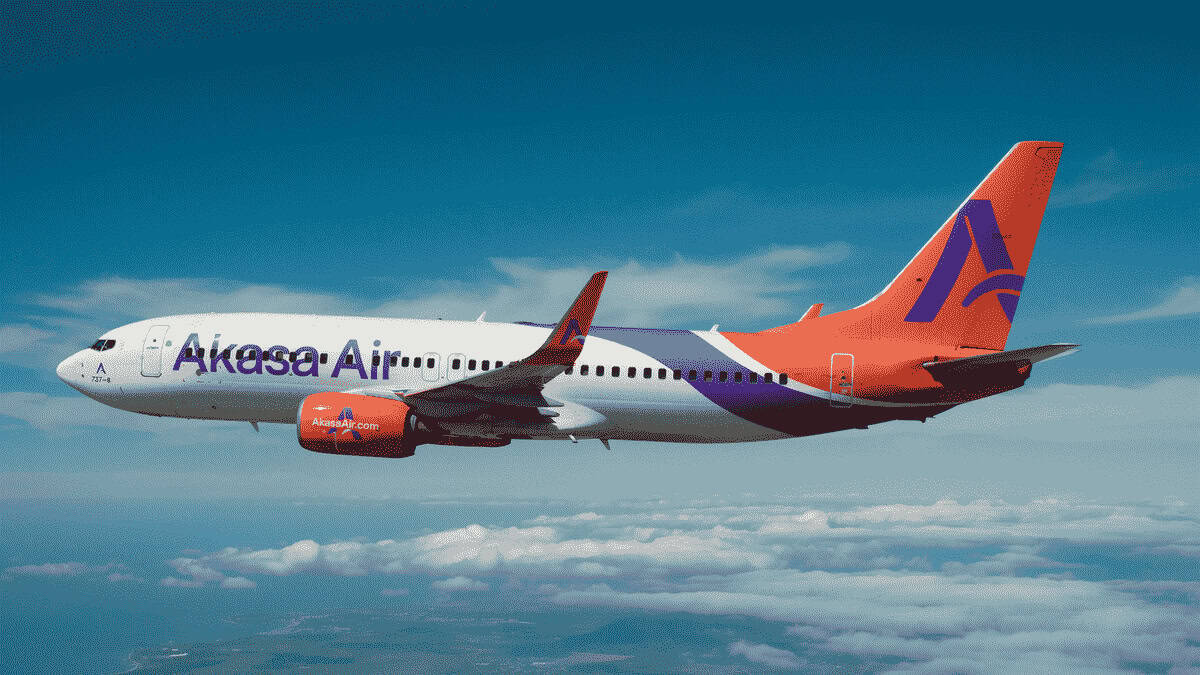
Image generated with Ai
Akasa Air has reached a defining moment in its rapid rise within Indian aviation after taking delivery of its 40th aircraft, a major milestone that significantly strengthens its operational footprint across domestic and emerging international markets. The airline, known formally as Akasa Air, continues to scale at a pace that places it among the most aggressively expanding carriers in the country.
The latest aircraft addition is a Boeing 737 MAX 8-200, registered as VT-YBQ. Its arrival at Kempegowda International Airport in Bengaluru marks not just a fleet expansion event but a clear signal of sustained capacity-building in one of India’s most competitive aviation environments.
Advertisement
This delivery pushes Akasa Air further along its structured growth roadmap, reinforcing its ambition to build a modern, fuel-efficient, and high-frequency network that connects key Indian cities while gradually expanding international reach.
Reaching a 40-aircraft fleet is a significant operational benchmark for any airline, especially one as young as Akasa Air. The airline has achieved this in a relatively short span, reflecting strong capital backing, consistent aircraft induction planning, and high market demand for affordable air travel in India.
Advertisement
Each new aircraft is not just an addition to the fleet but a direct enhancement of the airline’s scheduling power. With more aircraft available, Akasa Air is able to increase frequencies on high-demand routes, reduce turnaround pressure, and improve overall network reliability.
This milestone also demonstrates a disciplined fleet strategy centered entirely on the Boeing 737 MAX family, enabling operational standardisation, simplified training, and efficient maintenance systems.
The arrival of the latest aircraft at Kempegowda International Airport in Bengaluru highlights the airport’s growing importance in Akasa Air’s network architecture. Bengaluru functions as one of the airline’s core operational bases, supporting both aircraft rotations and network distribution across southern and western India.
This strategic hub positioning allows the airline to efficiently connect metro cities with emerging Tier-2 and Tier-3 destinations. It also improves aircraft utilisation rates, which is a critical performance metric for low-cost carriers operating in highly competitive markets.
Advertisement
Advertisement
As passenger demand continues to rise in India’s aviation sector, Bengaluru’s role as a gateway hub ensures smoother connectivity flows and more flexible scheduling options for travellers.
At the heart of Akasa Air’s expansion strategy lies its exclusive reliance on the Boeing 737 MAX family, particularly the MAX 8-200 variant. This aircraft is designed for higher seating capacity and improved fuel efficiency, two essential factors for cost-competitive airline operations.
The aircraft’s modern design allows airlines to reduce fuel consumption per seat, thereby improving operational economics while maintaining competitive fare structures. This efficiency advantage is crucial in India’s price-sensitive aviation market.
By standardising its fleet around a single aircraft family, Akasa Air is also simplifying pilot training, maintenance logistics, and spare parts management, all of which contribute to lower long-term operational complexity and higher reliability.
India’s aviation sector is currently experiencing strong growth momentum driven by rising middle-class travel demand, improved regional connectivity, and increasing affordability of air travel. Within this environment, Akasa Air has positioned itself as a high-growth low-cost carrier.
The airline’s steady fleet expansion reflects this demand surge, with increased aircraft numbers allowing it to open new routes and strengthen frequency on existing corridors. This expansion is particularly important in a market where seat demand often outpaces supply during peak travel seasons.
The 40th aircraft milestone is therefore not an isolated achievement but part of a broader structural shift in Indian aviation, where new-age carriers are rapidly scaling to capture untapped travel demand.
With each new aircraft induction, Akasa Air enhances its ability to serve a wider network of destinations across India. The increased fleet size directly translates into more daily departures, improved connectivity between secondary cities, and better schedule flexibility for passengers.
This expansion strategy also supports improved aircraft utilisation, allowing the airline to maximise operational hours while maintaining efficiency. High-frequency operations on popular routes help the airline strengthen its competitive positioning against established domestic carriers.
As capacity increases, passengers benefit from more options, reduced congestion during peak hours, and improved reliability in flight availability across key routes.
Although primarily a domestic-focused carrier, Akasa Air’s growing fleet also lays the foundation for gradual international expansion. Short-haul international markets in South Asia, the Middle East, and Southeast Asia are natural extensions of its current network.
The Boeing 737 MAX aircraft enables medium-range operations, making it suitable for future cross-border routes. As additional aircraft are inducted, the airline gains the operational flexibility required to expand beyond India’s borders in a controlled and scalable manner.
This step-by-step expansion approach ensures that international growth is supported by sufficient fleet strength and operational maturity.
Fleet expansion is not only about scale but also about improving passenger experience. Newer aircraft such as the Boeing 737 MAX offer quieter cabins, improved seating layouts, and more efficient onboard systems, all of which contribute to a better travel experience.
For Akasa Air, maintaining a young and modern fleet also enhances brand perception in a highly competitive market where customer expectations continue to rise. Reliability, comfort, and punctuality remain key differentiators in India’s low-cost aviation sector.
The airline’s continued investment in modern aircraft ensures that it remains aligned with global aviation standards while catering to the evolving needs of Indian travellers.
The induction of Akasa Air’s 40th aircraft marks more than a numerical milestone. It represents a broader transformation in India’s aviation landscape, where new carriers are rapidly scaling to meet unprecedented travel demand.
With a focused fleet strategy, strong operational hubs, and a clear expansion roadmap, Akasa Air continues to position itself as one of the most dynamic players in the country’s aviation ecosystem. The latest Boeing 737 MAX delivery reinforces that trajectory, setting the stage for further growth in both domestic and international markets.
Akasa Air expands its travel network with the induction of its 40th Boeing 737 MAX, as the new aircraft significantly boosts fleet capacity, strengthens Bengaluru operations, and supports the airline’s rapid growth strategy across India’s domestic and emerging international routes.
As India’s air travel market continues to expand, fleet milestones like this highlight the accelerating pace of competition, capacity growth, and connectivity development across the region.
Advertisement
Advertisement
Advertisement













Saturday, September 5, 2026

Friday, September 4, 2026

Saturday, September 5, 2026

Friday, September 4, 2026

Thursday, September 3, 2026

Wednesday, September 2, 2026

Friday, September 4, 2026