
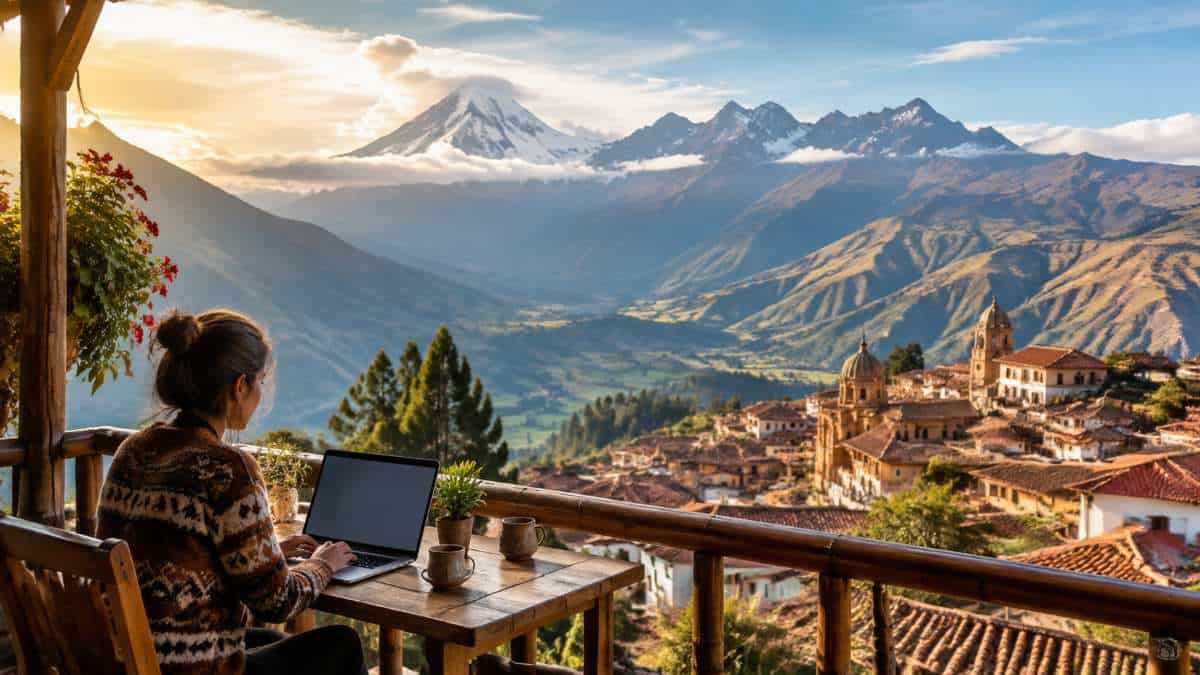
Image generated with Ai
Colombia, Ecuador, Peru and Chile are unfolding as one of the world’s most defining remote-work tourism corridors in 2026, building a linked route across South America’s Pacific edge where digital nomads can now live, work and travel for some extended time. Expanding from Medellín and Bogotá in Colombia through Quito, Cuenca, Lima, Cusco and finally Santiago and Valparaíso in Chile, the Andean Remote-Work Corridor keeps flexible residency options, affordable living costs, reliable digital infrastructure and a unique overland travel experience across the Andes mountain chain. The corridor has earned momentum as remote professionals rapidly search destinations that offer more options than just holidays. The remote professional population has begun to choose destinations with more than just vacation opportunities. Traditionally, digital nomads would travel to distant locales, only to spend a few days or weeks in each one before moving on. Now, they can work remotely and stay in a new location for months at a time, all while exploring the local culture and work opportunities that the place has to offer. The route marries professional and personal opportunities, covering valleys, ancient cities, and urban areas with extensive options for work.
This route offers remote workers the opportunity to conveniently adjust to the working hours of their employers. Because of the time zones of Colombia, Ecuador, and Peru, they have more direct working hours compared to the employers in the United States and Canada. Because of this, remote workers do not have to adjust to working late at night. Improving transportation and fiber networks, coworking space investment, and remote work visa programs in the Andean countries, coupled with work-based immigration in Colombia and Ecuador and a supportive law in Peru and Chile, allow remote workers to legally work in those countries. The tourism industry also benefits from this change. Traditional vacationers are less likely to make multi-month reservations, however, remote working digital nomads are more likely to stay for longer, supporting the local economy.
The popularity of the Colombia-to-Chile route is closely connected to the global rise of slow travel. Remote professionals now have the flexibility to remain in destinations for weeks or months, creating demand for places that combine lifestyle quality, affordability and connectivity.
The Andean corridor stands apart because travellers can move continuously across four countries without depending entirely on flights. The route follows one of the most dramatic landscapes on Earth, allowing visitors to transition from Colombia’s green mountain valleys to Ecuador’s volcanic highlands, Peru’s ancient Incan regions and Chile’s modern cities and desert landscapes.
Advertisement
The corridor offers several advantages that match the needs of digital nomads:Advantage Why It Matters Time-zone alignment Matches US Eastern and Central working hours Lower living costs More affordable than many North American and European destinations Long-stay options Colombia and Ecuador provide dedicated remote-work visas Reliable connectivity Fibre internet and mobile networks support professional work Overland mobility Buses and border routes allow affordable slow travel Diverse experiences Combines culture, nature, adventure and urban lifestyles
The route also benefits from the Pan-American Highway network, which connects many major cities along the western side of South America. Private bus companies and regional transport operators have made long-distance travel easier for international visitors who want to combine professional commitments with exploration.
Colombia has become the natural starting point for many remote workers entering the Andean corridor. The country has built one of the strongest digital nomad ecosystems in South America, supported by international connectivity, affordable living expenses and established foreign communities. The main remote-work destinations include Medellín, Bogotá and Manizales, each offering a different lifestyle experience. Medellín remains the country’s leading digital nomad hub. Often recognised for its year-round spring-like climate, the city provides comfortable temperatures generally ranging between 22°C and 28°C. The destination’s transformation from an industrial centre into a technology and innovation hub has helped attract entrepreneurs, freelancers and international companies.
Neighbourhoods such as El Poblado and Laureles have become major centres for remote workers. These areas provide coworking spaces, international restaurants, modern accommodation and cafés designed for professionals who work online. The city also benefits from strong digital infrastructure. Fibre-optic internet services are widely available, while mobile connectivity supports remote work requirements across urban areas.
Advertisement
Advertisement
Bogotá plays a different but equally important role. As Colombia’s capital and largest transport hub, the city provides direct international connections through El Dorado International Airport. It is particularly attractive for professionals who prefer a major business environment with access to corporate networks, cultural attractions and government institutions.
Colombia is among the regional leaders in creating a dedicated remote-work immigration system. The Visa V Nómadas Digitales, established through Resolution 5477, allows eligible foreign remote workers to remain in the country for up to two years. The visa is designed for individuals who work remotely for foreign companies, operate international freelance businesses or provide digital services outside Colombia.
Applicants must demonstrate:
The required income level is approximately around $1,400 USD per month, depending on annual minimum wage changes. After entering Colombia, visa holders must obtain a Cédula de Extranjería, which serves as official foreign resident identification. This combination of legal access, affordability and lifestyle appeal has helped Colombia establish itself as the northern anchor of the Andean remote-work journey.
Continuing south, Ecuador has become one of the most attractive destinations within the corridor due to its dollar-based economy, affordable lifestyle and strong residency benefits. The country offers a different experience compared with Colombia. While Medellín provides a vibrant urban environment, Ecuador attracts remote workers looking for stability, nature and slower-paced living.
The main destinations include Quito, Cuenca and Baños. Quito, located at approximately 2,850 metres above sea level, combines historic architecture with modern services. The capital provides international airport access, coworking spaces and reliable internet infrastructure. Cuenca has become particularly popular among long-term international visitors. The city offers a UNESCO-listed historic centre, walkable neighbourhoods, lower costs and a relaxed atmosphere. It has developed a reputation as one of Ecuador’s strongest destinations for travellers seeking a balance between comfort and cultural immersion. Baños provides another option for remote workers who prefer nature-based lifestyles. Surrounded by mountains, waterfalls and outdoor activities, the destination represents the growing demand for work-and-adventure travel.
Ecuador’s Rentista para Trabajo Remoto visa has strengthened its position in the digital nomad market. The programme provides:Category Details Visa name Rentista para Trabajo Remoto Maximum stay Up to two years Income requirement Approximately $1,446 USD per month Major advantage US dollar economy Residency pathway Potential permanent residency after 21 months
The dollarised economy is a major attraction because international visitors avoid exchange-rate uncertainty. For remote workers earning foreign currency, this provides greater financial predictability. Ecuador also connects efficiently with neighbouring countries, allowing travellers to continue south through established overland routes.
Peru represents the cultural centre of the Andean corridor, combining ancient history, world-famous cuisine and dramatic natural landscapes. The country’s remote-work destinations include Lima, Arequipa, Cusco, the Sacred Valley and Pisac. Lima serves as the main international gateway and business centre. The districts of Miraflores and Barranco have become popular among remote workers due to their modern infrastructure, restaurants, accommodation options and strong internet connectivity. The city’s culinary reputation adds another attraction. Remote workers can maintain professional schedules while experiencing one of the world’s most recognised food destinations.
Further inland, Cusco and the Sacred Valley attract travellers seeking a deeper connection with nature and history. Cusco’s position as the former capital of the Inca Empire provides access to major cultural attractions, while nearby communities such as Pisac offer quieter environments suitable for longer stays. However, altitude remains an important consideration. Cusco sits at approximately 3,400 metres above sea level, meaning visitors may need time to adjust before returning to intensive work schedules.
Peru has taken steps toward creating a formal digital nomad visa through Legislative Decree 1582. However, the required immigration procedures have not yet been incorporated into the official administrative system. As a result, remote workers currently depend on existing tourist entry conditions, generally allowing stays between 90 and 183 days depending on immigration rules. Despite the lack of an active digital nomad visa, Peru remains highly attractive because of its cultural value and overland connectivity.
Peru has developed one of the corridor’s strongest travel networks through services such as Peru Hop.
The hop-on-hop-off model connects:
Lima → Paracas → Huacachina → Arequipa → Lake Titicaca → Cusco
These services provide flexible travel options, hotel pickup facilities, onboard charging, Wi-Fi availability and English-speaking assistance. Premium bus operators such as Cruz del Sur also provide comfortable long-distance connections with executive seating suitable for overnight journeys.
Chile represents the final stage of the Andean Remote-Work Corridor and provides some of the strongest infrastructure conditions in South America. The country’s leading destinations include Santiago, Valparaíso and Pucón. Santiago offers a modern urban environment with excellent transport, advanced digital infrastructure and some of the fastest internet speeds in Latin America.
The city’s coworking ecosystem, reliable public transportation and business services make it suitable for remote professionals who require a highly developed working environment. Valparaíso provides a different experience with coastal scenery, historic neighbourhoods and creative industries. The destination attracts visitors seeking a balance between professional productivity and lifestyle experiences.
Unlike Colombia and Ecuador, Chile does not currently operate a dedicated digital nomad visa.
Remote workers generally use:
Although Chile has higher living costs compared with other countries along the corridor, it offers advantages through modern infrastructure, safety and internet performance.
A defining feature of the Andean corridor is the ability to travel gradually across countries by land.
Important border crossings include:Connection Border Route Colombia–Ecuador Ipiales–Tulcán through Rumichaca Bridge Ecuador–Peru Huaquillas–Tumbes or Macará–Zapotillo Peru–Bolivia Desaguadero or Lake Titicaca route Peru–Chile Tacna–Arica Santa Rosa–Chacalluta crossing
Long-distance companies including Peru Hop, Cruz del Sur, Flota Imbabura and other regional operators support international movement. For digital nomads, this creates a unique travel model where transportation becomes part of the experience rather than simply a way to reach the next destination.
Reliable internet has become one of the most important requirements for remote-work tourism. Across major cities in Colombia, Ecuador, Peru and Chile, visitors can access:
Starlink coverage has also expanded across rural areas, allowing remote workers to remain connected in locations such as Peru’s Sacred Valley, Ecuador’s mountain regions and Chile’s remote landscapes. Regional mobile providers including Claro, Movistar and Entel provide additional connectivity options, while eSIM services allow travellers to maintain mobile data access across borders.
| Destination | Estimated Monthly Cost | Internet Quality | Main Appeal |
|---|---|---|---|
| Medellín, Colombia | $1,200–$1,800 | High | Social urban lifestyle |
| Cuenca, Ecuador | $1,000–$1,500 | High | Affordable historic living |
| Cusco, Peru | $900–$1,400 | Moderate to High | Culture and adventure |
| Santiago, Chile | $1,800–$2,500 | Very High | Modern infrastructure |
| Destination | Best Period | Conditions |
|---|---|---|
| Medellín | December–March, July–August | Mild weather and lower rainfall |
| Quito/Cuenca | June–September | Highland dry season |
| Cusco/Sacred Valley | May–October | Best trekking and outdoor conditions |
| Lima | December–April | Sunny coastal summer |
| Santiago | October–April | Spring, summer and autumn |
The Colombia to Chile Andean Remote Work Corridor is one of the most exciting new developments for South American tourism. Built for the modern traveler, it has characteristics such as flexible transit, affordable living, convenience, cultural interest, and authenticity. Colombia, Ecuador, Peru, and finally Chile provide strong infrastructure, residency, culture, and digital nomad foundations respectively. As remote work redefines global tourism, the Andes are now much more than a destination. They are a connected workspace where professionals can live, work, and travel across one of the most incredible regions in the world.
Advertisement
Tags: Andean remote work corridor, Andes travel route, Colombia digital nomad visa, Colombia remote work, Digital nomad destinations
Advertisement
Advertisement













Saturday, September 5, 2026

Friday, September 4, 2026

Saturday, September 5, 2026

Saturday, September 5, 2026

Thursday, September 3, 2026

Wednesday, September 2, 2026

Saturday, September 5, 2026

Saturday, September 5, 2026


