
Ireland Stands Alongside Cyprus and Others as Schengen EES Exposes Different Passport Rules for Travel

Updated
Published
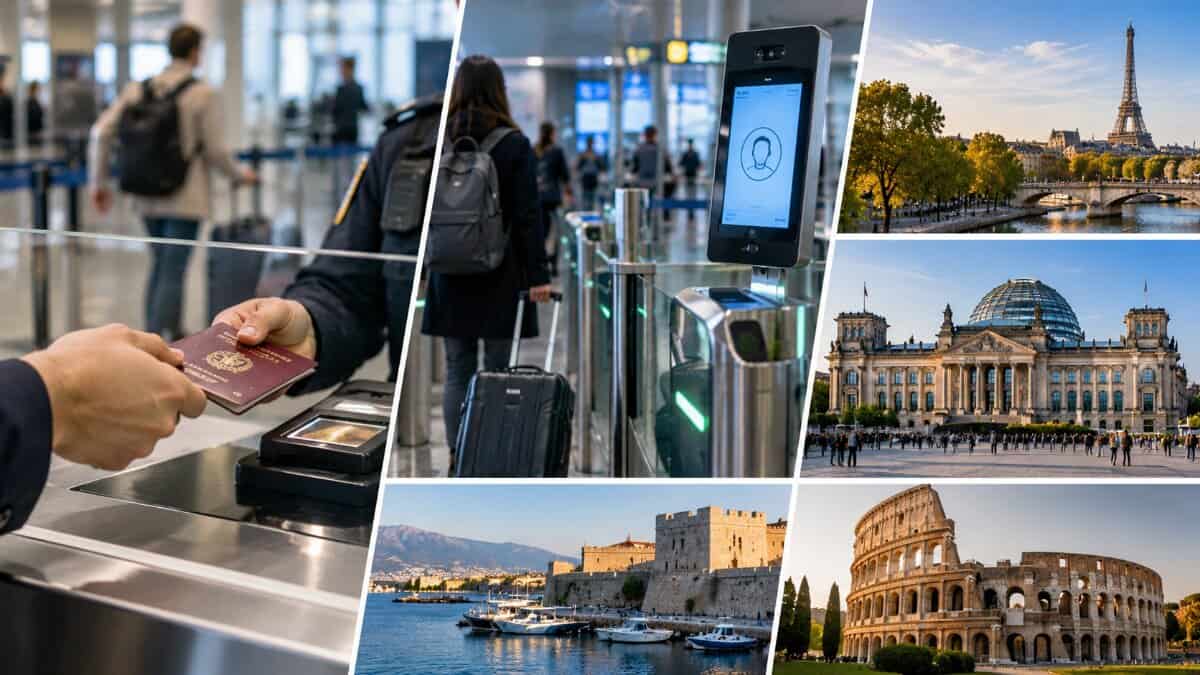
Europe’s digital border system has entered a new operational stage, but passport rules still divide five EU destinations. Since 7 October, carriers serving the Schengen area have no longer been required under the EES transition to verify old passport stamps. Digital checks on applicable single- and double-entry visas remain mandatory. France, Germany and Italy use the Entry/Exit System at external Schengen borders. Ireland and Cyprus do not. For non-EU travellers, differences affect visas, residence permits and authorised stays.
October 2026 Brings a Fresh Passport-Check Deadline, Not a New Border Law
According to the EU agency eu-LISA, airlines, sea carriers and qualifying international coach operators were required to use its Carrier Interface from 10 April 2026. The service helps check whether someone travelling with a Schengen short-stay visa allowing one or two entries has already used those entries. Carriers also had to inspect passport stamps until 6 October 2026; that extra obligation has ended.
Advertisement
Advertisement
This distinction matters. The deadline ended a carrier obligation, not immigration controls, visas or passport requirements. Airlines must still examine the travel documents needed for the journey, while Schengen border authorities continue to decide admission. The carrier response does not calculate remaining Schengen days. Travellers can consult the separate official EES authorised-stay tool. A successful boarding check does not guarantee permission to enter or remain.
EES began on 12 October 2025 and became fully operational on 10 April 2026. The October deadline marked the end of an additional verification period, not another EES launch.
Advertisement
Advertisement
Five EU Countries, Two Border Systems and Different Visa Outcomes
All five countries belong to the EU, but membership alone does not determine EES coverage. Ireland and Cyprus retain separate checks.
| Country | EES position in October 2026 | Passport-stamping position | Practical consequence for visitors |
|---|---|---|---|
| Ireland | Does not operate EES | National entry stamps remain applicable | Check Irish entry permission and visa rules separately |
| Cyprus | Does not operate EES | National entry stamps remain applicable | Check Cyprus entry rules and its separate stay allowance |
| France | Operates EES at Schengen external borders | Digital registration replaces routine EES-covered stamps | External arrival or departure may generate an EES record |
| Germany | Operates EES at Schengen external borders | Same digital treatment for covered travellers | Schengen-wide stay calculation includes days in Germany |
| Italy | Operates EES at Schengen external borders | Same digital treatment for covered travellers | Leaving Italy for Ireland or Cyprus triggers a Schengen exit |
EES covers most non-EU short-stay visitors, whether visa-required or visa-exempt. It records travel-document details, facial images, fingerprints where required, entry and exit dates and refusals of entry. EU, Icelandic, Liechtenstein, Norwegian and Swiss nationals are excluded. Further exemptions apply.
Advertisement
Advertisement
Ireland and Cyprus Share an EES Exception but Not the Same Visa Policy
Ireland is outside Schengen and operates separate immigration arrangements alongside its Common Travel Area with the UK. Irish immigration guidance confirms that visitors entering Ireland directly are not registered through EES. For covered non-EU arrivals receiving permission, Irish officers issue landing stamps showing stay conditions, normally up to three months for short visits.
Cyprus is in a different legal position. It is an EU member preparing for full Schengen integration but does not yet operate EES. Its national border checks and applicable stamps continue. A Cyprus national visa or ordinary residence permit is not automatically a Schengen visa or Schengen residence permit.
Visa recognition is one-way. The Cyprus government recognises certain valid double- or multiple-entry Schengen visas for short visits to Cyprus, subject to nationality-specific exclusions and other entry conditions. That does not mean a Cyprus visa gives its holder the right to enter France, Germany or Italy. Nor does possession of a Schengen visa normally replace the need to establish whether an Irish visa is required. Requirements depend on nationality, documents and itinerary.
Irish and Cypriot Residence Permits Carry an Overlooked EES Risk
The European Commission clarified a crucial exemption on 27 July 2026. Non-EU nationals holding long-stay visas or residence permits issued by countries operating EES generally do not have to register in the system. But holders of ordinary residence permits or long-stay visas issued by Ireland or Cyprus are registered when travelling to participating Schengen countries, unless another personal exemption applies.
That means an ordinary Irish residence permit cannot be treated in the same way as a French or German residence permit at an external Schengen border. Likewise for Cyprus. Qualifying non-EU family members of EU or associated-country citizens may be exempt. Ireland’s immigration authority also highlights special conditions for relevant Withdrawal Agreement documents. Agents must verify the permit’s legal category, not merely its EU origin.
One Holiday May Contain Separate Schengen, Irish and Cypriot Stay Clocks
Under the Schengen Borders Code, eligible short visits to EES-operating countries are calculated together within a rolling 90-day period across any 180 days. Ireland and Cyprus do not form part of that combined calculation. Their periods are assessed separately. Leaving Schengen does not erase previously used days.
Advertisement
Advertisement
Consider a visa-compliant visitor who spends 30 days across France, Germany and Italy, then 12 days in Cyprus and seven in Ireland. Returning to France, those 30 Schengen days still count. Assuming no other stays, 60 Schengen days remain in that window. The Cyprus and Ireland days have not been added to the Schengen total. The return trip can nevertheless demand another permitted Schengen visa entry if the visitor is visa-required.
Movement between France, Germany and Italy normally does not create fresh EES entry records because those journeys are within Schengen. A flight from Italy to Cyprus or Ireland crosses the Schengen external boundary and generates an EES exit for a covered traveller; a subsequent arrival from either destination in France generates an EES entry. Temporary internal police checks do not themselves create EES entry records.
Airports, Carriers and Travel Technology Face Different Operational Tasks
France’s Interior Ministry reports that optional, free EES pre-registration devices have been installed at 25 major French airport, seaport and railway locations. Germany’s Federal Police confirmed nationwide EES operation at its air and sea external borders in April 2026; its EasyPASS automated border-control network includes 255 lanes across listed airports, not 255 dedicated EES kiosks. Italy’s government confirmed the replacement of routine passport stamps for eligible Schengen border crossings in April.
The Carrier Interface is not a travel-history portal. Eu-LISA says it provides the limited result necessary to check whether a one- or two-entry visa has already been used, without disclosing the traveller’s full history or the remaining lawful days. Its guidance distinguishes departures towards Ireland, where EES carrier queries are not required, from qualifying journeys from Ireland into Schengen, where they may be compulsory. Cyprus-to-Schengen journeys with covered single- or double-entry visas can also require a query.
For agents, the decisive border is the external Schengen crossing. Screening and connection planning must account for first-time biometrics.
Official Tourism Figures Show Why the Five-Country Split Matters Commercially
Eurostat reported 1.321 billion tourist-accommodation nights across the EU in the first half of 2026, up 1.7 per cent year on year. Ireland recorded 14.6 per cent growth in such nights, while Cyprus recorded a 7.7 per cent decline. Non-resident guests represented 92.6 per cent of Cypriot nights, compared with 18.5 per cent in Germany. These are accommodation figures, not EES registrations, and show no causal link to passport policy.
Advertisement
Advertisement
| Official indicator | Latest confirmed reference period | Relevance to visa and passport planning |
|---|---|---|
| EES entries and exits exceeded 150 million | European Commission, 6 August 2026 | Shows system scale, not unique visitor numbers |
| EU accommodation nights: 1.321 billion, up 1.7% | Eurostat, first half of 2026 | Shows travel demand behind border operations |
| Ireland accommodation nights: up 14.6% | Eurostat, first half of 2026 | Highlights growing visitor-service demand outside EES |
| Cyprus accommodation nights: down 7.7%; 92.6% from non-residents | Eurostat, first half of 2026 | Shows overseas-market dependence without implying EES causation |
| Germany: 18.5% of nights from non-residents | Eurostat, first half of 2026 | Shows a different visitor mix within EES territory |
Industry Analysis: The Real Problem Is a Mismatched Document Journey
The overlooked business risk is not simply whether a border guard stamps a passport. It is the gap between four decisions made at different points: whether a traveller needs a national visa, whether a Schengen visa still permits another entry, whether a residence document exempts its holder from biometric registration and whether enough permitted days remain. A package can pass its initial airline check and still face a problem at the next border. Conversely, a traveller leaving Schengen for Cyprus may lawfully spend time there without consuming the same Schengen allowance, yet need a second visa entry to return. This makes five-country itineraries unusually dependent on clear pre-sale advice. Tour operators should build country-specific eligibility checks into booking workflows and train staff to distinguish permission to board, permission to enter and permission to remain. This does not prove system failure. Digital borders remain distinct from uniform European visas.
ETIAS Adds a Future Difference, but Has Not Started
Another distinction is already built into the proposed travel-authorisation map. The future ETIAS scheme includes Cyprus among 30 destinations, but excludes Ireland. France, Germany and Italy are also within its future scope. ETIAS is intended for eligible visa-exempt non-EU travellers and is separate from EES border registration. As at 15 October 2026, the European Commission’s official portal states that ETIAS is not operating and is not taking applications. The EU previously targeted late 2026, but no launch date or applications should be assumed.
Critical Operational Steps for Travel Agents and Tour Operators
- Classify each stop as Schengen EES territory, Ireland or Cyprus before issuing itinerary documents.
- Check passport nationality, visa category, entry count, expiry date and any national Cyprus or Irish requirements.
- Separate ordinary Irish or Cypriot residence permits from qualifying family-member or Schengen-issued exemptions.
- Recalculate rolling Schengen days after each visit; never assume a short exit resets the 90-day allowance.
- Apply digital carrier checks to eligible one- and two-entry Schengen visas, without treating the result as a guarantee of admission.
- Allow for biometric processing at the first relevant external border and maintain a document-resolution procedure for complex bookings.
- Monitor only official EU announcements before adding future ETIAS requirements to traveller communications.
What Happens Next for European Border Compliance
Europe is moving towards digital identification, not uniform passport rules. Eu-LISA will continue monitoring EES performance and publishing aggregated statistics. Cyprus is expected to remain on a different EES footing until its Schengen status changes, while Ireland retains separate border arrangements. Tourism businesses will benefit more from accurate screening than promises of universally stamp-free travel. Travellers still need to understand which border they are crossing, which document permits entry and which national stay clock applies.
FAQs
Does EES apply to France, Germany and Italy?
Yes. Eligible non-EU short-stay travellers are registered when crossing their external Schengen borders, not routinely on journeys between the three countries.
Do Ireland and Cyprus still stamp passports?
Yes, where their national immigration rules require a stamp. Neither operates EES, although the categories receiving stamps differ by traveller status.
Does an Irish or Cypriot residence permit avoid EES?
Not automatically. Ordinary permits do not create the general exemption enjoyed by qualifying permits from EES-operating countries. Some family-member exemptions apply.
Advertisement
Advertisement
Can a Schengen visa cover Cyprus and Ireland?
Some valid double- or multiple-entry Schengen visas are recognised by Cyprus, subject to conditions and exclusions. Ireland applies separate visa rules.
Has ETIAS already become mandatory in October 2026?
No. The official EU portal still says ETIAS is not operational. It is planned to include Cyprus and the Schengen countries, but not Ireland.
Advertisement
