
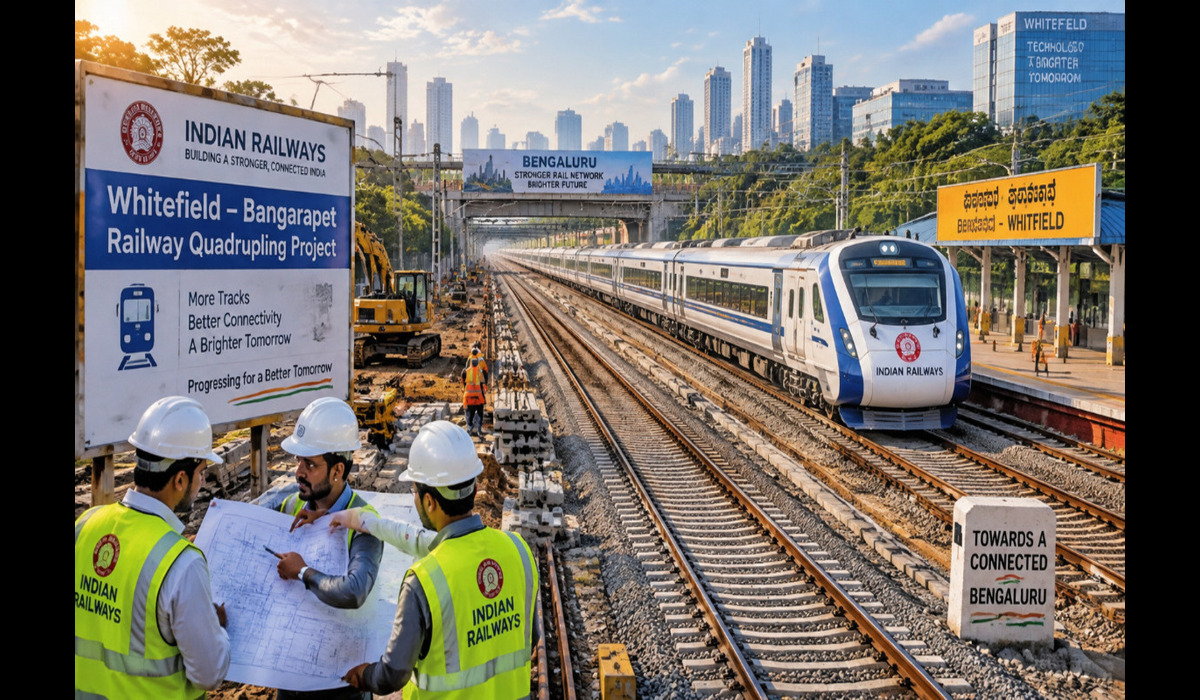
Image generated with Ai
The Whitefield-Bangarapet railway quadrupling project has been sanctioned in India as part of a large scale expansion of railway infrastructure in order to increase railway capacity within southern India worth ₹10,021 crore. The project was sanctioned by the Cabinet Committee on Economic Affairs (CCEA) on 9 September 2026 and includes the addition of the third and fourth railway lines on the 47 kilometres Whitefield–Bangarapet railway line in the state of Karnataka which will facilitate the connectivity of people commuting from Bengaluru.
The railway multitracking project is expected to alleviate congestion on one of the most important transport routes in Karnataka due to growing residential, industrial developments, and technological industries in Bengaluru. This project forms part of five railway multitracking projects sanctioned in total in Karnataka, Tamil Nadu, Andhra Pradesh and Telangana covering a distance of 540 kilometres.
The development means that there will be a long-term change in regional mobility for travelers who will benefit from the added operational capacity after the completion of the additional railway lines.
Bengaluru has experienced rapid urban expansion, especially in areas such as Whitefield, which has developed into one of the city’s largest technology and employment hubs. Thousands of residents travel daily between eastern Bengaluru, nearby towns and the city’s major employment centres.
Advertisement
Advertisement
The existing railway corridor has faced increasing pressure due to rising passenger demand and the need to balance commuter services with freight operations.
The project is expected to benefit passengers travelling from areas including Whitefield, Malur, Tyakal and Bangarapet, where daily movement towards Bengaluru has increased significantly.
The central government has approved the addition of two more railway lines between Whitefield and Bangarapet, converting the existing double-track corridor into a four-line section.
The project received approval along with four other railway multitracking initiatives under a combined investment package of ₹10,021 crore.
| Project Detail | Information |
|---|---|
| Project name | Whitefield–Bangarapet railway quadrupling |
| Location | Karnataka, India |
| Route length | 47 km |
| Expansion type | Third and fourth railway lines |
| Approval authority | Cabinet Committee on Economic Affairs |
| Approval date | 9 September 2026 |
| Part of package | Five railway multitracking projects |
| Total package investment | ₹10,021 crore |
| Completion target | Up to 2029–30 |
The project aims to increase capacity and improve operational efficiency along a route that serves both passenger and freight requirements.
The Whitefield–Bangarapet corridor plays an important role in connecting Bengaluru with eastern Karnataka and onward railway networks.
Currently, passenger trains and freight services share limited track capacity. Adding two more lines will allow railway operators greater flexibility when scheduling different types of trains.
The expansion could become especially important as Bengaluru continues attracting new residents, businesses and investments.
The Whitefield–Bangarapet project is only one part of a wider railway capacity-building programme covering four southern Indian states.
The five approved projects together cover 17 districts and will add around 540 kilometres to the railway network.
The government said these projects are designed to improve mobility, strengthen logistics efficiency and create additional capacity for passenger and freight transportation.
Improved railway connectivity can influence tourism by making destinations easier to access and encouraging travellers to explore areas beyond major cities.
The southern India railway expansion will improve connectivity to several important tourism and religious destinations, including locations such as Tirupati, Kolar Gold Fields, Hogenakkal Falls, Hosur Fort, Mettur Dam, Kodaikanal Hills and Sathyamangalam Wildlife Sanctuary.
For visitors exploring Karnataka and neighbouring states, expanded rail capacity could improve future travel choices.
The project is also important for freight transportation. Rail capacity improvements allow more efficient movement of goods, supporting industries and reducing pressure on existing routes.
The approved projects are expected to support transportation of commodities including coal, cement, iron and steel, containers, automobiles, food grains, petroleum products and fertilisers.
The expansion supports India’s broader strategy of using railway infrastructure to improve economic competitiveness.
The approval of the Whitefield–Bangarapet project does not immediately change existing train schedules. The project will move through planning, construction and implementation stages before passengers experience the full benefits.
Travellers should continue checking Indian Railways updates for current services.
The project is a long-term infrastructure investment designed to improve future travel reliability.
It is a railway expansion project adding third and fourth lines between Whitefield and Bangarapet in Karnataka.
The corridor expansion covers 47 kilometres.
The project is part of a ₹10,021 crore railway multitracking package approved by the government.
No. The project requires construction and implementation before additional railway capacity becomes available.
The wider package covers Karnataka, Tamil Nadu, Andhra Pradesh and Telangana, improving connectivity across southern India.
The approval of the Whitefield-Bangarapet railway quadrupling project is a significant step towards the enhancement of transport infrastructure in Karnataka state. The project entails the creation of two more railway lines on the 47 kilometres of rail tracks in an attempt to ensure smooth movement of passengers and minimize congestion.
The development is being conducted as part of the ₹10,021 crore expansion project of railways in southern India.
Advertisement
Advertisement
Advertisement













Thursday, September 10, 2026

Thursday, September 10, 2026

Thursday, September 10, 2026

Thursday, September 10, 2026

Thursday, September 10, 2026

Wednesday, September 9, 2026

Thursday, September 10, 2026
Thursday, September 10, 2026