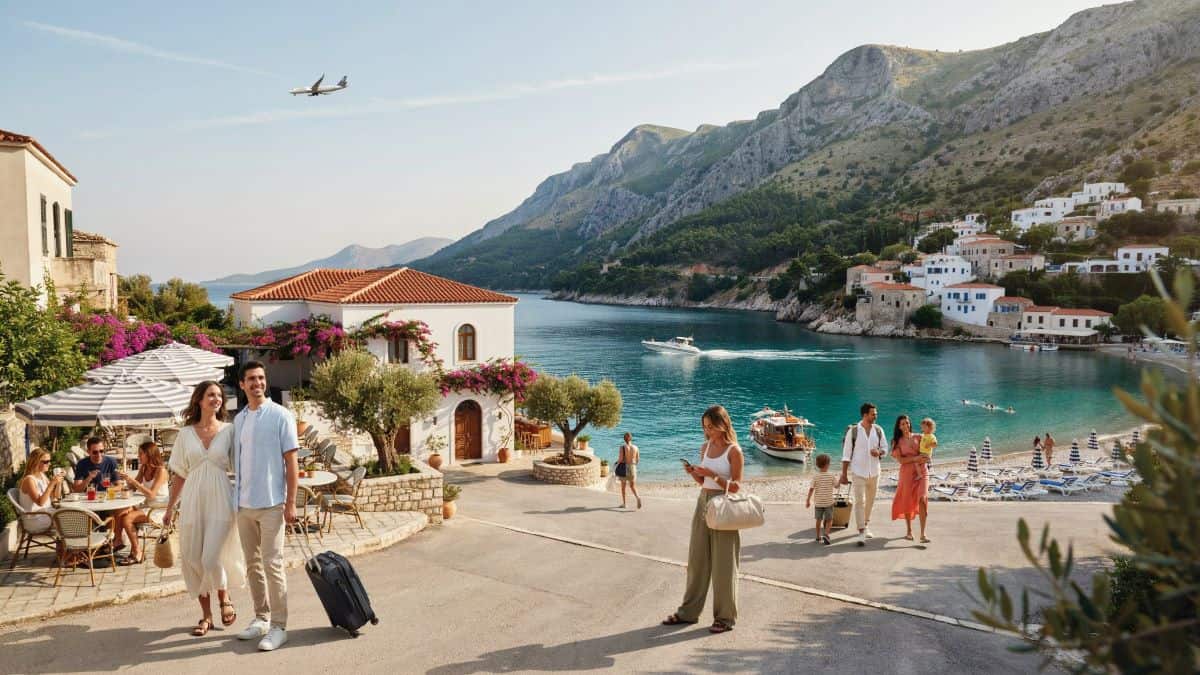
Image generated with Ai
In 2026, Albania is taking a step into the European tourism limelight. According to official statistics, tourist visitors to tourist accommodation facilities increased by 17.0% in June compared to the previous year, the country received 3,858,055 air passengers in the second quarter, a 26.4% increase from Q2 2025.
These two figures reveal the scale of the shift. More travellers are using Albania’s formal accommodation sector, airlines are carrying substantially more passengers, and international connectivity is widening as the summer travel season intensifies.
Yet the strongest insight lies beneath the headline numbers. Albania’s accommodation, aviation and border-entry indicators are growing at very different speeds. That does not weaken the tourism story. It shows that the country’s visitor economy is becoming more complex, with air access, overnight stays and cross-border movements each capturing a different part of Albania tourism growth in 2026.
| Tourism indicator | Latest official result | Annual change |
|---|---|---|
| Registered accommodation visitors | June 2026 | +17.0% |
| Air passengers | 3,858,055 in Q2 | +26.4% |
| Recorded flights | 23,216 in Q2 | Up from 18,458 |
| Foreign airlines operating | 33 in Q2 | Up from 29 |
| Foreign citizen entries | 1,346,279 in June | +1.3% |
| Total citizen entries | 2,081,649 in June | +0.9% |
| Albania real GDP | Q1 2026 | +3.71% |
Official figures: Albania’s Institute of Statistics, INSTAT, and government transport data.
Advertisement
June’s 17% rise in accommodated visitors did not arrive suddenly. Albania entered summer after recording positive annual accommodation growth in every month of the first half of 2026.
That sustained pattern matters because it points to demand stretching beyond a short peak-season boom.
Month Change in accommodated visitors January +15.1% February +9.7% March +20.8% April +19.7% May +12.4% June +17.0%
March delivered the strongest increase, at 20.8%, while April followed closely at 19.7%. Even February, the slowest month in percentage terms, remained firmly positive.
The pattern gives Albania a valuable advantage. Destinations that generate demand across several seasons can reduce their reliance on a narrow July-August window. If the trend continues, Albania could strengthen tourism activity during spring, autumn and eventually the wider year rather than concentrating growth almost entirely along the summer coastline.
Foreign visitors are helping drive the expansion.
INSTAT recorded a 23.7% increase in non-resident accommodated visitors in March and a 22.6% increase in April. Resident visitor growth remained positive but lower, at 15.9% and 12.9% respectively.
The international mix is also becoming increasingly relevant for Albania’s tourism strategy. January data showed Italy accounting for 25% of foreign accommodated visitors, followed by Kosovo at 14%, Germany at 6%, the United Kingdom at 5% and France at 4%.
That spread gives Albania access to both nearby regional markets and some of Europe’s largest outbound travel economies.
For the visitor economy, international overnight demand matters far beyond room sales. Travellers staying in a destination also spend on restaurants, transfers, attractions, excursions, cafés and local services. As a result, growth in foreign accommodated visitors can create a broader economic footprint than a simple border crossing alone.
Aviation is currently producing the most dramatic growth rate among Albania’s major travel indicators.
The country handled 3,858,055 air passengers in Q2 2026, compared with 3,052,511 in the same quarter of 2025. That represents an increase of more than 805,000 passengers in a single year.
Flight activity expanded alongside demand.
Albania aviation indicator Q2 2025 Q2 2026 Air passengers 3,052,511 3,858,055 Recorded flights 18,458 23,216 Foreign airline companies 29 33
This matters because accessibility can reshape how travellers perceive a destination. More flights and more airlines can widen origin markets, create additional itinerary options and make short breaks more practical.
The official figures do not prove that aviation growth directly caused the 17% accommodation increase. However, the simultaneous rise in passengers, commercial activity and registered stays strongly suggests that improved air access is helping Albania convert international interest into real travel demand.
INSTAT also recorded 121,684 aircraft movements in Albanian airspace, but 80.9% were overflights. Those movements should not be treated as visitor traffic entering Albania.
June’s border data tell a different story.
Albania recorded 2,081,649 entries by Albanian and foreign citizens, only 0.9% more than a year earlier. Foreign citizen entries reached 1,346,279, rising 1.3%, while Albanian citizen entries totalled 735,370.
June 2026 movement Number YoY change Total entries 2,081,649 +0.9% Foreign citizen entries 1,346,279 +1.3% Albanian citizen entries 735,370 +0.2% Total departures 2,008,987 +4.7%
At first glance, foreign entries rising only 1.3% may appear difficult to reconcile with accommodation growth of 17% and air passenger growth of 26.4%.
The explanation is methodological.
Border statistics count movements through Albania’s land, sea and air border points. A person who leaves and later re-enters may appear more than once. Accommodation statistics instead measure guests who stay at least one night in registered tourist establishments.
These figures therefore answer different questions.
The more revealing takeaway is that Albania’s formal accommodation economy is expanding far faster than its headline June border-movement figure. That may signal changes in traveller behaviour, accommodation choice or market composition, although further data on overnight stays and occupancy are needed before drawing a firm causal conclusion.
Albania’s visitor economy remains overwhelmingly connected to Europe.
Of the 1,346,279 foreign citizen entries recorded in June, some 1,249,278 came from Europe. Southern Europe generated 66% of European entries, while Central and Eastern Europe contributed another 14%.
Travel purpose also exposes the character of demand.
INSTAT reported that 98% of foreign citizen arrivals were for personal purposes. The category includes holidays, visits to friends and relatives, medical travel, religious journeys and transit.
Personal-purpose entries increased 1.6% year on year, while business and professional entries fell 17.7%.
For tourism planners, this provides a clear strategic signal. Albania’s current growth story depends heavily on leisure and personal mobility, particularly from nearby and wider European markets. Maintaining easy access, competitive air links and adequate accommodation capacity will therefore remain central to sustaining momentum.
Tourism’s influence increasingly extends beyond airports and accommodation establishments.
Albania’s real GDP grew 3.71% year on year in Q1 2026. The broad economic group covering trade, transport, accommodation and food services increased 1.61% and contributed 0.21 percentage points to total real GDP growth.
The 1.61% figure should not be labelled “tourism GDP growth” because the category includes several non-tourism activities. However, it confirms that accommodation and food services are expanding within a broader service economy that also supports visitor spending.
The Bank of Albania has provided another significant signal. It has identified tourism receipts among the sources contributing to stronger foreign-currency inflows in recent years, alongside remittances, foreign direct investment and labour income.
That places tourism in a much wider economic context. Every additional international stay can affect not only hotel occupancy but also restaurant revenue, transport demand, employment, foreign-exchange earnings and local business activity.
The headline figure needs careful interpretation.
INSTAT’s accommodation statistics cover registered tourism establishments including:
The survey follows methodology aligned with European tourism-statistics standards and covers registered establishments within the relevant statistical system.
Unregistered accommodation and its guests are not included.
For that reason, the most accurate statement is:
Visitors staying in Albania’s registered tourist accommodation increased 17% year on year in June 2026.
It would be inaccurate to automatically rewrite the figure as a 17% rise in Albania’s total international tourist arrivals.
That distinction is particularly important as short-term rental and informal accommodation markets grow across European destinations.
Albania is no longer producing just one encouraging tourism statistic. Its 2026 data show several parts of the travel economy advancing simultaneously.
The strongest signals are clear:
This combination gives Albania greater visibility within the competitive Mediterranean and Balkan tourism landscape.
The next challenge is more important than headline growth alone. Albania must turn rising traveller volumes into longer stays, stronger occupancy, greater visitor spending, wider regional distribution and sustainable tourism value.
The next official figures will show whether this momentum carries through Albania’s busiest summer period. INSTAT is scheduled to publish July 2026 citizen-movement statistics on 25 August, followed by July accommodation data on 17 September.
Those releases will matter because July provides a much clearer test of Albania’s ability to absorb peak-season demand.
For now, the evidence is compelling. Albania Tourism Surges in 2026 as Hotel Demand Rises by 17% and Air Travel Drives a Powerful Visitor Boom because registered stays are climbing, aviation is expanding at exceptional speed, international markets remain deeply engaged and tourism is becoming increasingly important to the wider economy.
The defining question for Albania is therefore shifting. It is no longer simply whether travellers are arriving. It is how effectively the country can turn that accelerating demand into lasting tourism value.
In conclusion, Albania tourism surges in 2026 as hotel demand rises by 17% and air travel drives a powerful visitor boom because several growth engines are moving together. Registered accommodation is attracting more guests, international travellers are supporting stronger hotel demand, and expanding airline activity is bringing far more passengers into the country. Air travel is fuelling Albania’s access to key European markets, helping tourism spread beyond traditional seasonal patterns. At the same time, official data show that accommodation growth, border movements and aviation demand measure different parts of the visitor economy. Together, they confirm a broader and connected tourism expansion.
Advertisement
Advertisement
Advertisement












Tuesday, September 8, 2026
Tuesday, September 8, 2026

Tuesday, September 8, 2026
Tuesday, September 8, 2026
Tuesday, September 8, 2026
Tuesday, September 8, 2026
Tuesday, September 8, 2026
Tuesday, September 8, 2026