
Vietnam Has Officially Built The Most Terrifyingly Epic Bach Long Bridge That Will Break Your Mind On Travel, Here’s The Latest Update

Published
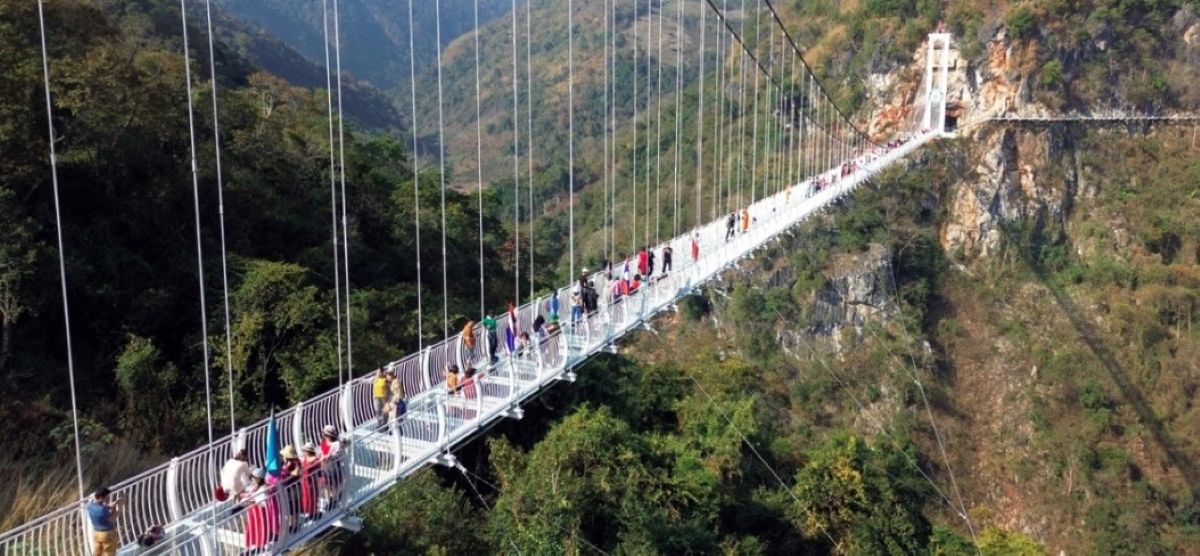
Image Credit Vietnam National Authority of Tourism
Imagine how it will feel to cruise down the world’s longest glass-bottomed bridge and stare straight down, picture yourself on the longest glass-bottomed bridge standing on a transparent surface 150 meters over a lush, jungle canyon. What will it feel like to break a bridge record and make people think about what is possible? While looking straight down. In China, the bridge record was once held. However, the Bach Long Bridge also serves the tea pickers, who have a unique and dangerous occupation. Dedicated, high-adrenaline travelers will be able to visit it. This record will appeal to travelers. to adventurers.
An Explanatory Introduction To Vietnam’s Record-Breaking Glass Marvel
Vietnam proudly showcases the Bach Long Bridge, located in the scenic district of Moc Chau, which holds the prestigious title from Guinness World Records as the world’s longest glass-bottom bridge. Furthermore, this colossal engineering structure surpassed previous height and length records held by similar installations in China. The magnificent transparent span stretches dramatically across a deep green valley, offering visitors an unparalleled bird’s-eye view of the natural landscape below. Consequently, adrenaline enthusiasts and vacationers from every corner of the globe are traveling to experience the thrill of stepping onto a completely transparent walkway elevated far above the forest floor. Meanwhile, hospitality analysts emphasize that this landmark significantly raises the global visibility of Northern Vietnam. Ultimately, the bridge demonstrates how modern structural engineering can revitalize local economies while creating unforgettable travel moments.
Advertisement
Advertisement
Developing high-altitude architectural marvels drastically alters how international travelers plan their journeys. People actively look for iconic, record-setting destinations that combine natural beauty with heart-pounding adventure. The emergence of Moc Chau as a major point of interest shows that travelers willingly venture past traditional urban centers. By providing an extraordinary sensory experience, the bridge motivates vacationers to explore hidden mountain regions across Southeast Asia.
Strategic Value For International Itineraries And Regional Travel Networks
Advertisement
Advertisement
Integrating globally recognized landmarks into multi-day tour schedules gives tourism providers a distinct competitive advantage in the global market. Modern vacationers consistently demand bucket-list experiences, and a certified record-holding structure serves as an irresistible focal point for promotional campaigns. Vacation packages featuring this unique bridge naturally stand out to travelers who seek out memorable, once-in-a-lifetime journeys.
Furthermore, introducing high-altitude glass walkways into standard journeys through Vietnam encourages international guests to extend their overall vacation length. Travelers who previously limited their visits to major urban hubs like Hanoi are now eager to journey farther north into rural mountain territories. This geographic expansion spreads economic benefits evenly, supporting small businesses, home-stays, and local guide services in isolated rural communities.
Elevating Moc Chau Into A Worldwide Destination For High-Impact Adventure
Traditionally famous for its picturesque tea plantations, misty hills, and mild climate, Moc Chau has swiftly converted into an international epicenter for high-thrill adventure tourism. The opening of a world-record facility attracts a broader demographic of global travelers who value active exploration over passive sightseeing. This massive surge in popularity revitalizes the local hospitality sector, driving fresh investments into regional roads, hotel accommodations, and public transportation networks.
Beyond providing immediate excitement, the massive transparent walkway inspires travelers to discover the broader cultural and ecological heritage of Northern Vietnam. Neighboring indigenous villages, cascading waterfalls, and mountain trekking routes benefit directly from the increased visitor traffic centered around the giant structure. Consequently, regional tourism experiences steady, sustainable economic development that empowers local residents for years to come.
Engineering Marvel Suspended High Above Northern Vietnam’s Natural Landscape
Advertisement
Advertisement
Architecturally, the glass bridge hangs boldly across a profound rainforest canyon, seamlessly joining two opposing mountain ridges in Son La province. Constructed using specialized, multi-layered tempered glass panels, the pathway offers exceptional transparency alongside uncompromising structural durability and safety. This combination of altitude, architectural scale, and rigorous safety design provides guests with an exhilarating yet completely secure trek over the canyon depth.
The sleek design of the transparent deck blends gracefully into the mountain scenery without spoiling the sweeping vistas of Moc Chau. Crossing the high-altitude bridge gives pedestrians the incredible sensation of floating through the air above the canopy. Thus, the structure stands as both a remarkable technical achievement and an immersive ecological adventure for curious travelers.
Global Tourism Shifts Toward Thrill-Seeking Infrastructure And Milestone Travel
The official recognition of the world’s longest glass-bottom bridge has created significant enthusiasm across the global hospitality sector. Modern tourists prioritize destinations that deliver both an intense surge of excitement and breathtaking, picture-perfect scenery. By eclipsing earlier engineering records established in China, the world-class facility in Moc Chau firmly establishes Vietnam as a leading destination for iconic adventure attractions.
This fundamental evolution in consumer interest reshapes travel routing on an international scale. Vacationers now seek out remote destinations in rural provinces like Son La to witness human engineering harmonious with raw nature. As a result, long-haul travel markets report rising demand for outdoor, nature-centered excursions in beautiful tropical locations.
Precise Structural Specifications and Engineering Tolerances Governing the Architectural Span
Advertisement
Advertisement
The structural engineering powering the Bach Long Bridge in Moc Chau represents an extraordinary application of modern physics, high-tensile material sciences, and precision load distribution. Spanning a total length of 632 meters (2,073 feet), the overall installation consists of two distinct segments: a 290-meter main cable-suspended bridge swinging dramatically across an open canyon, coupled with a 342-meter glass cliffside walkway attached directly to vertical rock faces. Elevated 150 meters (492 feet) above the forest floor, the primary walking deck measures 2.4 meters across, while the cliffside section narrows to 1.5 meters.
To achieve absolute transparency without compromising structural integrity, the walkway panels utilize three layers of specialized 40-millimeter-thick tempered glass produced by Saint-Gobain in France. The massive glass deck relies on two 30-meter-tall main anchoring towers supported by high-grade steel suspension cables imported from South Korea. Designed to comfortably bear continuous mechanical forces, the walkway safely accommodates 450 to 500 people simultaneously. Rigorous safety checks prior to the grand opening confirmed these structural tolerances, including stress tests where heavy sport utility vehicles were driven across the glass surface.
Comparative Dimensional Analysis and Asian Benchmark Standards in High-Altitude Glass Infrastructure
The official certification granted by Guinness World Records on April 30, 2022, marked a major shift in Asian civil engineering, allowing Vietnam to surpass former record holders in China. Prior to the completion of this monumental project in Son La province, the longest glass bridge title belonged to a 526-meter span situated in Qingyuan, Guangdong province. Another globally renowned predecessor was the 430-meter-long Zhangjiajie Grand Canyon glass bridge located in Hunan province.
Extending 632 meters from end to end, the Bach Long Bridge exceeds the Qingyuan structure by more than 100 meters, setting an unprecedented benchmark for transparent pedestrian pathways built across rugged mountain topographies. This architectural triumph effectively diverts global engineering attention and high-value international leisure tourism away from established sites in China, directing steady visitor flows straight into the scenic highlands of Northern Vietnam.
Economic Revenue Generation Models and Financial Projections Across Son La Province
Advertisement
Advertisement
The launch of this record-breaking glass installation has served as a powerful economic engine for commercial, hospitality, and transportation sectors throughout Moc Chau district and greater Son La province. Immediately following its public unveiling, the site recorded 4,000 visitors on day one, expanding past 15,000 visitors over its first three operational days. During high-demand travel seasons, such as the regional plum blossom bloom and major national holidays, daily attendance routinely swells between 10,000 and 20,000 people, generating roughly 1.2 trillion VND ($48 million USD) in quarterly tourism revenues.
Pricing structures are fixed at 550,000 VND ($22 USD) for adult weekday entry and 650,000 VND ($26 USD) during weekends and public holidays. These robust ticket sales provide reliable financial resources that directly fund local municipal projects, regional highway repairs, and long-term employment opportunities for native mountain communities.
Shifting Inbound Visitor Demographics and Global Geographic Migration Patterns
Tourism throughout Son La province has undergone a dramatic transformation, evolving from a modest domestic market into a thriving destination for international travelers. Historically, travel to Moc Chau consisted primarily of domestic weekend road excursions originating out of Hanoi, located roughly 200 kilometers (124 miles) to the east.
Following the bridge’s global debut, long-haul arrivals from Europe, North America, East Asia, and neighboring countries like Laos—situated merely 13 kilometers from the Moc Chau Island complex—represent a rapidly growing share of total visitors. During peak holiday periods, average accommodation occupancy across the region’s 300 lodging establishments hits 100% capacity, illustrating strong global demand for record-holding adventure destinations.
Transit Network Capacities and Infrastructure Expansion Mandates for Regional Highways
Advertisement
Advertisement
Welcoming a major international landmark into the rugged terrain of Northern Vietnam has placed substantial pressure on local roadway networks and inter-provincial transit lines. Traffic volume along National Highway QL6, the main arterial highway linking Hanoi to Moc Chau and Son La, increases heavily during peak weekend travel hours, with typical drive times ranging from 4 to 5 hours.
To streamline transit for incoming tourists, government transportation authorities are planning major roadway expansions, including upgraded express routes and smoother access roads leading into Muong Sang commune. These strategic infrastructure investments aim to shorten travel times, remove logistical bottlenecks, and optimize long-distance passenger transit efficiency across the northern provinces.
Environmental Protection Protocols and Ecotourism Footprint Management
Constructing high-capacity pedestrian infrastructure across delicate mountain ecosystems demands comprehensive environmental controls to prevent deforestation and habitat damage. The Bach Long Bridge stretches over a lush, ecologically rich rainforest gorge, suspended 150 meters above the canopy without disturbing native flora or fauna along the valley floor.
Ground disruption was strictly restricted to the precise mounting bases for the two 30-meter steel cable towers and rock anchor points. Furthermore, park management enforces strict operational controls, including mandatory one-way foot-traffic routes, strict daily visitor caps, and specialized waste collection systems designed to preserve surrounding ecosystems.
Synergistic Integration with Adjacent Cultural, Historical, and Natural Destinations
Advertisement
Advertisement
The Bach Long Bridge functions as an anchor attraction within a broad network of natural, historical, and cultural sites spread throughout Son La province. Pedestrians crossing the transparent path walk directly into Chim Than Cave (God Bird Cave), a historical karst cavern renowned for its intricate stalactites and rich native folklore.
Visitor traffic naturally spreads into surrounding attractions, including the multi-tiered Dai Yem Waterfall, over 3,000 hectares of rolling tea farms, traditional Thai ethnic villages in Ang village, and scenic trekking routes up Pha Luong mountain. This rich density of nearby activities motivates travelers to stay multiple days rather than making brief day trips.
Expansion of Hospitality Infrastructure and Real Estate Investment Growth Rates
Rising visitor numbers have triggered a commercial real estate boom and accelerated hospitality developments throughout Moc Chau. The region’s accommodation inventory, encompassing nearly 300 registered hotels, guesthouses, and eco-homestays, regularly reaches full capacity during peak seasons, driving strong demand for additional room inventory.
Standard homestay lodging rates ranging between 600,000 and 800,000 VND per night generate excellent yields for property owners, spurring capital investment into boutique eco-resorts and high-end mountain retreats. This influx of real estate development expands the regional economy beyond traditional farming, creating skilled career paths in hotel management, culinary arts, and professional tour guiding.
Real-Time Load Monitoring Systems and Severe Weather Safety Protocols
Advertisement
Advertisement
Operating a transparent pedestrian bridge suspended 150 meters in the air requires state-of-the-art monitoring technologies to ensure safety under harsh atmospheric conditions. The three-layer, 40mm French tempered glass panels feature shatter-proof interlayers constructed to withstand extreme heat, intense humidity, and torrential monsoon rains.
Integrated digital load sensors attached to the South Korean steel cables continuously monitor real-time weight distribution, ensuring total bridge weight stays well within safe operating limits. Site directors also enforce immediate operational closures during high winds, dense fog, or electrical storms, maintaining rigid safety protocols that protect international visitor confidence.
Re-anchoring Northern Vietnam’s Position Within Global Tourism Routes
Constructing a world-record architectural phenomenon in Son La province fundamentally alters tourist travel routes throughout Southeast Asia. Historically, international vacation itineraries across Vietnam focused almost exclusively on popular coastal and urban hubs such as Hanoi, Ha Long Bay, Hue, and Ho Chi Minh City.
The international acclaim surrounding the Bach Long Bridge encourages travel agencies to extend standard tour itineraries, guiding travelers inland toward northern mountain destinations. By establishing Moc Chau as a key mountain destination alongside Sapa, Vietnam successfully broadens its international appeal, fueling sustainable economic development across its northern interior.
The Final Verdict
Advertisement
Advertisement
Once you finish your long journey across Bach Long Bridge, you’ll see a glass ribbon suspended high over the Moc Chau canyon and something new and something profound will happen to you. It won’t be about the thrill from the 150 meter drop that you will be standing next to. It will be about spending time to realize that it is against nature and scale that something this magnificent will make people pause to consider the beauty of creation. Some people dare to dream and build and some people don’t. This deep, sweeping ribbon of glass will do much more than just span the two peaks of the Son La mountain range. This ribbon will connect the traditional rural region and a more interactive, instant world. You will come to understand that this ribbon is as much about design as it is location.
When the sun sets and the mist blankets the land, Vietnam has once again proven itself by building yet another extraordinary structure with no relation to the posing contests of world record breaking. Vietnam has built a place where dreamers standing side by side in the air can breathe and be alive. The bumper will calm itself but the feeling of being above the clouds will never fade.
Advertisement
