
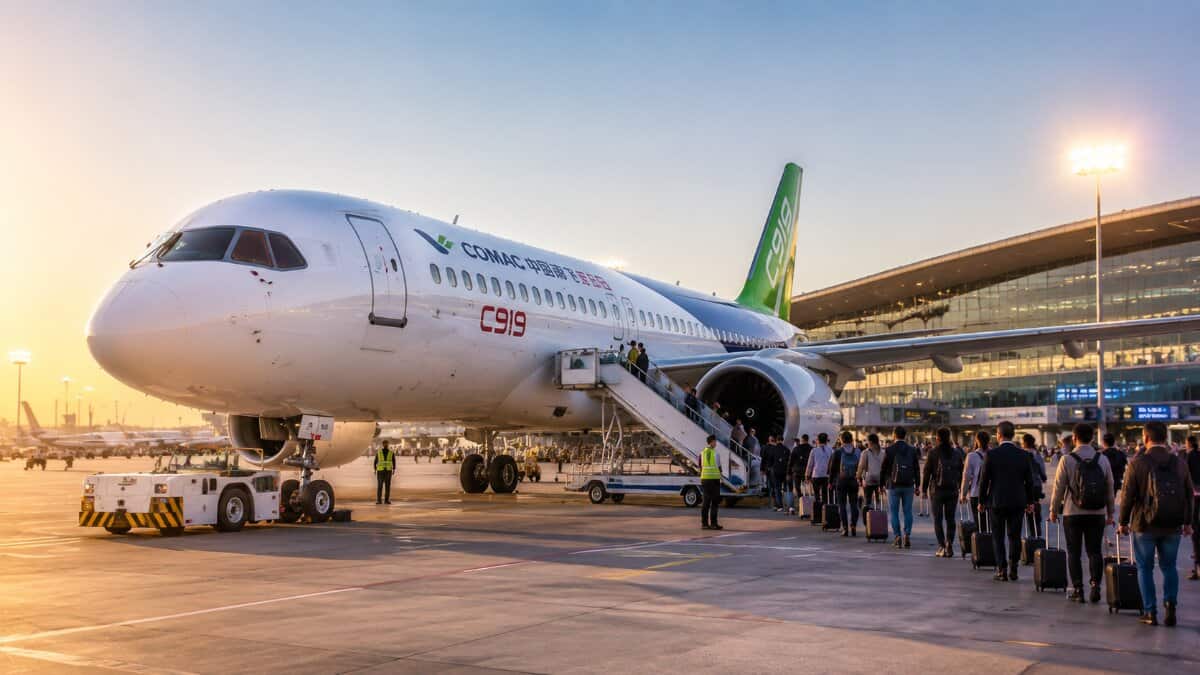
Image generated with Ai
A new chapter in global aviation begins on August 12 as China’s C919 passenger aircraft leaves domestic skies for its first scheduled international commercial flight between Beijing and Ulaanbaatar. Operated by Air China, the route will become the first regular overseas passenger service for the aircraft, putting China’s homegrown jet into a real-world international environment for the first time.
For travellers, the milestone is about more than one new flight route. The C919’s international debut could influence the future of airline competition, aircraft choices and regional connectivity as China attempts to establish a stronger position in the global passenger aircraft market.
Advertisement
The aircraft’s performance on this route will be closely watched by airlines, aviation experts and passengers as the industry looks for new alternatives in the narrowbody aircraft sector.
Most passengers do not choose flights based only on the aircraft manufacturer. However, competition between aircraft makers can eventually affect the choices travellers have when booking flights.
Advertisement
Today, the global narrowbody passenger aircraft market is largely dominated by Airbus and Boeing. The arrival of another major aircraft programme could create new possibilities for airlines expanding their fleets.
The importance of this development is not only where the aircraft flies, but what the operation proves about its ability to serve international passengers.
The Beijing–Ulaanbaatar service represents a major test because it is a normal commercial operation rather than a demonstration flight.
A successful international aircraft programme requires more than building an aircraft. Manufacturers must prove reliability, operational performance and passenger confidence in different markets.
Advertisement
Advertisement
The route has existing business and tourism demand between China and Mongolia, making it a practical choice for the aircraft’s first international step.
The first overseas destination is important because aircraft manufacturers need routes where airlines can operate consistently and evaluate performance under real conditions.
The Beijing–Ulaanbaatar connection already has established travel demand, allowing Air China to introduce the C919 on a commercially active route.
Rather than launching on a route designed only for publicity, the service places the aircraft in a genuine passenger environment.
The success of the C919 could eventually influence how airlines plan future fleets. Aircraft manufacturers compete not only through technology but also through cost, reliability, support networks and airline confidence.
If the C919 gains wider acceptance, airlines could have another option when replacing older aircraft or expanding operations.
However, global aircraft adoption takes time. Airlines require years of operational data before making major fleet decisions.
Before entering international commercial service, the C919 built experience mainly through domestic Chinese operations.
The aircraft entered scheduled passenger service in China before gradually expanding its route network.
These operations helped the aircraft develop operational experience before moving into a wider international market.
China’s entry into the commercial aircraft market represents one of the biggest changes in aviation manufacturing in recent decades.
The narrowbody aircraft segment is particularly important because these jets operate thousands of daily flights connecting cities around the world.
The C919’s progress will be measured not only by its engineering performance but also by whether airlines and passengers develop long-term confidence in the aircraft.
Although the C919 is entering international service, travellers should understand that availability will remain limited in the early stages.
Aircraft expansion depends on airline decisions, delivery schedules and future route announcements.
For passengers, the aircraft is one part of the travel experience. Airline service, reliability and route convenience remain equally important.
The first international commercial flight is an important achievement, but becoming a global aircraft competitor will require long-term success.
Aircraft programmes must build trust among airlines, regulators and passengers before gaining widespread adoption.
The coming years will determine whether the C919 becomes primarily a Chinese aviation success story or develops into a major international competitor.
The C919’s first scheduled international passenger service will begin on August 12.
Air China will operate the first regular international commercial C919 passenger service.
The aircraft will operate between Beijing Capital International Airport and Chinggis Khaan International Airport in Ulaanbaatar, Mongolia.
The C919 is designed to compete in the narrowbody aircraft market, where Airbus and Boeing currently have a strong global presence.
International expansion will depend on airline demand, regulatory approvals and the aircraft’s long-term operational performance.
China’s C919 international debut marks a significant moment not only for Chinese aviation but also for the future of global air travel. The Beijing–Ulaanbaatar route will provide the aircraft with its first opportunity to operate regularly outside China, giving the industry valuable insight into its international potential.
For travellers, the biggest impact may come in the years ahead. If the C919 succeeds internationally, passengers could eventually see more airline choices, new routes and a more competitive aviation market.
Advertisement
Advertisement
Advertisement













Saturday, September 5, 2026

Friday, September 4, 2026

Saturday, September 5, 2026

Friday, September 4, 2026

Thursday, September 3, 2026

Wednesday, September 2, 2026

Friday, September 4, 2026