
Piedmont Operated American Airlines Flight PDT5824, an Embraer ERJ-145 to Jackson Diverts Back to Charlotte Douglas International Airport, United States: Latest Update

Published
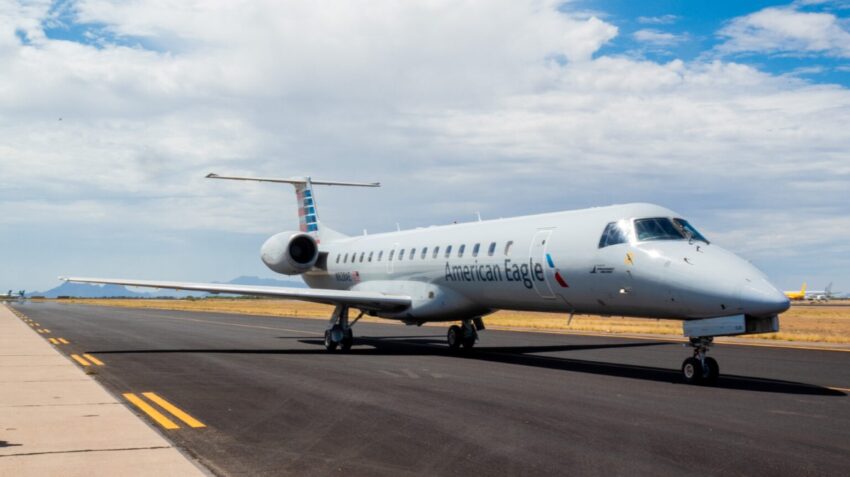 Image generated with Ai
Flight PDT5824, operated by Piedmont for American Airlines, has drawn attention after a sudden return to its departure point. The Embraer ERJ-145 was flying from Charlotte Douglas International Airport to Jackson when it reportedly Diverts Back to Charlotte Douglas International Airport, United States. According to initial tracking data, the aircraft belonging to Piedmont Operated American Airlines Flight PDT5824 followed a precautionary profile, with aviation monitoring suggesting a controlled turnaround shortly after take-off from Charlotte Douglas International Airport before landing safely in the United States. Authorities have not released cause details, and investigation remains ongoing pending airline confirmation and maintenance review.
Piedmont Airlines Flight PDT5824, operating as American Airlines service from Charlotte to Jackson on 17 June 2026, returned to Charlotte shortly after departure. Flight-tracking data confirms the diversion, but no official explanation for the turnaround has yet been released by the airline or aviation authorities.
Advertisement
Advertisement
What happened to Flight PDT5824 shortly after departure?
Tha Data of Flightaware and Flightradar shows that, Piedmont Airlines Flight PDT5824, an Embraer ERJ-145 operating under the American Airlines regional network, departed from Charlotte Douglas International Airport at 09:10 local time on 17 June 2026 before reversing course and returning to its origin airport shortly afterwards, according to publicly available flight-tracking data and aviation monitoring systems.
The service was scheduled to continue to Jackson–Medgar Wiley Evers International Airport but instead terminated its climb phase and re-entered the Charlotte airspace, where it landed safely without further continuation of the planned route.
Advertisement
Advertisement
The aircraft involved, an Embraer ERJ-145 operated by Piedmont Airlines under the broader banner of American Airlines, was recorded as completing a precautionary return, although the precise operational trigger has not been officially confirmed.
Aviation tracking platforms show the aircraft’s trajectory forming a tight loop back to Charlotte, a pattern commonly associated with early-stage technical indications, onboard alerts, or precautionary crew decisions, but no verified emergency code such as a 7700 squawk has been publicly reported at this stage.
Advertisement
Advertisement
Airlines typically refrain from releasing immediate technical details until engineering inspections and crew reports are completed, and in this case no formal statement has yet clarified whether the return was driven by mechanical, operational, or medical considerations.
The intended destination, Jackson–Medgar Wiley Evers International Airport, was not reached, but the aircraft’s return to Charlotte allowed for immediate inspection capability and operational control. Aviation protocols in such scenarios are deliberately conservative, meaning even minor anomalies can trigger a return-to-base decision.
The diversion of Piedmont Operated American Airlines Flight PDT5824, an Embraer ERJ-145 to Jackson Diverts Back to Charlotte Douglas International Airport, United States, appears to be a precautionary return based on available flight tracking data and absence of any confirmed distress signals. While the aircraft safely returned to Charlotte Douglas International Airport, United States, the cause remains officially unverified, with no immediate statement from American Airlines or aviation regulators. Such returns are typically linked to precautionary system alerts or operational checks, rather than confirmed emergencies. Until further technical disclosure is made, the incident remains classified as a standard safety-driven diversion within regional aviation operations.
Was this an emergency landing or a precautionary diversion?
Despite public interest in the incident, there is currently no confirmed evidence that Flight PDT5824 declared an in-flight emergency before returning to Charlotte, and early tracking data suggests the event is more consistent with a precautionary air return rather than a full emergency landing scenario.
In aviation operations, a return to departure airport is often initiated when a crew identifies an irregular system indication, cabin issue, or operational uncertainty that does not necessarily meet emergency thresholds, and such decisions are made conservatively to prioritise safety margins over continuation of flight.
The absence of publicly released distress signals or emergency transponder codes means the situation cannot yet be categorised beyond a diversion, and aviation authorities typically rely on post-flight maintenance inspections and crew debriefings before assigning a formal classification to such events.
Advertisement
Advertisement
Historically, aircraft operating under regional subsidiaries like Piedmont Airlines follow strict procedural protocols that require returning to base when abnormal indications arise, even if those indications are later found to be non-critical or sensor-related.
Until official documentation from American Airlines or aviation regulators is released, the event remains classified in public data as an operational return, and any assumption of severity would be speculative rather than evidence-based.
Advertisement
