
Boston Logan’s Amelia Puts AI Hologram Help in Front of Travellers Now What Miami and More Airports Are Doing

Updated
Published
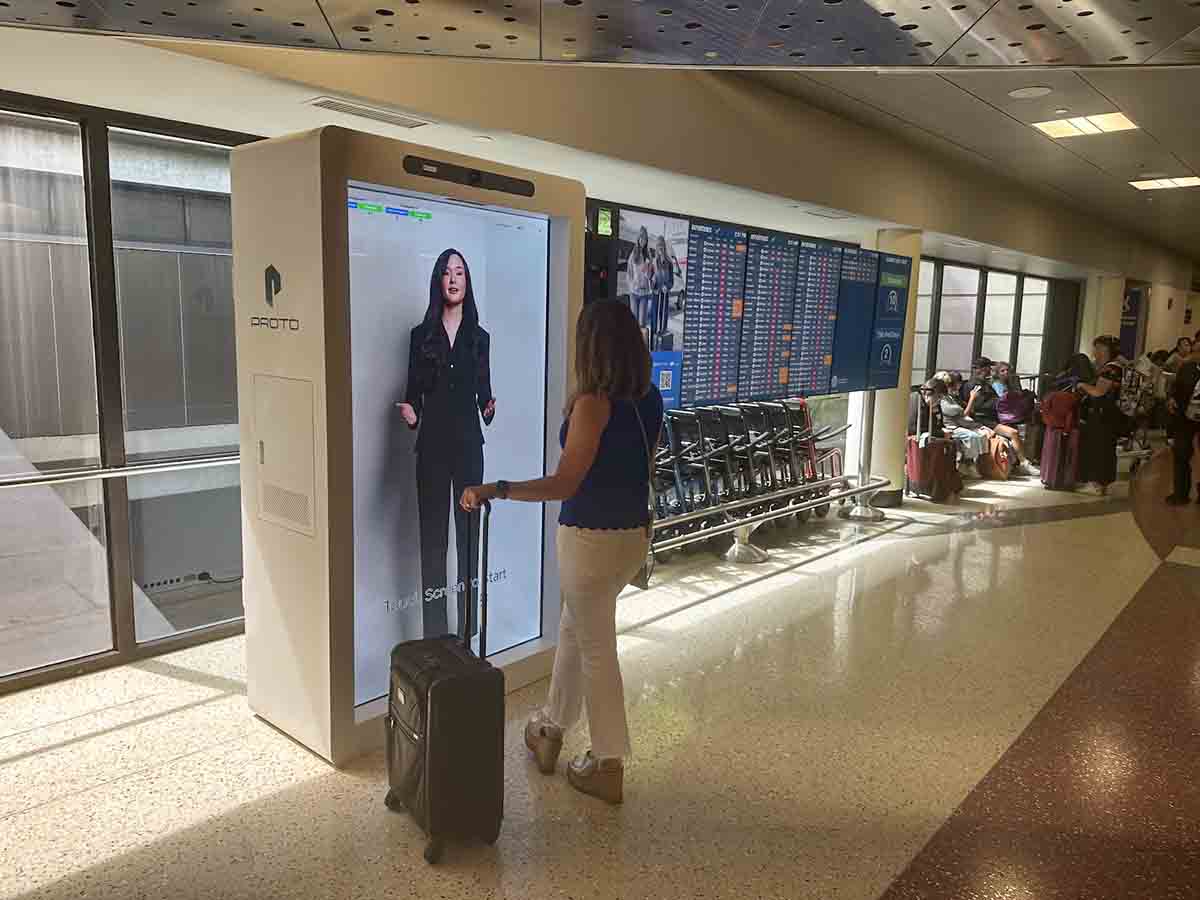
Image generated with Ai
Boston Logan’s Amelia puts AI hologram help in front of travellers, but what are Miami and more airports doing as digital assistants reshape the way passengers get help?
Boston Logan’s Amelia puts AI hologram help in front of travellers, signalling a striking shift in airport assistance. But what Miami and more airports are doing may be just as important. Across the aviation sector, airports are testing digital avatars, holographic concierges and intelligent assistants to make navigation faster and easier. Meanwhile, these systems are moving beyond novelty. They can answer questions, provide directions and deliver airport information in real time. As a result, travellers could soon encounter AI help as routinely as departure screens and information desks. The technology is gaining attention because airports want smarter passenger services without losing human support.
Advertisement
Advertisement
Airports are moving beyond conventional information screens and mobile apps as artificial intelligence begins to take a more visible role in helping passengers navigate terminals, find services and obtain travel information.
Boston Logan International Airport is the latest major airport to enter this emerging space with Amelia, a life-size AI avatar designed to interact with passengers through natural conversation and provide real-time directions. However, Amelia is part of a wider international movement. Airports in the United States, France and the Middle East have already experimented with holographic or three-dimensional digital assistants, while Japan is testing a related model using remotely operated avatar robots.
Advertisement
Advertisement
The technology varies from airport to airport, but the underlying objective is broadly similar: make passenger assistance faster, more accessible and easier to understand while allowing human employees to concentrate on situations that require personal judgement.
Boston Logan International Airport is testing a new approach to passenger assistance, bringing an AI-powered hologram concierge into the terminal to help travellers navigate one of the United States’ busiest aviation gateways.
Advertisement
Advertisement
The Massachusetts Port Authority (Massport) announced on September 8, 2026, that Boston Logan has introduced Amelia, a life-size, hyper-realistic AI avatar designed to communicate with passengers conversationally and provide real-time assistance. The pilot positions Boston Logan as the largest airport to introduce AI avatars specifically to support travellers inside the airport environment.
Amelia Brings AI Assistance Into the Terminal
Unlike conventional digital information screens, Amelia is designed to provide a more human-scale interaction. Passengers can communicate with the AI concierge through a self-contained installation featuring a touchscreen, without requiring additional external hardware.
The system can help travellers locate departure gates, restaurants, shops, airport lounges and baggage claim areas. Amelia provides step-by-step directions alongside live mapping, giving passengers a visual and conversational way to understand where they need to go.
For travellers dealing with tight connections, unfamiliar terminals or the general complexity of a large airport, the system is intended to make finding their way less stressful.
“Amelia represents the future of passenger engagement,” said Glenn E. Smith, Spatial Computing and Hologram XP, at Holomedia AI. “She combines the best of human connection with the power of AI. We designed her to meet travelers where they are, in their language, at their pace, helping them navigate the airport with confidence and ease.”
“It takes bold vision to implement emerging technologies like holograms and AI avatars, innovations that still feel like science fiction to most people,” said David Nussbaum, Founder of Proto Hologram. “But Massport understands that the technology is ready now, and that it can create a smoother and more pleasant experience at Boston Logan while also supporting the human staff so they can do their best too. We’re proud to work with Massport to help bring the future into the present.”
Advertisement
Advertisement
The technology has been developed through a partnership involving Massport, Proto Hologram and Holomedia AI. Proto’s hologram technology is already being used across sectors including healthcare, education, finance, retail, sports and entertainment.
Multilingual and Accessibility Features Expand Its Role
A key element of Amelia’s deployment is its ability to communicate with passengers in multiple languages. The system can support up to 40 languages, with English, Spanish and French included in the Boston Logan implementation.
That capability could be particularly useful in an international airport, where travellers arrive with different language needs and varying levels of familiarity with US airport procedures.
Accessibility has also been incorporated into the service. Amelia’s installation includes high-contrast displays, closed captioning, WCAG-compliant mapping and wheelchair-accessible positioning.
These features indicate that the project is intended not simply as a technology demonstration, but as another passenger-service channel designed to accommodate a broader range of travellers.
Real-Time Airport Information and Human Support
Amelia’s role extends beyond static directions. The AI Concierge Wayfinder is integrated with airport information to provide real-time TSA wait times, allowing passengers to better judge how much time they may need before reaching their departure area.
Advertisement
Advertisement
The system can also connect travellers with a live customer service agent when an issue requires human intervention.
This distinction is important for airport operations. Rather than positioning AI as a replacement for airport personnel, Massport describes Amelia as a way to augment existing customer-service resources.
During busy periods, the AI assistant can handle routine navigation questions while airport employees focus on more complicated passenger needs and situations requiring direct human judgement.
Miami International Airport — AI Hologram Assistants
Miami International Airport (MIA) is one of the clearest examples of an airport already using holographic AI assistants at scale.
MIA introduced four AI-powered holographic assistants at high-traffic passenger locations. The project brings together Mappedin, Satisfi Labs and HYPERVSN, combining conversational artificial intelligence with spatial mapping and physical holographic displays.
The assistants are designed to provide location-specific information and help passengers navigate the airport.
Advertisement
Advertisement
Their deployment points include areas around TSA Checkpoint 4, the MIA Mover connection, Customs in Concourse J and the international arrivals greeters’ lobby.
The system is significant because the AI is not intended merely to answer generic questions. Its integration with spatial information enables passengers to receive guidance relevant to their location inside the airport.
Travellers can ask questions and receive directions, while QR codes can provide digital navigation information that passengers can continue using on their own devices.
Miami’s implementation demonstrates how airport AI is increasingly becoming location-aware, connecting conversational assistance with the physical geography of a terminal.
That development is particularly important for large airports, where passengers may know what they need but struggle to determine precisely where to find it.
LaGuardia Airport — Bridget
LaGuardia Airport’s Terminal B provides perhaps the closest comparison with Boston Logan’s Amelia.
Advertisement
Advertisement
The New York airport introduced Bridget, a life-size, hyper-realistic AI hologram designed to act as a passenger-service and wayfinding ambassador.
Bridget uses Proto’s hologram technology and Holomedia AI’s Concierge Wayfinder, the same technology partnership associated with Amelia’s deployment at Boston Logan.
Passengers can interact with Bridget to obtain information about gates, shops, lounges, baggage claim and terminal navigation.
The significance of Bridget lies in the way the technology attempts to recreate some of the characteristics of face-to-face assistance. A passenger does not simply read information from a flat screen; instead, the system presents a human-scale digital figure capable of conversational interaction.
That approach is intended to make information easier to engage with, particularly in an environment where passengers can be distracted, rushed or unfamiliar with the terminal.
The LaGuardia deployment also establishes an important point for understanding Boston Logan’s announcement: Amelia is not the first airport hologram concierge of its kind. Rather, Boston Logan is joining an airport industry that is increasingly testing embodied AI as a customer-service tool.
Advertisement
Advertisement
Lyon-Saint Exupéry Airport — 3D Virtual Agent
Europe has also entered the AI-avatar race.
At Lyon-Saint Exupéry Airport in France, VINCI Airports trialled a 3D virtual agent capable of responding to passengers’ spoken questions.
The project differs somewhat from the physical holographic installations in Boston, Miami and New York, but its passenger-service objective is closely related.
The virtual agent can provide information about flights, gates, airport services, shops and destinations, while also helping passengers navigate the airport through an interactive map.
Multilingual functionality is another major component, with the system designed to communicate in around 30 languages.
For an international airport, multilingual AI can potentially reduce the pressure on information desks while giving travellers an immediate way to ask questions in a language they are comfortable using.
Advertisement
Advertisement
Lyon’s trial also highlights an important transition in airport technology: AI assistants are increasingly being connected to live operational and spatial information, rather than operating solely as databases of pre-written answers.
Zayed International Airport — Lifelike AI Avatar
Zayed International Airport in Abu Dhabi is another airport associated with lifelike AI-avatar passenger assistance.
Selam.AI’s airport technology is designed around a real-time digital avatar capable of answering questions concerning flights, gates, lost and found, transit and airport facilities.
The platform is designed to support more than 30 languages, reflecting the highly international passenger profile of Abu Dhabi.
The significance of this type of deployment extends beyond novelty. At a major international hub, passenger questions can arise at any hour and in many languages.
An AI avatar can potentially provide a consistent first layer of assistance while directing more complicated cases towards airport employees.
Advertisement
Advertisement
This mirrors the operational philosophy behind Amelia: use automation for routine passenger interactions while preserving human expertise for issues that cannot be resolved through standard information.
Japanese Airports — Remote Avatar Robots
Japan is pursuing a different version of embodied passenger assistance.
All Nippon Airways (ANA) and avatar technology company avatarin have expanded the use of newme avatar robots at regional airports.
Unlike a hologram that generates an artificial digital person, the newme system provides a physical avatar platform that can be remotely operated by a human.
This means an employee based elsewhere can interact with passengers through the robot, creating a form of remote face-to-face assistance.
The model is particularly relevant to airports where maintaining a large permanent customer-service workforce may be difficult.
Advertisement
Advertisement
It also demonstrates that the airport industry’s experimentation with embodied technology is not limited to generative AI. Some airports are combining robotics, remote human support and digital interfaces to extend the reach of existing staff.
From Virtual Characters to Intelligent Airport Concierges
The evolution is notable when Boston Logan’s current Amelia is considered alongside earlier airport experiments.
Boston Logan itself previously tested a virtual assistant called Carla in 2012. Carla was used to provide information to passengers about security procedures at the international terminal.
More than a decade later, Amelia represents a substantially more sophisticated concept.
Today’s systems can combine generative AI, conversational interfaces, digital humans, spatial mapping and real-time airport information. The result is an assistant that can potentially understand a passenger’s question, establish what they are looking for and connect the response to their physical location.
That could prove particularly valuable in sprawling terminals, where traditional signs and static maps cannot always provide the most intuitive route.
Advertisement
Advertisement
What This Means for the Future of Airports
The emergence of Amelia, the holographic assistants at Miami, Bridget at LaGuardia and 3D AI assistance at Lyon reflects a broader transformation in airport passenger experience.
The strongest use case is not necessarily replacing a person behind an information desk. It is extending assistance capacity.
An AI avatar can remain available around the clock, answer repetitive questions, communicate across multiple languages and provide standardised information. Human staff can then spend more time dealing with disrupted journeys, accessibility requirements, complex connections, security issues and passengers who require personal assistance.
There are also practical challenges. AI systems must rely on accurate and timely airport data. Directions need to remain correct when gates, security queues or terminal operations change. Multilingual responses must be understandable rather than merely technically accurate. Most importantly, passengers need an obvious route to a human employee when technology cannot resolve their problem.
For that reason, the success of airport avatars will ultimately be measured less by how realistic they look and more by whether they make the passenger journey genuinely easier.
Boston Logan’s Amelia therefore represents another step in an industry-wide experiment. Miami is testing holographic assistants connected to spatial intelligence; LaGuardia has deployed a highly similar digital concierge; Lyon is exploring multilingual 3D passenger assistance; Abu Dhabi is using lifelike AI-avatar technology; and Japan is extending human support through remote avatar robots.
Advertisement
Advertisement
The common thread is clear: airports are beginning to turn artificial intelligence from something passengers use on their phones into something they can see, speak to and interact with inside the terminal itself.
“AI is rapidly becoming a practical part of the modern airport experience, and Amelia is a compelling example of how technology can complement, rather than replace, human hospitality. By combining conversational assistance, real-time information, multilingual capabilities and accessible wayfinding, Boston Logan is addressing some of the everyday challenges travellers face in busy terminals. What makes this development particularly encouraging is its passenger-first approach. Similar initiatives at airports around the world show that digital avatars can improve access to information while allowing frontline teams to focus on more complex needs. This is a positive step towards smarter, more inclusive and efficient airports.” says, Anup Kumar Keshan, Editor-in-Chief, TTW
Boston Logan Tests a New Model of Airport Hospitality
The introduction of Amelia reflects a broader shift in aviation towards technology that interacts directly with passengers rather than simply displaying information.
David Nussbaum, Founder of Proto Hologram, said the project demonstrates that technologies such as holograms and AI avatars can now move beyond the realm of science fiction and become practical customer-service tools.
Glenn E. Smith of Holomedia AI described Amelia as a new form of passenger engagement, combining conversational AI with a physical, human-scale presence.
For Boston Logan, the pilot will provide an opportunity to assess how travellers respond to an embodied AI assistant in a live airport environment.
Advertisement
Advertisement
The significance of the trial therefore goes beyond Amelia herself. Airports worldwide are looking for ways to improve wayfinding, manage passenger demand and deliver consistent assistance while maintaining human support where it matters most.
If the Boston Logan pilot proves effective, AI avatars could become an increasingly familiar feature of airport terminals, particularly for routine questions, multilingual assistance and real-time navigation. The technology does not remove the need for airport staff; instead, its value will depend on how effectively it complements them.
Boston Logan’s Amelia is consequently less about replacing the traditional airport concierge and more about creating another layer of assistance — one that is available around the clock, responds conversationally and can guide passengers through the airport when they need help.
Boston Logan’s Amelia puts AI hologram help directly in front of travellers, but Miami and more airports are showing that this technology is becoming an international aviation trend. From holographic assistants to three-dimensional avatars and remotely operated robots, airports are testing new ways to answer passenger questions and simplify navigation.
Importantly, these systems are not necessarily designed to replace people. Instead, they can manage routine enquiries, provide directions and deliver information while airport teams handle situations requiring judgement and personal assistance. That balance could determine whether digital concierges become a lasting part of airport operations.
As the technology improves, passengers may see more AI assistants appearing alongside traditional information desks and digital signs. For now, Boston Logan’s Amelia provides another prominent example of how airports are experimenting with more interactive, accessible and responsive passenger services. The next question is how quickly travellers will embrace them.
Advertisement
