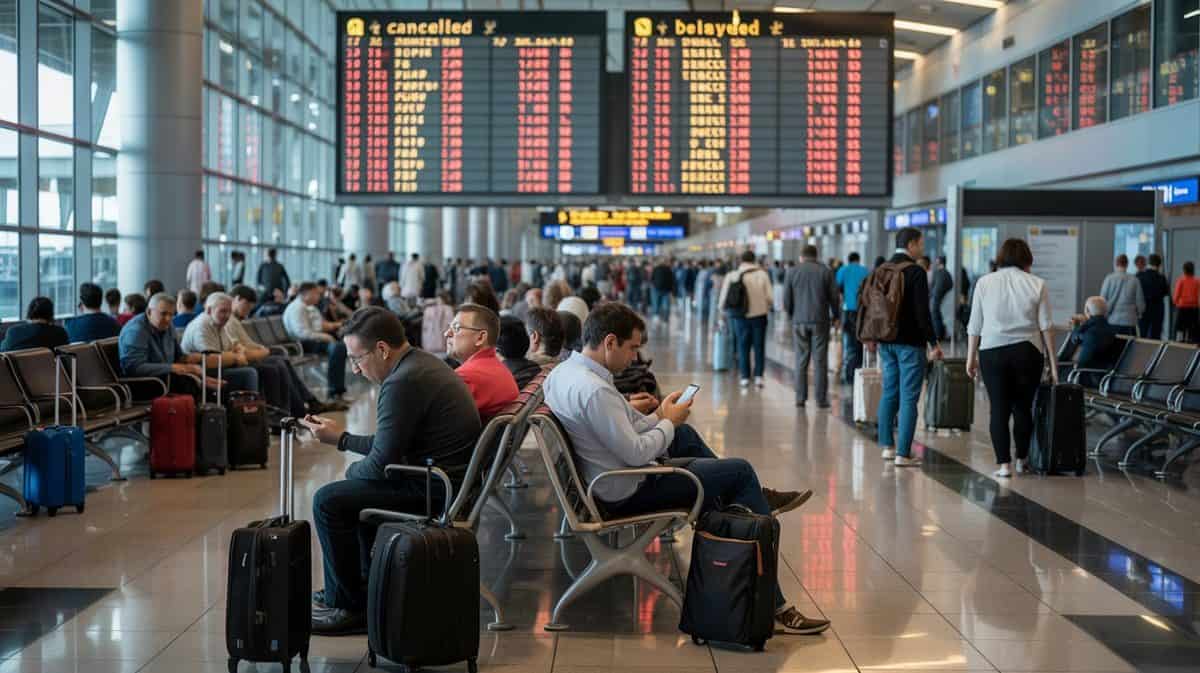
Image generated with Ai
South Africa is moving ahead with one of its most significant airport investment programmes in years, with Airports Company South Africa deploying R21.7 billion across its national airport network to expand capacity, modernise infrastructure and improve the experience of millions of passengers.
The five-year capital programme covers the nine principal airports managed by ACSA and represents the company’s largest infrastructure investment allocation since preparations for the 2010 FIFA World Cup.
Advertisement
Major projects are concentrated around O.R. Tambo International Airport in Johannesburg and Cape Town International Airport, while regional gateways including George, Chief Dawid Stuurman International and King Phalo airports are also part of the infrastructure pipeline.
Cape Town is preparing for particularly extensive development, with ACSA announcing an approximately R10.14 billion phased infrastructure programme that will transform terminal facilities, aircraft parking capacity and the airport’s runway configuration.
Advertisement
Advertisement
O.R. Tambo, meanwhile, is central to ACSA’s longer-term cargo, passenger and public-transport infrastructure plans, reinforcing Johannesburg’s position as a major connecting gateway for South Africa and the wider African aviation market.
| Key Area | Confirmed Development |
|---|---|
| Airport operator | Airports Company South Africa |
| Total capital programme | R21.7 billion |
| Investment period | Five-year programme |
| Airports managed | Nine principal South African airports |
| Major hubs | O.R. Tambo and Cape Town International |
| Cape Town programme | Approximately R10.14 billion |
| Cape Town priorities | Terminal expansion, runway realignment, gates and apron capacity |
| O.R. Tambo priorities | Cargo development, transport interchange and future passenger capacity |
| George Airport | Terminal expansion |
| Chief Dawid Stuurman International | Terminal development |
| King Phalo Airport | Departure lounge expansion |
| Network objective | Capacity, resilience and passenger experience |
| Government passenger target | 42 million passengers annually across ACSA network |
| Wider focus | Technology, cargo, safety and regional competitiveness |
The programme is designed to address a combination of existing infrastructure requirements and future passenger growth.
South Africa’s Department of Transport has identified airport investment as an important component of plans to handle approximately 42 million passengers annually across ACSA’s network while simultaneously increasing air-freight capacity.
The capital programme is not limited to constructing new terminals.
ACSA says investment is being directed towards refurbishment, rehabilitation, efficiency improvements, technology, regulatory compliance and new capacity. The approach is intended to improve asset reliability while ensuring that existing airport infrastructure can continue supporting passenger and airline operations as demand grows.
The scale of the programme demonstrates the strategic importance of aviation to South Africa.
Airports provide essential infrastructure for tourism, trade, business travel and cargo, meaning improvements can influence economic activity well beyond terminal buildings.
Cape Town International Airport is preparing for one of the most significant phases of infrastructure development in its history.
ACSA confirmed in February 2026 that the airport will undergo a phased programme valued at approximately R10.14 billion, forming part of the wider R21.7 billion national investment strategy.
A central element will be the reconfiguration and expansion of terminal infrastructure.
The domestic arrivals area will be extensively redeveloped, while domestic departures capacity will increase through additional contact gates and passenger loading bridges.
Aircraft infrastructure will also expand.
Additional apron stands are planned for domestic and international operations, giving airlines more parking capacity and improving aircraft movements around the airport.
The programme will additionally increase commercial and lounge space while improving passenger-processing facilities.
For travellers, these developments should eventually mean greater terminal capacity and a more modern airport environment, although phased construction will inevitably require careful management while the airport remains operational.
Runway development is one of the most consequential components of Cape Town International Airport’s programme.
ACSA plans to realign the airport’s primary runway, an infrastructure project intended to improve operational capability and accommodate future aviation demand.
The runway project will form part of a broader transformation involving terminal redevelopment and airside capacity.
ACSA has indicated that the appointment of the runway contractor is expected during the procurement process ahead of construction, while major terminal work is scheduled to progress in phases.
Runway infrastructure has long-term implications because airport capacity is determined not only by how many passengers terminals can process but also by how efficiently aircraft can arrive, depart and move between runways, stands and gates.
Cape Town’s investment is therefore designed to address both sides of the capacity equation.
Johannesburg’s O.R. Tambo International Airport remains central to ACSA’s national investment strategy because of its importance to passenger connections, freight and international aviation.
One of the flagship projects identified by ACSA is the Midfield Cargo Terminal development, beginning with phase one.
Cargo capacity is strategically important to South Africa because O.R. Tambo supports high-value and time-sensitive trade alongside passenger aviation.
ACSA’s longer-term infrastructure pipeline also identifies a Midfield Passenger Terminal Complex for a future regulatory investment period.
Additional plans include a new bus station and public-transport interchange, potentially strengthening connections between the airport and the surrounding Gauteng transport network.
The programme consequently views O.R. Tambo as more than a passenger terminal complex. Its future role incorporates freight, surface transportation and additional passenger capacity.
Fuel security has also become an important aviation infrastructure priority.
South Africa’s Department of Transport has said projects are being accelerated to improve the reliable availability of jet fuel to airlines across ACSA airports.
The issue is particularly relevant at O.R. Tambo, where recent supply disruptions have demonstrated the importance of resilient aviation-fuel infrastructure and diversified supply chains.
Airports require dependable storage and replenishment arrangements because fuel interruptions can quickly affect airline schedules and network operations.
Investment in airport resilience therefore extends beyond visible terminal upgrades.
Power, fuel, technology, baggage systems, security infrastructure and other operational assets all influence whether passengers and airlines experience a reliable airport.
For South Africa, improving these underlying systems will be as important as constructing additional passenger facilities.
Regional airports form another important component of the programme.
George Airport is expected to receive terminal expansion because passenger throughput had already exceeded the facility’s original design capacity before the pandemic.
The airport serves an important tourism market along South Africa’s Garden Route and provides air access to destinations across the Western Cape.
Increasing terminal capacity could improve passenger processing while providing infrastructure capable of accommodating future demand.
The economic significance extends beyond the airport itself.
Regional aviation supports accommodation providers, attractions, tour companies, car-rental businesses and other tourism enterprises by making destinations easier to reach from Johannesburg, Cape Town and other markets.
Better airport infrastructure can consequently help distribute tourism activity beyond South Africa’s largest metropolitan centres.
ACSA’s infrastructure pipeline includes projects at additional regional airports.
Chief Dawid Stuurman International Airport in Gqeberha is earmarked for terminal development, strengthening capacity at an important Eastern Cape gateway.
King Phalo Airport in East London is expected to receive an expanded departure lounge as part of the regional investment programme.
ACSA has also previously identified infrastructure requirements across its broader network as part of its refurbishment and rehabilitation strategy.
These projects may be smaller than the developments planned for Johannesburg and Cape Town, but they are important to the resilience of South Africa’s domestic aviation network.
Regional airports connect communities with major economic centres while supporting domestic tourism and business travel.
Tourism is one of the sectors positioned to benefit directly from improved airport infrastructure.
South Africa attracts travellers for safaris, cities, beaches, wine tourism, cultural experiences and major business events, making efficient aviation gateways essential to the visitor economy.
Cape Town International is particularly important because it provides direct access to one of Africa’s major international tourism destinations.
O.R. Tambo performs a different but equally important role.
Johannesburg functions as a connecting hub, allowing international passengers to transfer onto domestic and regional flights serving destinations throughout Southern Africa.
Improving infrastructure at both airports can therefore support different parts of the tourism journey: Cape Town as a major destination gateway and Johannesburg as a major distribution and connecting point.
The implications extend beyond South Africa.
Johannesburg serves as an important connecting point for passengers travelling between long-haul markets and destinations elsewhere in Southern Africa.
Stronger airport infrastructure can support airlines seeking to expand regional frequencies or develop new routes, although airport investment alone cannot guarantee additional air services.
Airlines will continue assessing demand, aircraft availability, operating costs, bilateral agreements and commercial viability before introducing routes.
Nevertheless, adequate airport capacity removes one potential obstacle to growth.
For tour operators building multi-country African itineraries, dependable connections through South Africa can make it easier to combine destinations across the region.
Technology forms another pillar of ACSA’s longer-term strategy.
The company has identified digitisation and innovation as tools for improving passenger flows, reducing service interruptions and strengthening operational efficiency.
ACSA’s strategy includes greater use of technology to future-proof airport operations alongside research and innovation partnerships.
Predictive maintenance is particularly relevant.
Instead of waiting for infrastructure such as baggage systems, escalators or other critical equipment to fail, data-driven maintenance can help airport operators identify potential problems before they interrupt operations.
Digital passenger-processing systems can similarly reduce bottlenecks and make journeys through terminals more efficient.
These developments show that airport modernisation is increasingly about software, data and operational intelligence as much as concrete, terminals and runways.
Airport construction can generate economic activity during development, but the longer-term impact comes from additional aviation capacity.
ACSA says its infrastructure projects are intended to support job creation, local enterprise development and greater regional competitiveness.
Cargo expansion at O.R. Tambo could support exporters and logistics businesses, while increased passenger capacity can benefit airlines, tourism companies, hotels and other industries dependent on connectivity.
ACSA has also emphasised participation by small, medium and micro enterprises within its procurement ecosystem.
This means the R21.7 billion programme is being positioned not simply as airport expenditure but as an infrastructure investment with wider economic-development objectives.
Large airport projects cannot be completed without some interaction with normal passenger operations.
ACSA’s phased approach is intended to allow airports to continue functioning while infrastructure is expanded and modernised.
At Cape Town in particular, terminal redevelopment will need to be carefully sequenced because domestic and international passengers will continue using the airport throughout the construction period.
Travellers may encounter temporary routing changes, construction zones or adjustments to airport facilities as individual projects advance.
However, the objective is to increase long-term capacity without unnecessarily disrupting current aviation operations.
Passengers should continue checking airport and airline information as major construction phases begin, particularly where terminal access or processing arrangements are temporarily modified.
The R21.7 billion investment programme represents a substantial shift from post-pandemic recovery towards longer-term aviation growth.
Cape Town International Airport is preparing for major terminal and runway development, while O.R. Tambo is advancing cargo and surface-transport projects and positioning itself for additional passenger capacity in the future.
Regional airports are also receiving attention, ensuring that infrastructure investment is not concentrated exclusively in South Africa’s two largest aviation markets.
ACSA has already spent more than R1.4 billion of the approved infrastructure allocation, with the remaining programme forming part of its five-year investment pipeline.
The larger objective is to create an airport network capable of supporting passenger growth, air cargo, tourism and stronger regional competitiveness.
For travellers, the most visible benefits will eventually appear through larger and more efficient terminals, improved facilities and additional capacity. For South Africa’s tourism and aviation industries, the consequences could be considerably broader.
A modernised airport network can strengthen the country’s ability to compete for airlines, international visitors, business travellers and freight while maintaining its role as one of Africa’s most important aviation gateways.
Advertisement
Advertisement
Advertisement












Tuesday, September 1, 2026

Tuesday, September 1, 2026

Tuesday, September 1, 2026

Tuesday, September 1, 2026

Tuesday, September 1, 2026

Tuesday, September 1, 2026

Tuesday, September 1, 2026

Tuesday, September 1, 2026