
Switzerland Comes Along With Japan and Other Countries Deploying Driverless Airside Shuttles

Published
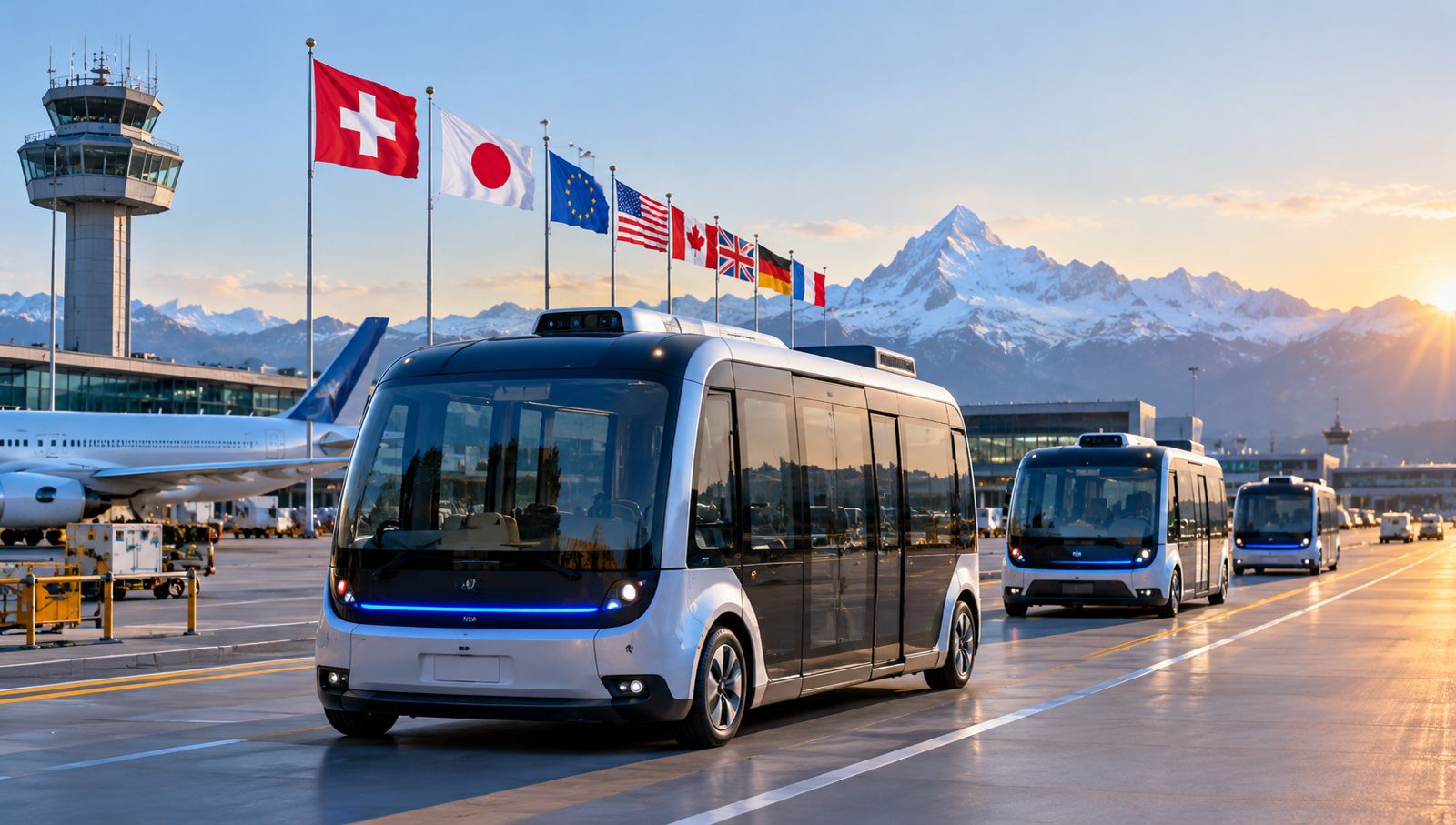
Image generated with Ai
Switzerland joins Japan and other countries in using driverless airside shuttles at busy international airports. These new driverless vehicles are cutting traffic jams at many of the world’s busiest airports. The new driverless buses are allowing flight crews to travel on electric buses without any driver. Major airports around the world are getting rid of traffic jams. This new technology is greatly cutting carbon emissions while also providing more efficient use of the airport each day. Travel will never be the same.
Airports around the world are now making changes to use new driverless electric buses on their aprons to safely transport flight crews.
Why Are Airports Introducing Driverless Airside Shuttles?
Airports constantly grapple with severe ground congestion and high labor overheads as vast fleets of buses shuttle flight crews and maintenance personnel across sprawling tarmacs. Traditional internal transport operations rely heavily on fossil-fuel vehicles that continuously add to ground-level carbon emissions while remaining vulnerable to chronic labor shortages and scheduling bottlenecks. Deploying autonomous electric shuttle buses creates uninterrupted, on-demand transit loops that dramatically reduce operational expenditures and eliminate a major source of airside traffic congestion. Because these intelligent vehicles operate continuously without mandatory rest breaks, airfields can achieve unprecedented efficiency when moving personnel between distant remote stands and main terminal concourses.
How Does Sensor Fusion Power Airfield Navigation?
Navigating complex apron environments requires sophisticated technology capable of tracking moving aircraft, baggage trains, and ground service equipment simultaneously in all weather conditions. Modern autonomous transport fleets overcome these immense challenges by utilizing advanced sensor fusion that seamlessly combines high-definition LiDAR grids, precision radar, and real-time optical cameras. This multi-layered sensory architecture allows the vehicle to construct a hyper-accurate 360-degree environmental map, ensuring it can instantly detect sudden obstacles or deviating service vehicles on the tarmac. By continuously cross-referencing live sensor data with high-precision GPS and onboard mapping algorithms, these shuttles execute precise braking and steering maneuvers without human intervention.
Advertisement
Advertisement
“This rapid global rollout of autonomous airside transport proves that the aviation industry is finally embracing cutting-edge automation to solve chronic labor and congestion challenges. By leveraging advanced LiDAR sensor fusion and strict geofencing, pioneering hubs in Zurich, Singapore, and Japan are setting a bold new benchmark for apron safety and operational efficiency. Moving passengers and flight crews across sprawling tarmacs without human drivers is no longer a distant sci-fi concept; it is an active, sustainable reality that is fundamentally reshaping how modern international airports function every single day.”
— Anup Kumar Keshan, Founder and Editor-in-Chief, Travel And Tour World
Advertisement
Advertisement
What Role Does Real-Time Geofencing Play in Safety?
Maintaining strict safety margins is the single highest priority for any aviation authority operating within active airside perimeters where heavy aircraft and high-speed ground equipment intersect. Real-time geofencing establishes rigid, invisible digital boundaries that restrict autonomous shuttle buses exclusively to authorized apron corridors and designated crew transit lanes. If a vehicle attempts to drift outside its pre-programmed operational zone or encounters an unexpected runway intrusion threat, the geofencing system instantly triggers failsafe protocols to halt the vehicle. This absolute spatial control guarantees that driverless transports remain safely separated from active taxiways, protecting both personnel and multi-million-dollar commercial aircraft from potential collisions.
For official regulatory framework updates and details on autonomous vehicle rollouts, you can review the Ministry of Transport Singapore Automated & Autonomous Vehicles Guidelines.
Advertisement
Advertisement
How Are Zurich and Singapore Leading the Rollout?
Global aviation hubs are actively validating these technologies through rigorous live operational deployments that push the boundaries of automated ground transportation in complex environments. Zurich Airport has successfully pioneered live operational rollouts of autonomous airside shuttle buses, advancing from supervised trials to completely driverless configurations on active apron corridors. Simultaneously, Singapore’s Changi Airport is integrating high-frequency automated vehicle networks to bridge distant cargo zones, maintenance facilities, and passenger terminals under strict civil aviation oversight. These pioneering implementations provide invaluable operational data, proving that driverless crew transports can deliver exceptional reliability while satisfying the world’s most stringent aviation safety standards.
Can Autonomous Fleets Solve Airfield Labor Shortages?
The aviation sector faces a persistent shortage of qualified ground operations personnel and commercial drivers, which frequently disrupts internal airline scheduling and airport turnaround times. Deploying driverless crew transports effectively decouples essential airside mobility from human labor availability, allowing airports to maintain reliable 24/7 internal transit networks. Ground staff can redirect their valuable time and expertise toward critical aircraft servicing tasks rather than spending hours driving routine personnel loops across massive airfield properties. Ultimately, this technological shift protects airports against escalating labor costs while establishing a future-proof, highly resilient foundation for sustainable global aviation infrastructure.
| Country & Hub Airport | Core Technology & Navigation | Primary Operational Focus | Current Deployment Status |
|---|---|---|---|
| Switzerland (Zurich Airport) | LiDAR grids, sensor fusion, and remote cockpit supervision | Crew and personnel transport along active apron corridors | Level 4 live operations active without onboard safety drivers |
| United States (Major Hub Airports) | Real-time optical cameras and geofenced mapping grids | Internal staff movements and multi-terminal cross-connections | Active testing and phased perimeter integration |
| Singapore (Changi Airport) | Advanced AI-driven localization and automated tractor networks | High-frequency cargo, baggage, and ground logistics loops | Live commercial deployment scaling toward an expanded fleet |
| Japan (Domestic Hubs) | Precision GPS and localized multi-sensor hardware | High-density crew transfers under strict civil compliance | Advanced domestic testing and pilot rollout phases |
Skyrocketing ground traffic congestion and severe labor shortages forced major aviation hubs to rethink apron transport logistics. Fortunately, the answer is to be found in advanced autonomous electric shuttle buses. After all, the self-driving vehicles utilize advanced LiDAR sensors and real-time geofencing. As such, they run non-stop around the clock without requiring drivers.
This eliminates scheduling conflicts while reducing ground carbon emissions and expensive labor overheads. Overall, the advanced electric shuttles open the door to a new era in airport operations.
Autonomous electric shuttles are set to fundamentally change the way airports function globally by removing apron traffic while eliminating labor overheads. After adopting the driverless technology, a growing number of Swiss airports are joining the likes of Japan in embracing autonomous shuttles and demonstrating that driverless vehicles can flourish in highly intense environments. More importantly, state-of-the-art sensor fusion and geofencing allow the driverless pods to offer maximum safety while working in tandem with large commercial aircraft. In short, the new age of electric shuttles will fundamentally change global aviation for the better.
Advertisement
