
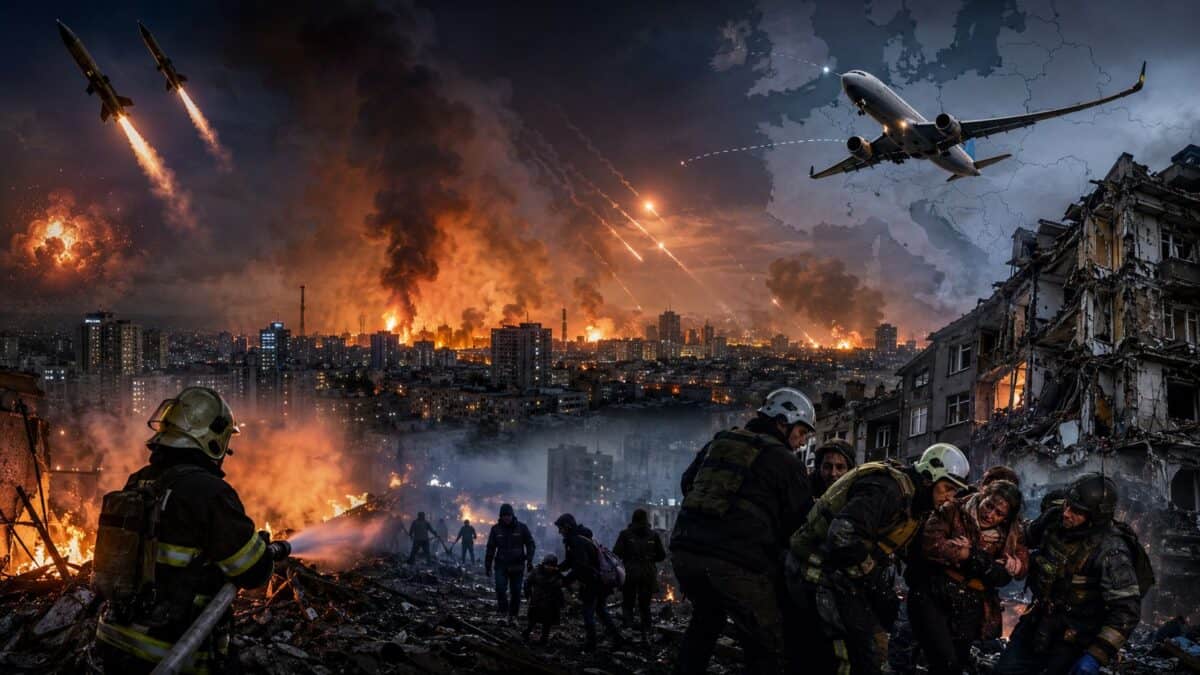
Image generated with Ai
Russia’s latest overnight bombardment of Ukraine has once again underscored the fragile security environment across Eastern Europe, prompting renewed concern among governments, airlines, travel companies and international visitors monitoring the region. At least six people were killed after Russia launched 41 missiles and 125 attack drones, with Kyiv emerging as the primary target during several hours of sustained aerial assaults. Fires erupted across multiple districts of the Ukrainian capital, residential buildings suffered significant damage, and emergency responders carried out rescue operations while air raid alerts continued through the night. The strikes arrived only a day after Ukrainian drones targeted military-related infrastructure inside Russia, highlighting the increasingly rapid cycle of retaliatory attacks that continues to reshape regional travel dynamics.
Although commercial aviation over Ukrainian airspace has remained suspended since February 2022, the Russia missile attack on Ukraine continues to influence travel confidence well beyond the country’s borders. Airlines, insurance providers, tour operators, multinational companies and logistics networks remain highly sensitive to every escalation because conflict-related developments increasingly affect route planning, passenger confidence, business travel decisions and broader tourism recovery across Europe. The latest attacks therefore extend beyond military significance, reinforcing the reality that geopolitical instability remains an important consideration for international travellers, particularly those with journeys involving neighbouring countries or Eastern European transport corridors.
Advertisement
The latest attack began during the early hours of the morning, with Ukrainian authorities reporting waves of missiles and drones arriving over several hours. Air defence systems remained active throughout the night as emergency personnel responded to explosions, fires and structural damage across numerous parts of the capital.
According to Ukrainian officials, Russia launched 41 missiles alongside 125 attack drones, making it one of the more significant combined aerial assaults in recent weeks. Authorities confirmed that multiple districts experienced damage as debris from intercepted projectiles and direct impacts ignited fires in residential and commercial areas.
Advertisement
Advertisement
Emergency services reported major incidents across several districts, including Sviatoshynskyi, Shevchenkivskyi, Solomianskyi, Desnianskyi and Dnipro. Rescue teams evacuated residents from burning apartment buildings while firefighters battled blazes that spread through residential complexes, office facilities and industrial sites.
Officials later confirmed that at least six people lost their lives, while dozens more sustained injuries requiring emergency medical treatment.
The attack once again demonstrated Russia’s continued use of combined missile and drone operations designed to place sustained pressure on Ukrainian air-defence networks.
| Incident | Details |
|---|---|
| Main target | Kyiv and surrounding region |
| Missiles launched | 41 |
| Attack drones launched | 125 |
| Confirmed fatalities | At least 6 |
| Injured | Dozens |
| Duration | Several hours overnight |
| Main damage | Residential buildings, industrial facilities, offices, infrastructure |
The overnight bombardment did not occur in isolation. It followed a significant Ukrainian drone operation that reportedly struck logistics facilities, warehouses and an oil-related installation within Russian territory only one day earlier.
Advertisement
Advertisement
The increasingly rapid succession of attacks illustrates how the conflict has evolved beyond traditional front-line combat. Long-range drones, precision-guided missiles and increasingly sophisticated aerial technologies now enable both sides to conduct operations hundreds of kilometres from active battle zones.
For travellers, these developments reinforce an important reality: while military engagements remain geographically concentrated, the broader security picture continues changing rapidly.
International organisations monitoring aviation safety continue assessing developments because military activity involving long-range missiles creates additional complexity for regional airspace management.
The latest overnight operation forms part of a broader pattern that has characterised much of 2026.
According to figures released by Ukrainian authorities, Russia has dramatically increased the pace of long-range aerial attacks using multiple weapon systems.
During a single recent week alone, Ukraine reported that Russia had deployed approximately:Weapon Type Reported Weekly Usage Attack drones Around 1,450 Guided aerial bombs More than 1,640 Missiles 99
These figures illustrate the sustained operational tempo facing Ukrainian air-defence forces.
Compared with earlier stages of the conflict, drone warfare has become substantially more prominent because unmanned systems can be produced relatively quickly and employed alongside cruise missiles and ballistic missiles to complicate defensive responses.
Military analysts increasingly describe this approach as layered aerial warfare, combining different weapon types to maximise operational pressure.
One of Ukraine’s greatest operational challenges continues to be maintaining sufficient stocks of interceptor missiles.
Western-supplied air-defence systems have significantly strengthened Ukraine’s ability to intercept incoming threats, yet officials continue warning that available interceptors remain limited relative to the scale of Russian attacks.
Among these systems, Patriot air-defence batteries remain especially important because they are capable of engaging advanced ballistic missile threats that cannot easily be intercepted using shorter-range systems.
However, sophisticated interceptor missiles require continuous production, international coordination and sustained logistical support.
As aerial attacks increase in both frequency and complexity, maintaining interceptor inventories has become almost as strategically significant as deploying the launch systems themselves.
| Capability | Importance |
|---|---|
| Ballistic missile interception | Protects major cities from high-speed missile attacks |
| Cruise missile defence | Reduces infrastructure damage |
| Drone interception | Limits casualties and protects civilian infrastructure |
| Layered defence | Improves interception success against mixed attacks |
| Civil protection | Supports emergency response and evacuation operations |
For the international travel industry, security developments inside Ukraine continue carrying implications well beyond the country’s borders.
Although Ukraine’s airports remain closed to commercial passenger operations, neighbouring aviation authorities continually review regional security conditions to ensure safe management of international air traffic.
Following the closure of Ukrainian airspace in 2022, airlines were required to redesign numerous long-haul routes linking Europe with Asia and parts of the Middle East.
Many carriers continue operating longer flight paths around restricted airspace, increasing flight times, fuel consumption and operational costs.
Insurance companies likewise continue factoring geopolitical risk into aviation underwriting decisions, while multinational corporations regularly reassess business travel policies for staff operating across Eastern Europe.
The latest escalation therefore serves as another reminder that geopolitical events remain capable of influencing aviation planning despite the conflict entering its fifth year.
Despite continuing conflict inside Ukraine, much of Eastern Europe has experienced a gradual recovery in tourism since the pandemic.
Countries including Poland, Romania, Slovakia, Hungary and the Baltic states have welcomed growing numbers of international visitors while simultaneously supporting humanitarian and logistical operations linked to Ukraine.
However, every major escalation generates renewed international attention, occasionally influencing traveller perceptions even in destinations located hundreds of kilometres from active combat zones.
Tourism boards throughout the region have consequently invested heavily in communicating accurate information regarding visitor safety, transport connectivity and operational normality.
The distinction between countries directly affected by military operations and neighbouring destinations remains particularly important for international travellers unfamiliar with regional geography.
Even so, travel advisors generally recommend monitoring government travel advisories before departure because security conditions can evolve quickly.
The Russia missile attack on Ukraine is not solely a military development. It also carries significant implications for international transport, tourism investment, supply chains and traveller confidence. Since the full-scale invasion began in February 2022, Ukraine’s tourism industry has effectively come to a standstill, while neighbouring countries have adapted to an evolving security landscape.
Before the conflict, Ukraine welcomed millions of international visitors annually for business, cultural tourism, city breaks and heritage travel. According to the United Nations World Tourism Organization (UN Tourism), international tourism had been steadily recovering globally after the pandemic, yet Ukraine remains one of the few European destinations where commercial tourism has been almost entirely suspended because of the ongoing conflict.
The latest overnight strikes reinforce the uncertainty surrounding any future reopening of Ukrainian airspace or the resumption of international passenger flights.
At the same time, neighbouring countries have worked to reassure visitors that their tourism infrastructure remains fully operational. Poland, Romania, Slovakia, Hungary and Moldova continue serving as important transit hubs for humanitarian operations, diplomatic travel and business activities connected with Ukraine.
| Country | Current Tourism Situation | Operational Status |
|---|---|---|
| Ukraine | Commercial tourism remains severely disrupted | Civilian airspace closed |
| Poland | Tourism operating normally | International airports fully operational |
| Romania | Tourism and aviation functioning normally | Increased regional transport role |
| Slovakia | Tourism unaffected outside normal travel conditions | Airports operating normally |
| Hungary | Tourism continuing | International connectivity maintained |
| Moldova | Tourism operating with heightened regional awareness | Airport operational |
The closure of Ukrainian airspace has reshaped aviation across Europe and parts of Asia for more than four years.
Commercial aircraft no longer transit Ukrainian skies, forcing airlines to rely on alternative routings. These diversions often increase flying times, fuel consumption and operational costs, particularly on services connecting Europe with destinations in Asia and the Middle East.
Although carriers have gradually adapted their schedules, every major escalation prompts renewed monitoring by aviation authorities and airline operations centres. Flight planning teams continuously evaluate Notices to Airmen (NOTAMs), regional airspace restrictions and security assessments before aircraft depart.
The conflict has also highlighted the growing importance of dynamic flight planning. Modern airlines increasingly use real-time intelligence, satellite tracking and geopolitical risk assessments to modify routes when required, ensuring compliance with international aviation safety standards.
For passengers, these operational changes are generally invisible, yet they remain an essential component of maintaining safe international air travel.
Most travellers visiting Europe are unlikely to experience direct disruption because of the latest attacks. Nevertheless, those planning journeys involving Eastern Europe should remain informed and prepared.
Travellers with itineraries including Poland, Romania, Hungary, Slovakia or Moldova should check official government travel advice before departure and remain aware of any developments that could affect regional transport.
Business travellers working in logistics, humanitarian assistance or diplomatic sectors may encounter additional security procedures depending on their destination and operational requirements.
Anyone intending to travel close to Ukraine’s borders should ensure they possess comprehensive travel insurance, understand local emergency procedures and remain attentive to updates issued by national authorities.
| Travel Consideration | Current Advice |
|---|---|
| Flights to Ukraine | Commercial passenger services remain suspended |
| Ukrainian airspace | Closed to civilian aviation |
| Border crossings | Operational, subject to national procedures |
| Neighbouring EU countries | Tourism and transport functioning normally |
| Travel insurance | Verify conflict-related exclusions before departure |
| Official travel advice | Check government advisories before travel |
While Ukraine remains closed to leisure tourism, the wider European travel market has demonstrated remarkable resilience.
International visitor demand across Southern, Central and Western Europe has continued growing, supported by expanding airline capacity, strong summer bookings and recovering long-haul markets.
Nevertheless, geopolitical developments continue influencing traveller behaviour. Industry analysts note that periods of heightened international tension often result in short-term increases in travel enquiries regarding safety, insurance and itinerary flexibility.
Tour operators have consequently expanded flexible booking policies, while airlines continue offering schedule adjustments where operationally necessary.
The latest escalation is therefore unlikely to alter broader European tourism trends substantially, although it reinforces the importance of transparent communication between governments, airlines and travellers.
The prolonged conflict has accelerated cooperation among European governments, aviation regulators and international organisations responsible for air navigation and transport safety.
Airspace management now incorporates increasingly sophisticated risk analysis, integrating intelligence assessments, satellite monitoring and operational coordination across multiple jurisdictions.
These measures have enabled airlines to maintain high levels of operational safety despite prolonged geopolitical instability in parts of Eastern Europe.
Meanwhile, continued international support for Ukraine’s defensive capabilities reflects broader efforts to protect civilian infrastructure, maintain essential services and preserve long-term regional stability.
For the travel sector, confidence remains closely linked to predictable aviation operations and accurate public information rather than speculation.
The overnight attacks serve as another reminder that geopolitical developments remain capable of influencing travel far beyond the immediate conflict zone.
International airlines, airport operators, insurers, multinational corporations and travel management companies increasingly incorporate geopolitical risk into everyday operational planning.
Business continuity strategies now routinely consider airspace restrictions, supply chain resilience, employee mobility and destination risk assessments.
For travellers, the most practical response remains informed preparation. Monitoring official advisories, purchasing suitable insurance and remaining flexible with travel plans continue to represent best practice whenever travelling within or near regions experiencing geopolitical tension.
Although the Russia missile attack on Ukraine primarily reflects the continuing military conflict, its indirect effects extend across international aviation, tourism economics and global mobility. As governments, airlines and travellers adapt to an evolving security environment, accurate information and responsible travel planning remain indispensable.
1. What happened in the latest Russia missile attack on Ukraine?
Russia launched 41 missiles and 125 attack drones in an overnight assault targeting Kyiv and surrounding areas. The strikes killed at least six people, injured dozens more and caused widespread damage to residential buildings, industrial facilities and other infrastructure across several districts of the Ukrainian capital.
2. Which areas of Kyiv were affected by the overnight strikes?
According to Ukrainian authorities, the attacks caused damage and fires in Shevchenkivskyi, Sviatoshynskyi, Solomianskyi, Desnianskyi and Dnipro districts of Kyiv, where emergency services carried out rescue and firefighting operations.
3. Why did Russia launch the latest missile and drone attack?
The strikes came a day after Ukraine reportedly carried out long-range drone attacks against logistics facilities and an oil-related site inside Russia. The latest barrage forms part of the continuing military conflict, with both sides increasingly using drones and long-range missiles.
4. Is it safe to travel to Ukraine now?
No. Most governments continue advising against all travel to Ukraine because of the ongoing war. Ukrainian airspace remains closed to civilian commercial aviation, and the security situation can change rapidly.
5. Are flights operating to and from Ukraine?
No. Since February 2022, Ukraine’s civilian airspace has remained closed to commercial passenger flights. International airlines do not operate scheduled services to Ukrainian airports.
6. Will this attack affect travel elsewhere in Europe?
The latest strikes are unlikely to disrupt tourism across most European destinations directly. However, airlines and aviation authorities continue monitoring regional security, and travellers should check official travel advisories before visiting countries close to Ukraine.
7. How has the Russia-Ukraine war affected European aviation?
The conflict has forced airlines to avoid Ukrainian airspace, leading to longer flight routes, increased fuel costs and revised scheduling on some services between Europe, Asia and the Middle East.
8. Which air defence systems are most important for Ukraine?
Ukraine relies heavily on advanced air defence systems, particularly Patriot missile defence batteries, to intercept ballistic and cruise missiles. Ukrainian officials have repeatedly highlighted the need for additional interceptor missiles to maintain effective protection.
9. What should international travellers do before visiting Eastern Europe?
Travellers should monitor official government travel advisories, confirm that their travel insurance covers geopolitical disruptions, remain flexible with travel plans and stay informed about regional transport updates, particularly when travelling near Ukraine.
10. How does the ongoing conflict impact the travel industry?
The conflict continues to influence airline route planning, aviation insurance, business travel policies and traveller confidence. While tourism across much of Europe remains strong, geopolitical developments are closely monitored by airlines, tour operators and international travellers when planning journeys in Eastern Europe.
Advertisement
Tags: aviation safety, Eastern Europe tourism, european travel, Kyiv attack, Russia missile attack on Ukraine
Advertisement
Advertisement













Saturday, September 5, 2026

Friday, September 4, 2026

Saturday, September 5, 2026

Saturday, September 5, 2026

Thursday, September 3, 2026

Wednesday, September 2, 2026

Saturday, September 5, 2026

Saturday, September 5, 2026


