

Ngerulmud Palau’s Quiet Capital Amidst the Scenic Beauty of Babeldaob and Koror, a Testament to Unfulfilled Ambitions and Missed Opportunities
Published
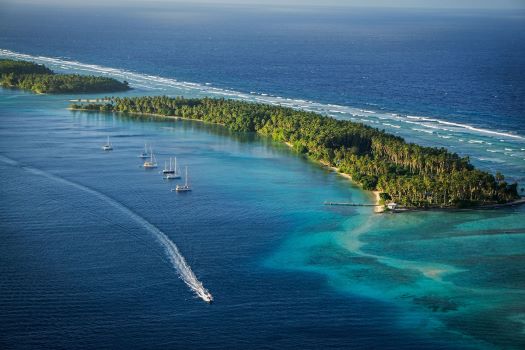 Image generated with Ai
Ngerulmud, the capital of the Pacific island nation of Palau, is located in a serene and visually stunning environment, surrounded by crystal-clear seas and lush greenery. Despite its picturesque setting, the capital stands as an oddity within the global landscape of government hubs. With only 390 residents, it is one of the least populated capitals in the world. This rarefied place, with its grand but mostly empty buildings, seems like a relic of a larger-than-life building project that has never truly come to fruition.
The Rise and Fall of Ngerulmud’s Capital Status
The notion of relocating Palau’s capital had its origins in the country’s constitution, which, in 1979, instructed the government to create a permanent capital on Babeldaob Island, the country’s largest landmass, within ten years. The decision was driven by the need to decentralize government from the commercial hub of Koror. Koror had served as the nation’s capital since Palau’s independence, but plans for a new government seat began to materialize in 1986. A Hawaii-based architecture firm, known for designing the Federated States of Micronesia’s Capitol complex, was contracted to design the new capital buildings.
However, the project faced significant delays. The local infrastructure was not equipped to support the ambitious plans, with few engineers or architects in Palau and the necessity of importing most construction materials. Development was sluggish, and it wasn’t until the early 2000s that real progress was made. The situation took a major turn when Palau secured a $20 million loan from Taiwan, as part of an effort to strengthen diplomatic ties and ensure Palau’s recognition of Taiwan on the global stage.
Advertisement
Advertisement
Construction and the Opening of Ngerulmud
The final capital complex, a $45 million investment, was completed and officially opened on October 7, 2006. The complex was designed to house separate buildings for the legislative, judicial, and executive branches of the government, all connected by a central open plaza. The inauguration of the complex was a grand event, attracting more than 5,000 attendees. Following this opening, government offices were moved from Koror to Ngerulmud, marking the formal shift of the capital.
Advertisement
Advertisement
However, despite the ceremony, the city’s population remained astonishingly low. The capital, meant to symbolize the growth and future of Palau, was barely inhabited. Its grand architecture and minimal occupancy gave it an eerie, abandoned feel that starkly contrasted with the hustle and bustle usually associated with a country’s capital.
Economic Struggles and the Ill-Suited Infrastructure
By 2013, Ngerulmud’s infrastructure had begun to show signs of strain. The buildings, which had been celebrated for their grandeur, were proving to be ill-suited for the local climate. In particular, the complex’s ventilation system had malfunctioned, leading to a mold infestation. The costs associated with maintaining the capital buildings escalated, and the country found itself sinking deeper into debt.
The situation grew more dire when it was reported that the Ngerulmud Post Office, which had opened in December 2011, was losing money. Despite operating for 16 months, it had accumulated expenses of over $30,000, while generating less than $2,000 in revenue. As part of cost-cutting measures in 2013, the post office was permanently closed. Ngerulmud was also the only settlement in Palau to have its own postal code, as the rest of the country used just one number to assist the United States Postal Service.
Ngerulmud’s Place in International Diplomacy
Despite its apparent failures, Ngerulmud did serve as the venue for some significant international events. In July 2014, it hosted the 45th Pacific Islands Forum. Although the official opening ceremonies took place in Ngerulmud, most of the event’s activities were held in Koror, with the leaders’ retreat taking place in Peleliu State. This underscored the disparity between Ngerulmud’s symbolic status and its practical use.
Advertisement
Advertisement
Further highlighting its diplomatic importance, in February 2016, Ngerulmud became the site of the 16th Micronesian Presidents’ Summit. The summit was attended by the presidents of Palau, the Marshall Islands, and the Federated States of Micronesia. These events, however, have not been able to substantially change the overall perception of Ngerulmud as a largely underutilized capital.
Impact on the Travel Industry
The unusual status of Ngerulmud as a capital city with so few residents and so little activity has had unique consequences for Palau’s tourism and travel industry. The island of Palau has long been known for its pristine natural beauty and coral reefs, which attract travelers seeking an off-the-beaten-path experience. However, the presence of a grand capital that is mostly empty has added a layer of intrigue to Palau’s image as a destination.
For travelers, the allure of visiting a capital city that feels more like a ghost town can serve as a curiosity-driven experience. Some may come to see the striking contrast between the grandeur of Ngerulmud’s government complex and the lack of life within it. Meanwhile, the financial struggles and low population numbers might have influenced the limited infrastructure available for tourists, potentially dissuading some from fully embracing Palau as a travel destination.
The global effects of Palau’s decision to create and maintain Ngerulmud as its capital are multifaceted. For diplomatic relations, the city serves as a symbolic gesture of Palau’s sovereignty and diplomatic partnerships, notably with Taiwan. However, for the average tourist, the vast emptiness of Ngerulmud could represent a destination that has been left in limbo.
A City of Contrasts
Ngerulmud, the capital of Palau, stands as a stark reminder of the complexities and challenges involved in urban planning and political decisions. Its mix of grandiosity and emptiness, its history of financial difficulty, and its role in international diplomacy highlight a unique chapter in the story of Palau. While it may remain a quiet, underpopulated area, its role in the broader context of Palau’s international presence is undeniable.
Advertisement
