
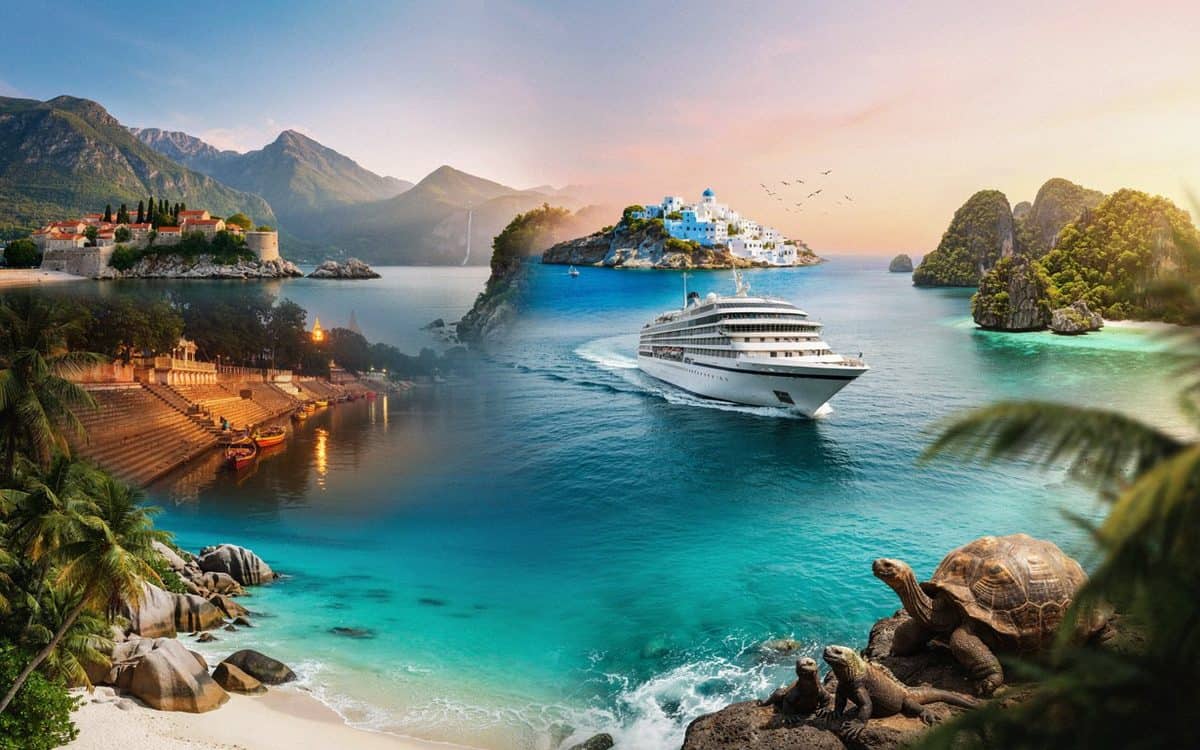
Image generated with Ai
Croatia and more countries are becoming very strong markets for small cruises, driving tourism, attracting high-value travellers and boosting local economies through rising cruise revenue earnings.
Croatia and more countries are emerging as very strong markets for small cruises, and the shift is reshaping tourism economies worldwide. Increasingly, travellers want intimate voyages, distinctive destinations and closer local experiences. Consequently, small cruises are gaining attention across established and emerging markets. Croatia remains particularly important, while Greece, Norway, the United States, Ecuador, Indonesia, India, Seychelles and other destinations are strengthening their positions. Moreover, smaller vessels can reach ports, islands, rivers and coastal communities that larger ships may not access easily. Therefore, rising demand is creating opportunities for tourism businesses, local communities and cruise operators to capture additional revenue earnings from specialised travel.
Advertisement
Small-ship cruising is no longer a niche alternative reserved for specialist travellers. In 2026, it has developed into a broad international travel segment spanning expedition voyages, luxury yachts, coastal exploration, river cruising, wildlife journeys and culturally focused itineraries.
Research from Tourism Economics and Travelzoo indicates that small-ship cruising is moving into the mainstream, with travellers increasingly interested in more personal, immersive and meaningful holidays. The research also identifies the itinerary and destination as major drivers of demand.
Advertisement
Advertisement
At the same time, CLIA reports that global expedition and exploration-ship capacity is expected to increase by 150% between 2019 and 2029, including ships on order. More than 40 purpose-built small expedition ships are already operating.
The industry’s strongest markets are spread across Europe, North America, Asia-Pacific and the world’s major expedition regions. Below is a country-by-country look at the Very Strong and Strong destinations shaping small-ship cruising.
Croatia stands among the strongest small-ship cruising destinations in Europe, thanks to its extensive Adriatic coastline, islands, historic towns and smaller ports.
Dubrovnik, Split, Hvar, Korčula and other Adriatic destinations are particularly compatible with smaller vessels. The appeal is not simply scenic cruising. Small ships can create itineraries focused on island visits, coastal communities and longer periods in individual destinations.
Croatia’s importance is also reflected in the interview with Powell Ettinger, Director of the Small Cruise Ship Collection, who said Croatia remains the company’s most popular destination.
The country’s combination of maritime geography and established tourism infrastructure gives it a particularly strong position within the Mediterranean small-ship industry.
Market position: Very Strong.
Greece is another natural market for small ships.
The Cyclades, Dodecanese and Ionian Islands provide an extensive network of destinations where smaller vessels can create itineraries around islands and harbours that are less suited to large cruise ships.
Patmos, Symi, Hydra, Mykonos, Santorini, Corfu, Crete and numerous smaller islands form part of the broader small-ship cruising landscape. Current destination research specifically highlights the ability of smaller vessels to reach harbours where large ships have limitations.
This makes Greece particularly competitive in luxury yacht cruising, boutique cruising and experiential Mediterranean itineraries.
Market position: Very Strong.
Norway occupies a particularly important position because it combines two major small-ship products: fjord cruising and expedition travel.
The country’s dramatic coastline, fjords and northern territories offer routes where landscape and access matter more than ship size.
Norway also provides a gateway to Arctic destinations, including Svalbard. Expedition itineraries can focus on wildlife, remote landscapes and nature rather than conventional port-based sightseeing.
Current small-ship itineraries feature Norwegian fjords among the world’s leading small-ship experiences, while expedition operators use northern Norway as a base for Arctic journeys.
Market position: Very Strong.
The United States is important to small-ship cruising in two ways: it is a major source of international cruise demand and also contains several important small-ship destinations.
Alaska is the standout example. The Inside Passage, Glacier Bay and smaller coastal destinations provide an environment particularly suited to expedition and nature-focused vessels.
Other opportunities include New England, the Pacific Northwest, Hawaii and selected river routes.
The wider US cruise market gives specialist small-ship operators a substantial customer base. Tourism Economics’ 2026 research specifically examined small-ship cruising demand in the US, UK, Germany and Canada, finding significant interest among travellers seeking immersive experiences.
Market position: Very Strong.
Ecuador’s position in small-ship cruising is closely linked to the Galápagos Islands.
The archipelago is one of the world’s most distinctive expedition destinations, where wildlife, conservation and controlled visitor access are central to the tourism model.
Small vessels are particularly appropriate for moving between islands and combining shipboard travel with guided excursions, wildlife encounters and marine activities.
Current small-ship industry research continues to place the Galápagos among the world’s leading small-ship experiences.
The destination demonstrates an important characteristic of the sector: sometimes the strength of a small ship is not luxury but access to a sensitive and geographically fragmented destination.
Market position: Very Strong.
Indonesia is one of the strongest Asian destinations for small-ship cruising, particularly because of its enormous archipelago.
Komodo, Raja Ampat and eastern Indonesia offer a combination of reefs, wildlife, islands and local communities that fits the small-ship model extremely well.
Small vessels can create journeys built around snorkelling, diving, nature, village visits and remote-island exploration.
Indonesia is also one of the destinations highlighted by Powell Ettinger as attracting increasing interest for the Small Cruise Ship Collection.
The country’s geographical diversity gives operators significant room to develop specialised itineraries rather than relying on a single cruise corridor.
Market position: Strong.
India’s small-ship opportunity is particularly significant in river and cultural cruising.
The Ganges and Brahmaputra provide routes through landscapes and communities that are fundamentally different from mainstream ocean cruising.
Small vessels can support journeys focused on heritage, culture, local life and river landscapes. The Ganges also features directly in the Small Cruise Ship Collection’s programme discussed by Ettinger.
His interview included an example of a village visited on a Ganges cruise, where a young boy learned English through interactions with passengers, later attended college and eventually became a teacher. Ettinger said the ship subsequently paid for a classroom to be built in the village.
That specific story should be attributed to Ettinger rather than presented as independently verified industry data. It nevertheless illustrates the company’s stated approach to local community engagement.
Market position: Strong.
The Seychelles offers a particularly strong proposition for boutique and small-ship cruising.
Its islands, reefs and marine environment lend themselves to sailing, island-hopping and intimate exploration.
Praslin, La Digue and other islands can form part of journeys where the vessel itself becomes a base for moving between different environments.
Small ships are well suited to this model because the destination is fundamentally about a collection of islands rather than a single conventional port.
The Seychelles is also one of the destinations Ettinger identified as receiving increased interest.
Market position: Strong.
Australia has a broad small-ship portfolio, but the Kimberley is particularly important.
The remote north-western region combines dramatic coastlines, Indigenous culture, wildlife and expedition-style exploration.
Other strong opportunities include Tasmania, the Great Barrier Reef and northern coastal waters.
Australia’s geography makes it particularly suitable for vessels designed around exploration rather than high-volume cruising. Expedition industry sources identify Australia and its Kimberley region as significant destinations for specialist voyages.
Market position: Strong.
New Zealand offers a compelling combination of mountains, fjords, wildlife and relatively remote coastal landscapes.
Fiordland and Milford Sound are particularly suited to small vessels seeking a more intimate experience of the landscape.
The country’s appeal is less about traditional cruise entertainment and more about scenery, nature and access.
Small-ship expedition itineraries can also connect New Zealand with the wider South Pacific, creating longer exploration journeys.
Current expedition port data includes Milford Sound, Fiordland and numerous New Zealand destinations within the specialist cruising network.
Market position: Strong.
Canada has two important small-ship opportunities: coastal British Columbia and the Arctic.
British Columbia provides access to dramatic coastal scenery and wildlife-rich waters, while Arctic Canada supports expedition voyages focused on remote communities, landscapes and wildlife.
The country’s enormous geography makes smaller vessels particularly useful for specialist itineraries.
Canada is also one of the four countries included in the 2026 Tourism Economics and Travelzoo research into small-ship cruising demand, alongside the US, UK and Germany.
Market position: Strong.
Iceland has become an important small-ship destination because its appeal centres on natural landscapes.
Volcanic terrain, glaciers, waterfalls, geothermal activity and North Atlantic wildlife provide the foundation for expedition-style itineraries.
The country also connects naturally with Arctic routes and northern European voyages.
Iceland’s ports, including Akureyri and Ísafjörður, appear in specialist expedition itineraries, demonstrating its established role in the sector.
Market position: Strong.
Italy’s long coastline and islands provide substantial potential for small-ship cruising.
The Amalfi Coast, Sicily, Sardinia, the Aeolian Islands and smaller Mediterranean ports can support itineraries built around culture, food, history and coastal scenery.
Small ships also offer a natural fit for travellers who want to combine famous Italian destinations with less conventional ports.
Italy’s established tourism infrastructure further strengthens its position.
Market position: Strong.
Spain’s Mediterranean coastline, Balearic Islands and Canary Islands give it a broad small-ship portfolio.
Barcelona and other major gateways can be combined with smaller destinations, while the Balearics provide strong opportunities for yacht-style and boutique cruising.
The Canary Islands add a different proposition, combining volcanic landscapes and Atlantic island exploration.
Specialist expedition port data includes destinations such as Barcelona, Palma de Mallorca, Ibiza, Málaga and the Canary Islands.
Market position: Strong.
Portugal has two particularly valuable small-ship products: the Douro River and Atlantic island cruising.
The Douro offers a classic river-cruise environment where smaller vessels are integral to the product.
The country’s Atlantic destinations, including Madeira and the Azores, also provide opportunities for nature and island-focused voyages.
The Douro is included among leading 2026 small-ship cruise choices, demonstrating the continuing importance of Portugal’s river product.
Market position: Strong.
Turkey has a distinctive position through its traditional gulet and yacht-cruising culture.
The Aegean and Mediterranean coasts provide numerous coves, historic sites and smaller coastal destinations.
Bodrum, Marmaris and Fethiye are particularly associated with this style of travel.
Turkey demonstrates how small-ship cruising can overlap with traditional sailing, boutique accommodation and experiential coastal tourism.
Market position: Strong.
Small-ship cruising is increasingly being positioned as a way to reach destinations and communities that larger cruise ships cannot easily access. Speaking in an Exclusive interview with Powell Ettinger, Director, Small Cruise Ship Collection, at Destinations: The Holiday & Travel Show 2026, Manchester. , explained how the company is showcasing intimate travel experiences, emerging destinations and community-focused sustainability.
Ettinger said the key objective during the four-day Manchester event was to connect with travellers interested in small-ship cruising around the world and demonstrate why this form of travel can sometimes be the best, and even the only, way to experience certain destinations.
According to Ettinger, the focus this year is particularly on the experiences available on board and the opportunities they create at destinations that may not be accessible through conventional cruising.
Rather than concentrating solely on the ship itself, the Small Cruise Ship Collection is seeking to highlight what travellers can experience because of the nature and scale of small-ship cruising.
Ettinger explained that the central message at the Manchester event was about the types of experiences travellers can have on board and at destinations that they would not necessarily experience in another way.
This approach places access and immersion at the centre of the small-ship proposition. Smaller vessels can form part of journeys to destinations where intimate encounters with local communities are an important component of the travel experience.
For the Small Cruise Ship Collection, therefore, cruising is presented not simply as accommodation combined with transportation, but as a means of reaching particularly interesting places and experiencing them differently.
When discussing current destination demand, Ettinger said Croatia continues to be the company’s most popular destination.
However, he also highlighted growing interest in destinations further afield, including Indonesia, India and the Seychelles.
The comments indicate that while established destinations remain important to the small-ship cruise market, travellers are also showing interest in more distant and distinctive experiences.
Indonesia, India and the Seychelles each offer very different environments and cultural experiences, giving small-ship itineraries opportunities to appeal to travellers looking for something beyond traditional cruise routes.
Ettinger described these destinations simply as “very interesting places to visit”, while emphasising that Croatia continues to lead the company’s popularity.
Sustainability was another major theme of the interview.
Asked about environmentally friendly and sustainable practices, Ettinger explained that the company uses a range of sustainability methods. However, he stressed that sustainability can mean different things to different people.
For the Small Cruise Ship Collection, sustainability is not limited to environmental considerations. A significant part of its approach involves ensuring that visits to local communities can generate economic benefits for the people who live there.
Ettinger gave the example of a small village in Indonesia visited by one of the company’s cruises. The visits can generate revenue for the community, which can then contribute towards important local needs, including education.
This model connects tourism with community development. Rather than treating a village simply as a sightseeing stop, the cruise visit can become a source of income that supports people living in the destination.
Ettinger also shared a particularly personal example from India, involving a village visited during a cruise on the Ganges.
He recalled that around 15 years ago, the company noticed a young boy, approximately 12 years old, who appeared whenever the ship visited the village. The boy would meet passengers, walk with them through the village and speak with visitors.
Eventually, someone asked him why he returned every week.
His answer was that he wanted to become a teacher and learn English. Speaking with visitors gave him an opportunity to practise the language.
The story did not end with those encounters.
According to Ettinger, the boy eventually went to college. After completing his studies, the ship paid for a classroom to be built in the village, and he subsequently became the teacher there.
The example illustrates the type of community relationship Ettinger believes can emerge from small-ship tourism. A visit that begins as a travel experience can, over time, contribute to opportunities within the destination itself.
The interview also addressed whether the Small Cruise Ship Collection collaborates with local communities.
Ettinger’s answer was unequivocal: “Absolutely. Very much so.”
He described collaboration with local communities as a key part of the company’s approach.
This community connection is particularly relevant to small-ship cruising because the scale of operations can allow itineraries to incorporate smaller settlements and more localised experiences.
Instead of focusing only on major tourism centres, small-ship journeys can connect travellers with villages and communities, creating direct interaction between visitors and residents.
That interaction can also create opportunities for local people to benefit from tourism, whether through direct spending, community projects or other forms of engagement.
The interview presents a clear distinction in the way the Small Cruise Ship Collection is marketing its product.
The emphasis is not simply on visiting a large number of destinations. It is on how travellers experience those destinations.
Ettinger’s comments repeatedly return to access, local interaction and community relationships. The ship becomes part of a wider travel experience rather than the sole attraction.
For travellers interested in less conventional journeys, this can be an important proposition. A smaller vessel may provide access to places where the experience is built around the destination, local people and cultural interaction.
At the same time, the company’s focus on Croatia alongside increasing interest in Indonesia, India and the Seychelles shows that small-ship cruising can combine established destinations with more distant and distinctive itineraries.
The interview took place at Destinations: The Holiday & Travel Show 2026 in Manchester, where the Small Cruise Ship Collection was seeking to meet people interested in small-ship cruising.
For Ettinger, the event offered an opportunity to explain why travellers might choose smaller vessels and to showcase the experiences that differentiate these journeys.
The emphasis on experiences is particularly significant in a travel market where destination discovery and meaningful interaction increasingly form part of the holiday decision.
Rather than presenting small-ship cruising purely as a cruise product, the interview frames it as a way of travelling to places and communities that can be difficult to experience through other forms of tourism.
The examples provided by Ettinger point towards a model in which tourism can have a direct relationship with local communities.
The Indonesian village example demonstrates how visitor revenue can contribute towards local needs. The Ganges village story provides an example of how a relationship that began through repeated cruise visits ultimately supported a former young visitor’s ambition to become a teacher.
Neither example suggests that every cruise visit automatically produces the same outcome. Instead, they demonstrate the company’s stated approach to community engagement and its interpretation of sustainable tourism.
For the Small Cruise Ship Collection, the value of a journey therefore extends beyond the passengers on board. Local communities and the destinations themselves are also part of the experience.
The country-by-country picture shows that small-ship cruising is not dependent on one destination or one type of traveller.
Croatia and Greece lead through Mediterranean island and coastal cruising. Norway and Iceland benefit from fjord and expedition demand. Ecuador has an exceptionally strong wildlife proposition through the Galápagos. The US combines a major customer base with Alaska and other domestic small-ship opportunities.
Meanwhile, Indonesia, India and the Seychelles represent different forms of Asian and Indian Ocean growth.
The industry’s expansion is also being supported by rising expedition capacity. CLIA says global expedition and exploration capacity is projected to grow by 150% between 2019 and 2029. National Geographic Traveller, citing CLIA research, reported that bookings for small-scale voyages increased by 22% between 2023 and 2024.
The central lesson is clear: small-ship cruising is increasingly being sold through the destination and the experience, rather than simply the vessel.
For travellers, that means smaller ships can provide access to islands, fjords, rivers, wildlife habitats and coastal communities that form the heart of the journey. For the industry, it creates a diversified market covering luxury, adventure, culture, nature and expedition travel.
With demand increasingly centred on immersive travel, the strongest small-ship countries are those where geography and experience give smaller vessels a genuine advantage over large-scale cruising.
The interview suggests that small-ship cruising is continuing to build its appeal around intimate experiences, destination access and local engagement.
Croatia remains the leading destination for the Small Cruise Ship Collection, while Indonesia, India and the Seychelles are attracting increasing interest, according to Ettinger.
Sustainability is being approached through multiple methods, including community-based benefits and collaboration with local populations. The Ganges village story demonstrates how such relationships can potentially create benefits that continue long after a single cruise visit.
As travellers increasingly seek distinctive experiences, the small-ship model offers an alternative to conventional mass-market cruising. Its strongest proposition, according to Ettinger, is not merely the size of the vessel but what that size makes possible: closer encounters, access to interesting destinations and meaningful connections with the communities visited.
The cause is clear: travellers increasingly seek personalised, immersive and destination-focused holidays instead of standardised cruise experiences. As a result, Croatia and more countries are building very strong markets for small cruises. These voyages can connect visitors with smaller ports, islands, villages, wildlife areas and culturally significant destinations. The answer lies in the industry’s ability to combine access, comfort, exploration and authentic experiences within carefully designed itineraries. Revenue earnings can then spread across cruise operators, accommodation providers, guides, transport companies, restaurants and local communities. Therefore, stronger small-cruise demand can support tourism economies while encouraging destinations to develop higher-value, experience-led travel products.
Advertisement
Advertisement
Advertisement













Saturday, September 5, 2026

Friday, September 4, 2026

Saturday, September 5, 2026

Saturday, September 5, 2026

Thursday, September 3, 2026

Wednesday, September 2, 2026

Saturday, September 5, 2026

Saturday, September 5, 2026


