
Italy Overtakes Greece, Spain, France, and Portugal as Mount Etna’s Continuing Eruption Sends Towering Ash Plumes Across Sicily, Triggers Aviation Monitoring, Challenges Summer Travel Plans, and Reinforces Europe’s Focus on Volcanic Tourism Safety

Published
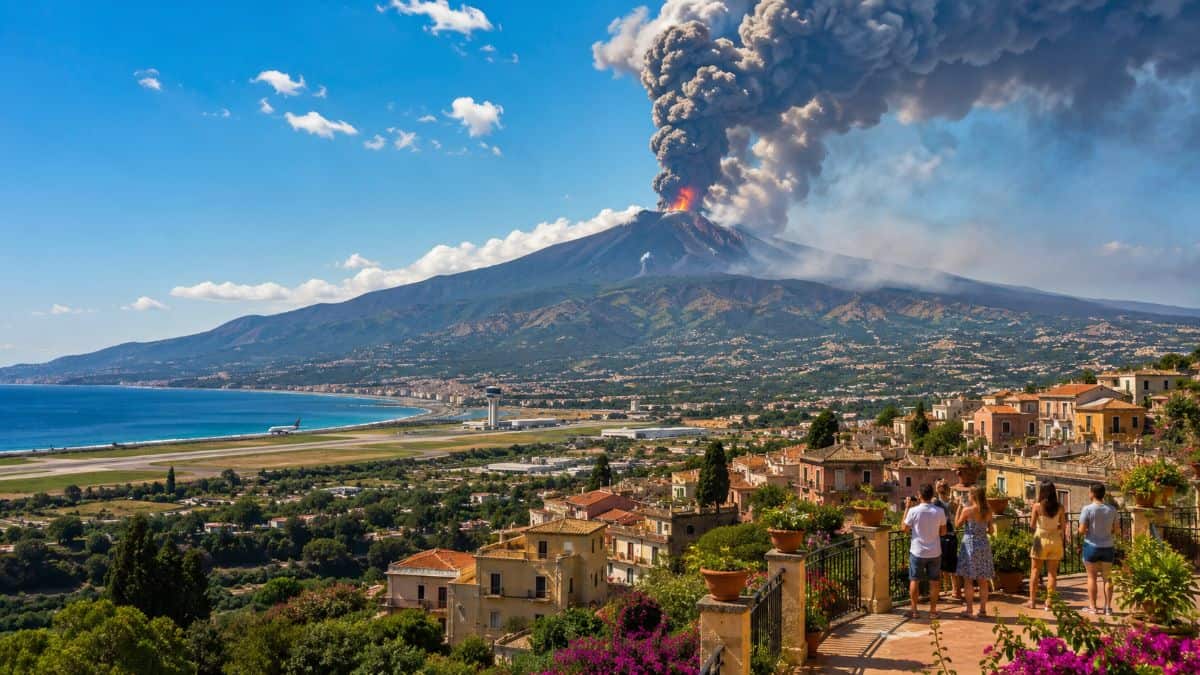
Mount Etna, Europe’s tallest and most active volcano, has once again become the focus of international travel attention as renewed eruptive activity sends towering plumes of volcanic ash and smoke high above eastern Sicily. The Italian National Institute of Geophysics and Volcanology (INGV) has issued a Yellow Volcano Observatory Notice for Aviation (VONA), indicating elevated volcanic activity that requires enhanced monitoring by aviation authorities. While the eruption has generated dramatic visuals visible across parts of Sicily, authorities continue to emphasize that the situation is being closely monitored and that travel across most of the island remains operational.
The latest volcanic activity arrives during one of Europe’s busiest tourism periods, when Sicily welcomes thousands of international visitors every day. Travelers from across the United Kingdom, Europe, North America, and Asia continue arriving to experience Sicily’s beaches, historic cities, vineyards, and Mount Etna itself. Although volcanic ash remains the principal concern for aviation operations, there have been no widespread shutdowns of tourism across the island. Instead, airlines, airports, tourism operators, and emergency authorities are working together to ensure passenger safety while maintaining normal travel services wherever conditions allow.
Italy Faces Renewed Aviation Monitoring as Mount Etna Remains Active
| Key Information | Latest Status |
|---|---|
| Volcano | Mount Etna |
| Location | Eastern Sicily, Italy |
| Aviation Alert | Yellow VONA |
| Monitoring Authority | Italian National Institute of Geophysics and Volcanology (INGV) |
| Main Concern | Volcanic ash affecting aviation |
| Tourism Status | Majority of Sicily remains open |
Mount Etna has remained one of the world’s most closely monitored volcanoes because of its frequent eruptions and proximity to populated communities and major transportation infrastructure. The current eruptive phase has produced continuous volcanic emissions, including ash clouds and smoke columns extending high into the atmosphere.
Italy’s INGV continues monitoring seismic activity, lava flows, volcanic tremors, gas emissions, and ash dispersion in real time. Aviation authorities rely on this scientific data to determine whether flight routes require adjustments or whether airport operations should be modified.
Advertisement
Advertisement
The Yellow VONA represents an elevated level of volcanic unrest rather than an indication of widespread disruption. It serves primarily as an advisory for pilots, airlines, and air traffic controllers to remain vigilant as volcanic conditions evolve.
How the Eruption Could Influence Air Travel Across Sicily
| Travel Sector | Potential Impact |
|---|---|
| Commercial Flights | Possible delays if ash increases |
| Airport Operations | Continuous monitoring |
| Air Routes | Temporary adjustments possible |
| International Arrivals | Mostly continuing |
| Domestic Flights | Subject to operational reviews |
Volcanic ash represents one of aviation’s most significant natural hazards because microscopic particles can damage aircraft engines, windshields, navigation equipment, and ventilation systems.
Advertisement
Advertisement
Consequently, airports serving eastern Sicily—particularly Catania Airport—remain under continuous observation whenever Mount Etna becomes more active.
Authorities stress that operational decisions depend on wind direction, ash concentration, eruption intensity, and atmospheric conditions. If volcanic ash moves toward active flight corridors, temporary restrictions may be introduced until conditions improve.
Advertisement
Advertisement
At present, the aviation alert remains precautionary rather than indicative of widespread cancellations.
Sicily’s Tourism Industry Continues Welcoming Visitors
| Tourism Area | Operational Status |
|---|---|
| Palermo | Open |
| Taormina | Open |
| Syracuse | Open |
| Cefalù | Open |
| Agrigento | Open |
| Coastal Resorts | Open |
Despite spectacular images circulating worldwide, Sicily’s tourism industry continues operating across most destinations.
Hotels, restaurants, museums, archaeological attractions, beaches, wineries, and cultural sites remain open throughout much of the island. Travelers visiting western and southern Sicily are experiencing little or no disruption.
Even eastern Sicily continues welcoming visitors, although access to areas closest to Mount Etna may change depending on volcanic conditions and civil protection advice.
Advertisement
Advertisement
Tour operators offering volcano excursions continue coordinating with local authorities to ensure visitor safety before conducting guided experiences.
Mount Etna Remains One of Europe’s Most Popular Natural Attractions
Mount Etna has attracted travelers for centuries because of its extraordinary geological significance and constantly changing landscape.
Recognized as a UNESCO World Heritage Site, the volcano combines scientific importance with adventure tourism, drawing hikers, photographers, volcanologists, nature enthusiasts, and cultural travelers from around the world.
Unlike many dormant volcanic destinations, Mount Etna offers visitors an opportunity to witness Earth’s geological processes in real time. Periodic eruptions have become part of Sicily’s tourism identity, although visitor safety always remains the highest priority.
Experienced guides regularly adjust hiking routes and excursion schedules whenever volcanic activity increases.
Scientific Monitoring Strengthens Travel Safety
| Monitoring Activity | Purpose |
|---|---|
| Seismic Monitoring | Detect volcanic movement |
| Gas Analysis | Measure eruption intensity |
| Thermal Imaging | Observe lava activity |
| Satellite Monitoring | Track ash plume movement |
| Aviation Coordination | Protect aircraft operations |
Italy possesses one of the world’s most advanced volcanic monitoring systems.
Advertisement
Advertisement
Scientists continuously analyze thousands of data points collected through seismic stations, satellite observations, GPS networks, thermal cameras, gas sensors, and field inspections.
This scientific infrastructure enables authorities to provide timely information to airlines, emergency agencies, airport operators, tourism businesses, and local governments.
The coordinated approach minimizes risks while allowing tourism activities to continue safely whenever possible.
Summer Travelers Encouraged to Stay Informed
The current eruption highlights the importance of monitoring travel updates before and during trips to volcanic destinations.
Travelers flying into Sicily should regularly check airline notifications regarding flight schedules, particularly if arriving through eastern Sicily.
Visitors planning Mount Etna excursions should confirm tour availability directly with licensed operators, as summit access may change depending on volcanic conditions.
Advertisement
Advertisement
Comprehensive travel insurance covering natural events can provide additional reassurance for international visitors, particularly during periods of increased geological activity.
Authorities also encourage travelers to follow official safety instructions and avoid entering restricted volcanic zones.
Sicily Demonstrates Tourism Resilience During Natural Events
Volcanic activity has long been part of everyday life in Sicily.
Communities surrounding Mount Etna have developed extensive emergency planning, scientific cooperation, and tourism management strategies that enable the region to respond effectively during periods of heightened activity.
Hotels, transportation providers, tourism boards, emergency services, and scientific institutions work together to provide accurate information while minimizing unnecessary disruption.
This coordinated response helps preserve traveler confidence while prioritizing public safety.
Advertisement
Advertisement
What the Eruption Means for International Tourism
| Industry Impact | Current Assessment |
|---|---|
| Leisure Tourism | Largely continuing |
| Business Travel | Minimal impact |
| Cruise Tourism | Monitoring conditions |
| Adventure Tourism | Guided access subject to safety reviews |
| Aviation | Enhanced monitoring continues |
For the broader European travel industry, Mount Etna’s latest eruption serves as a reminder that natural events can influence transportation while not necessarily halting tourism.
Modern volcanic monitoring technology allows authorities to make targeted operational decisions instead of imposing broad travel restrictions.
The situation also demonstrates how destinations with active geological landscapes can balance visitor experiences with comprehensive safety management.
As long as volcanic activity remains within anticipated monitoring thresholds, Sicily is expected to continue welcoming domestic and international travelers throughout the summer season.
Outlook for Travelers
Scientists continue closely observing Mount Etna as volcanic activity evolves.
The Yellow aviation alert remains a precautionary measure designed to enhance awareness rather than signal immediate widespread disruption.
Advertisement
Advertisement
Travelers planning visits to Sicily should stay informed through official aviation updates, airline communications, and local authority guidance.
For now, Sicily remains open, its tourism industry continues operating, and Mount Etna once again illustrates both the remarkable power of nature and the importance of science-led travel risk management.
Frequently Asked Questions
1. Why is Mount Etna currently making headlines?
Mount Etna is experiencing renewed eruptive activity, producing significant ash and smoke plumes that have prompted increased aviation monitoring.
2. What does the Yellow VONA alert mean?
A Yellow Volcano Observatory Notice for Aviation indicates elevated volcanic activity requiring close monitoring but does not automatically mean flights will be suspended.
3. Is Sicily still open to tourists?
Yes. Most tourism destinations, hotels, attractions, and services across Sicily continue operating normally.
4. Are flights to Sicily being cancelled?
Most flights continue operating, although delays or operational adjustments may occur if volcanic ash affects airspace.
Advertisement
Advertisement
5. Which airport is most closely monitored?
Catania Airport is the primary airport monitored because of its proximity to Mount Etna.
6. Can tourists still visit Mount Etna?
Yes, but access to summit areas may change depending on volcanic activity and guidance from local authorities.
7. Is volcanic ash dangerous to aircraft?
Yes. Volcanic ash can damage aircraft engines and navigation systems, which is why aviation authorities continuously monitor ash clouds.
8. Should travelers cancel their Sicily holidays?
There is currently no general recommendation to cancel trips. Travelers should monitor official updates and airline communications.
9. Who monitors Mount Etna’s activity?
Italy’s National Institute of Geophysics and Volcanology (INGV) continuously monitors the volcano and provides scientific updates.
10. What should travelers do before flying to Sicily?
Travelers should check flight status, monitor official advisories, stay in contact with their airline, and follow guidance issued by local authorities.
Advertisement
