
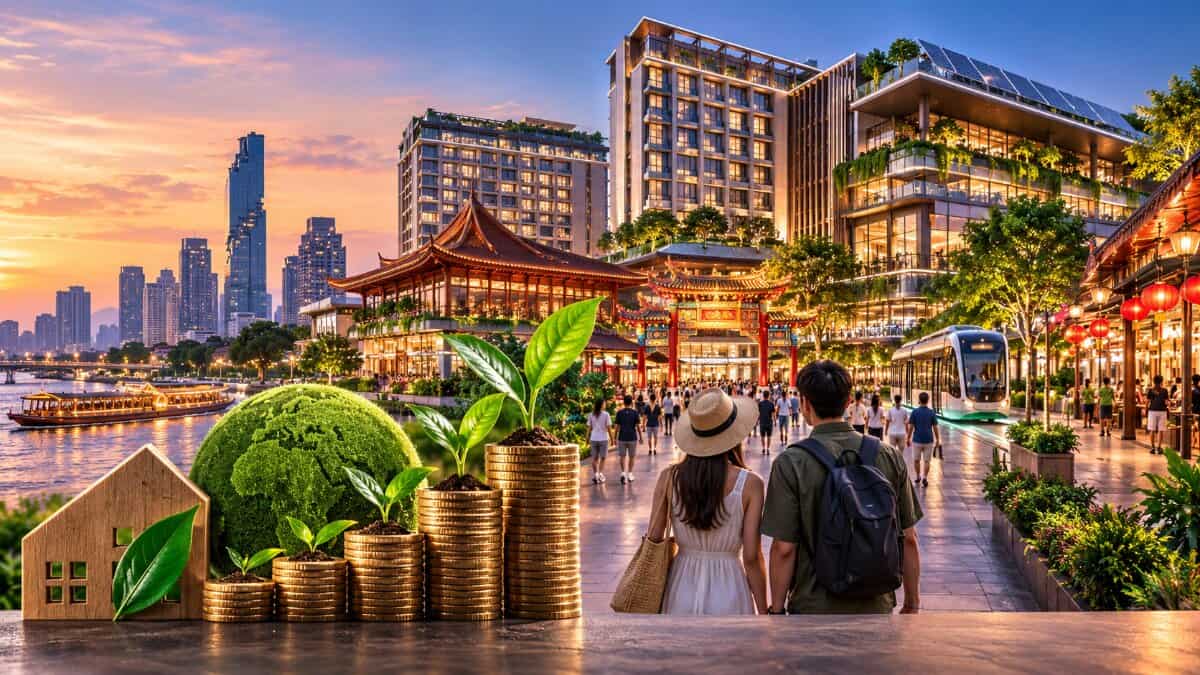
Image generated with Ai
Thailand’s latest sustainable tourism financing is not merely a hotel funding agreement. The THB40.5 billion AWC-SCB package combines a THB10.5 billion project-specific green loan for Woeng Nakornkasem Yaowaraj with a THB30 billion sustainability-linked facility for future developments. The structure moves capital towards mixed-use destination ecosystems combining accommodation, retail, culture, attractions and mobility, giving travel distributors a future product cluster rather than one new property.
Asset World Corp Public Company Limited and Siam Commercial Bank completed the THB40.5 billion financing arrangement on 16 July 2026. The package supports AWC’s long-term property pipeline while directing a defined portion towards the company’s largest mixed-use development in Bangkok’s Yaowarat district.
Advertisement
The distinction between the two financing components is critical. The Loan Market Association defines green loans through the allocation of proceeds to eligible green projects. Sustainability-linked loans instead connect financing conditions to predetermined borrower-level sustainability objectives. Therefore, the entire THB40.5 billion package should be described as sustainable financing, not exclusively as green financing.Financing component Value Share of package Disclosed purpose B2B travel relevance Green Loan THB10.5 billion 25.9% Development of Woeng Nakornkasem Yaowaraj under recognised green-building standards Directly supports a new Bangkok tourism district containing hotels, retail, cultural experiences and visitor infrastructure Sustainability-Linked Loan THB30 billion 74.1% Future quality developments across strategic Thai tourism destinations Extends sustainability-linked capital across AWC’s wider destination and hospitality portfolio Total financing THB40.5 billion 100% Sustainable growth and development pipeline Creates a financing platform capable of supporting multiple tourism assets rather than one isolated hotel
The percentage shares are calculated from the disclosed THB40.5 billion total. No public breakdown has yet been released covering interest margins, drawdown schedules, loan maturity, sustainability performance targets or independent verification arrangements.
Advertisement
Advertisement
The strongest industry angle lies in the financing architecture rather than the headline amount.
Traditional sustainable hotel investment has often concentrated on individual assets. Typical interventions include solar installations, efficient cooling systems, lighting upgrades, water conservation and building certification. The 2026 structure retains that environmental discipline through the project-specific green loan but places it inside a much broader destination-development strategy.
The THB10.5 billion tranche is tied to a defined urban district. The THB30 billion facility can support future portfolio developments whose financing conditions are linked to AWC’s wider sustainability performance. This creates two levels of accountability: environmental eligibility at project level and sustainability-linked performance at corporate level.
For tourism investors, this signals that sustainable finance is moving beyond back-of-house hotel engineering. It can now support the entire visitor journey, including where travellers stay, how they move, what attractions they visit, where they spend, and how heritage districts connect with surrounding communities.
This dual-layer model could become increasingly relevant to developers assembling resorts, cultural quarters, waterfront districts, integrated entertainment destinations and multi-property hospitality portfolios. Thailand’s official taxonomy now covers construction and real estate alongside energy and transport, creating a more structured national reference for classifying environmentally sustainable activities and directing capital towards lower-carbon development.
Woeng Nakornkasem Yaowaraj spans more than 14 rai in one of Bangkok’s oldest commercial and cultural districts. Full completion is scheduled for 2029.
The development will include InterContinental Bangkok Chinatown, Kimpton Bangkok Chinatown, premium retail space, a contemporary Chinese pavilion, community-oriented cultural areas and a Kung Fu Panda visitor experience developed with Universal Destinations & Experiences.
This combination widens the project’s commercial base. Hotel revenue will represent only one part of the destination economy. Retail leasing, food and beverage, entertainment, cultural programming and visitor circulation can create additional spending opportunities and extend dwell time.
The travel-trade opportunity will therefore extend beyond accommodation contracts. Tour operators could eventually combine luxury stays with gastronomy, heritage walks, family entertainment, river access and neighbourhood experiences inside one Bangkok itinerary.
| Destination element | Confirmed development detail | Potential traveller benefit | Travel-trade application |
|---|---|---|---|
| Luxury accommodation | InterContinental Bangkok Chinatown and Kimpton Bangkok Chinatown | Two internationally recognised hotel propositions within the same heritage district | Premium leisure, couples, lifestyle and high-value group packages |
| Retail and dining | Premium retail areas integrated into the mixed-use site | Greater convenience and longer visitor dwell time | Shopping, dining and evening itinerary extensions |
| Cultural infrastructure | Contemporary Chinese pavilion and spaces for communities and families | More structured interpretation of Thai-Chinese heritage | Cultural tours, educational groups and multigenerational travel |
| Entertainment | Universal-linked Kung Fu Panda experience | Family-oriented international attraction | Family packages and stopover programmes |
| Urban mobility | Planned tram serving the wider Yaowarat district | Easier circulation between attractions and transport nodes | Multi-stop itineraries with reduced transfer friction |
| Wider connectivity | Links planned towards Ong Ang Canal, the Chao Phraya River and the MRT network | Integration of rail, river and district-level movement | Combined river, heritage and urban exploration products |
| Road access | More than 800 parking spaces connected through the proposed mobility hub | Additional access for coaches, private vehicles and domestic visitors | Group touring, transfers and regional drive-market packages |
The proposed tram is especially important. Woeng Nakornkasem is intended to operate as its central mobility hub, connecting visitors with Ong Ang Canal, the Chao Phraya River, the MRT system and parking infrastructure. The disclosure does not yet provide the tram’s operating model, route length, capacity, construction timetable or ticketing structure. Travel companies should therefore treat the mobility plan as a development-stage component rather than a confirmed bookable service.
The financing arrives as Thailand seeks to protect tourism income while confronting uneven demand recovery, high travel costs and growing regional competition.
Thailand welcomed 32.97 million international visitors in 2025, down 7.23% year on year. International tourists generated THB1.54 trillion, while combined domestic and international tourism revenue reached THB2.70 trillion. The country’s publicly communicated 2026 ambition exceeds 33 million international arrivals and targets at least THB2.65 trillion in total tourism income.
Bank of Thailand data recorded approximately 14 million foreign visitors during the first five months of 2026. May tourism receipts improved as long-haul demand recovered and arrivals from China and Malaysia benefited from holiday periods. However, other short-haul markets weakened amid softer demand and reduced flight services linked to elevated energy costs.
This environment strengthens the commercial logic behind destination ecosystems. When arrival growth becomes less predictable, tourism operators must capture more value from each trip. A district combining hotels, dining, entertainment, heritage and transport can increase spending opportunities without depending entirely on higher visitor numbers.
Yaowaraj also offers year-round urban demand. Unlike weather-sensitive island resorts, Bangkok’s Chinatown can attract international leisure travellers, domestic visitors, food tourists, stopover passengers, families and corporate groups across multiple seasons.
AWC entered the financing arrangement after reporting THB6.78 billion in revenue for the first quarter of 2026, an increase of 9.5% year on year. Net profit reached THB1.99 billion.
Hospitality revenue rose 12% to THB4.08 billion, while commercial-business revenue increased 10.3% to THB2.63 billion. Same-store hotel revenue per available room reached THB5,230 per night. Asiatique The Riverfront recorded a 16% rise in average daily visitor traffic, demonstrating how attraction-led mixed-use destinations can support rental income and commercial performance.
At 31 March 2026, AWC recorded THB205.85 billion in total assets, THB108.03 billion in total liabilities and THB97.82 billion in equity. Its interest-bearing debt-to-equity ratio stood at 0.87 times.
As a scale comparison, the THB40.5 billion package equals approximately 19.7% of AWC’s reported balance-sheet assets at the end of March. This calculation illustrates the facility’s significance but does not mean the full amount has been drawn, spent or immediately added to liabilities.
The 2026 deal represents an acceleration of an established financing strategy rather than Thailand’s first use of sustainable real-estate lending.Year Announced financing Development emphasis Strategic progression 2020 THB4.5 billion IFC green loan Energy efficiency and hotel business operations Asset-level environmental improvement 2022 THB20 billion SCB sustainability-linked loan and ESG-linked interest-rate swap Corporate ESG targets, including emissions reduction and external sustainability performance Borrower-wide sustainability incentives 2023 THB20 billion SCB green and sustainability-linked financing Mega-destinations including Asiatique, Aquatique, Woeng Nakornkasem and Lannatique Multi-project destination development 2026 THB40.5 billion green and sustainability-linked package Ring-fenced Yaowaraj development plus future nationwide projects District-scale and portfolio-level financing combined
These are announced facility sizes and should not be added together as outstanding debt because the institutions have not publicly disclosed whether earlier arrangements were refinanced, replaced, extended or partially repaid.
For international hotel partners, the project creates a two-brand foothold in Chinatown. InterContinental can target established luxury and business demand, while Kimpton can address lifestyle-oriented travellers and experience-led urban breaks.
For destination management companies, the district could reduce the operational fragmentation that often complicates Bangkok programmes. Accommodation, dining, entertainment and cultural activities may be packaged within a tighter geographical area, supported by future links to river and rail transport.
The development may also support incentives, corporate groups and smaller cultural events. However, no official meeting-space capacities, ballroom specifications, group allocations or opening phases have been disclosed. MICE planners should avoid selling venue capabilities until detailed hotel factsheets and operational dates become available.
The broader THB30 billion facility presents a second opportunity. Future AWC projects could expand sustainable tourism inventory beyond Bangkok, potentially creating new contracting opportunities across accommodation, attractions, retail and destination experiences. The specific projects receiving that capital have not yet been identified in the 16 July announcement.
The THB40.5 billion package demonstrates that sustainable tourism investment in Thailand is evolving from isolated hotel improvements towards integrated destination systems.
Its most important feature is not simply the amount of capital. It is the combination of a ring-fenced green loan for a specific mixed-use district and a sustainability-linked facility supporting a broader development pipeline.
If delivered as planned, Woeng Nakornkasem Yaowaraj could turn part of Bangkok’s Chinatown into a more connected, higher-spending and longer-stay visitor zone while preserving cultural positioning as its principal differentiator.
For the wider travel industry, the deal provides a potential financing template for future tourism growth. Hotels, attractions, mobility, public spaces, cultural infrastructure and local commercial activity can increasingly be treated as interconnected components of one destination economy. That approach could shape how tourism projects across Thailand and other Asian markets are funded, measured and distributed during the next phase of global travel growth.
Advertisement
Tags: AWC SCB sustainability-linked loan, green finance for Thailand tourism investment, Thailand sustainable tourism, THB40.5 billion tourism financing, Yaowaraj mixed-use tourism development
Advertisement
Advertisement













Saturday, September 5, 2026

Friday, September 4, 2026
Saturday, September 5, 2026

Saturday, September 5, 2026

Thursday, September 3, 2026

Wednesday, September 2, 2026

Saturday, September 5, 2026

Saturday, September 5, 2026


