
Image generated with Ai
Oranjestad and more destinations in Aruba can be your first stop before Caribbean exploration, offering travellers far more than a traditional beach escape. First, the colourful capital provides an easy introduction to the island. Then, Eagle Beach, Palm Beach, Baby Beach and Mangel Halto bring spectacular coastal experiences. Meanwhile, Arikok National Park, Alto Vista Chapel, San Nicolas, California Lighthouse and the Natural Pool add adventure, culture and dramatic scenery. Therefore, Aruba creates a complete Caribbean journey in one destination. Visitors can start here, explore diverse attractions and discover why the island continues to strengthen its global travel appeal.
Travellers can explore Eagle Beach, Oranjestad, Arikok and local food in one compact trip. Moreover, strong tourism infrastructure makes visits simple. Official guidance also supports confidence, while normal precautions still matter. Together, these strengths keep Aruba attractive, varied and easy to enjoy, giving travellers clear reasons to return again for another Caribbean holiday soon.
Advertisement
Aruba ranks 14th as top safest travel destination in the Americas and Caribbean for 2026 delivers far more than a conventional beach holiday, with its ten leading destinations offering a complete travel and tourism journey through colourful cities, famous white-sand shores, luxury resort districts, cultural landmarks, mangrove waters and wild national park landscapes.
For travellers planning a Caribbean escape, Aruba presents an unusually diverse experience within a manageable island setting, where Queen Beatrix International Airport, AUA, provides the main gateway before visitors spread across destinations ranging from vibrant Oranjestad and Eagle Beach to remote Arikok National Park and the challenging Natural Pool. This variety gives the island a significant tourism advantage, because visitors can build holidays around relaxation, family activities, culture, adventure or nature while moving between dramatically different landscapes without the lengthy domestic travel often required in larger destinations.
Advertisement
Oranjestad introduces travellers to Aruba through a lively capital where colourful architecture, waterfront areas, shopping, restaurants and local attractions create a strong first impression, while its proximity to the island’s international airport makes arrival and onward exploration particularly convenient. For travel and tourism visitors, the city works as more than an entry point because it provides an urban experience that adds culture and commercial activity to an island holiday otherwise strongly associated with beaches and resort life.
Visitors can spend time exploring the streets before heading towards coastal destinations, allowing an Aruba itinerary to begin with history and local atmosphere rather than immediately moving into a hotel-based holiday routine. This balance makes Oranjestad important to the wider tourism economy, as the capital connects international arrivals with accommodation zones, visitor services and many of the island’s most popular attractions.
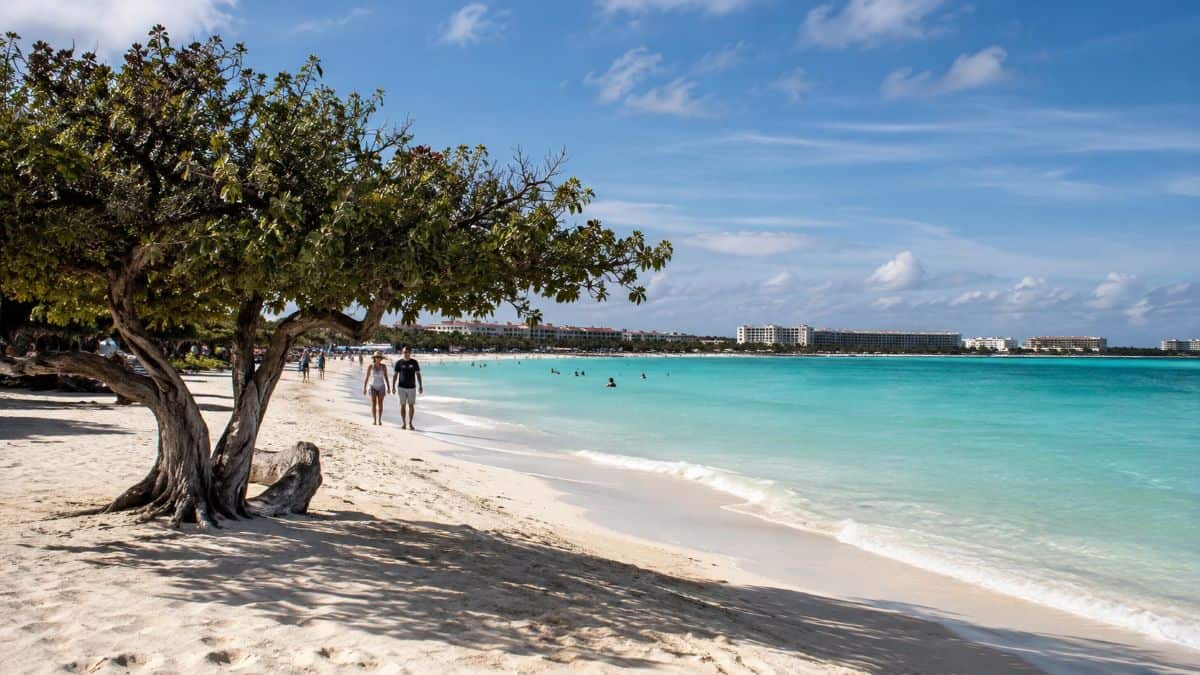
Eagle Beach has become synonymous with the image many travellers expect from a Caribbean holiday, featuring broad white sand, bright clear water and the distinctive fofoti trees that have helped make the location one of Aruba’s most photographed coastal scenes. Its spacious shoreline and relaxed atmosphere give beach-focused travel visitors room to swim, unwind and enjoy the scenery while remaining close to hotels and other tourism facilities.
Unlike a heavily built-up resort environment, Eagle Beach creates a feeling of openness that appeals to visitors seeking a quieter rhythm without sacrificing convenience or accessibility. This combination of natural beauty and practical access explains why the beach remains one of Aruba’s most important tourism assets and a major reason many international travellers place the island on their holiday lists.
Advertisement
Advertisement
Palm Beach offers a completely different atmosphere, concentrating major hotels, restaurants, entertainment, watersports and nightlife along a highly developed stretch of Aruba’s north-western coast. For travellers wanting an easy holiday structure where accommodation and activities are available nearby, the area provides one of the island’s most comprehensive tourism environments.
The district also functions as a useful base for wider travel across northern Aruba, particularly for visitors planning excursions to the California Lighthouse and surrounding coastal attractions. Its strong concentration of visitor infrastructure means Palm Beach remains especially attractive to travellers who value choice, convenience and a lively holiday atmosphere from morning through to late evening.
Arikok National Park changes the perception of Aruba by replacing manicured resort landscapes with rugged terrain, desert scenery, cacti, caves and powerful coastal environments that reveal the island’s wilder natural character. For tourism and travel enthusiasts looking beyond the beach, the park provides opportunities for hiking, sightseeing and adventure while protecting landscapes that form a major part of Aruba’s environmental identity.
The park is also home to several notable natural attractions, making it an important destination for visitors prepared to leave the main coastal corridors and explore more demanding terrain. This nature-based tourism dimension gives Aruba greater depth as a destination, allowing travellers to combine luxurious beach stays with experiences shaped by geology, wildlife and dramatic scenery.
Baby Beach stands out because of its protected, shallow lagoon, creating calmer conditions that make it particularly appealing to families travelling with children and visitors who prefer gentle swimming environments. The beach’s curved shoreline and clear water provide a distinctly different experience from Aruba’s open coastal areas, while its southern location encourages travellers to explore beyond the island’s principal resort districts.
Tourism visitors can combine a day at Baby Beach with a wider journey through southern Aruba, including nearby San Nicolas and other coastal attractions, making the location more than a standalone beach stop. Its family-friendly character strengthens Aruba’s travel appeal by ensuring that the island offers suitable experiences for visitors of different ages and holiday preferences.
Alto Vista Chapel introduces history and spirituality into an Aruba itinerary, offering travellers a landmark connected to the island’s religious heritage and positioned within a peaceful landscape away from the busiest tourism centres. Its setting creates an opportunity for visitors to slow down, take photographs and experience a more reflective side of Aruba after spending time in the island’s energetic beach and resort areas.
The destination also demonstrates the importance of cultural tourism, because Aruba’s identity cannot be understood entirely through sand, sea and luxury accommodation alone. Adding Alto Vista Chapel to a travel route gives visitors a broader perspective of the island, combining heritage with scenic exploration and making the overall holiday experience more varied.
San Nicolas provides a different cultural perspective through its local character, colourful street art and position in Aruba’s south, giving travellers an opportunity to explore an area with a noticeably different atmosphere from the island’s major resort zones. The city is particularly valuable for tourism because it can be combined with southern beaches, transforming a simple coastal excursion into a wider day of cultural discovery.
For visitors seeking local creativity and a less conventional travel experience, San Nicolas adds an important layer to the island’s destination portfolio and encourages exploration beyond the familiar Palm Beach and Eagle Beach areas. Its role as a gateway to attractions in southern Aruba further strengthens its value, allowing travellers to connect urban culture with some of the island’s most attractive coastal scenery.
Mangel Halto appeals to travellers looking for a quieter coastal setting, where mangroves, clear shallow water and marine experiences replace the busy energy of large hotels and crowded entertainment areas. This more natural environment is especially attractive for snorkelling enthusiasts and visitors who want to experience another side of Aruba tourism without moving too far from the island’s developed road network.
The destination demonstrates that Aruba’s beaches are not all designed around the same tourism model, with Mangel Halto offering a slower and more nature-oriented alternative to the island’s famous resort coast. For travel planners, including it in an itinerary creates variety by balancing major attractions with a more peaceful location where the natural coastal environment becomes the principal experience.
The California Lighthouse occupies one of Aruba’s most dramatic positions, offering expansive views across the island’s north-western landscape and creating a popular stop for sightseeing, photography and sunset watching. Its historic identity and commanding setting make it a natural addition to a northern travel route, particularly for visitors staying in or around Palm Beach.
The surrounding scenery also reveals a rougher coastal character that contrasts sharply with the calm resort beaches nearby, reminding tourism visitors that Aruba’s geography extends beyond its most famous sandy shores. This combination of history, landscape and accessibility keeps the lighthouse relevant for travellers seeking an easy excursion with strong visual rewards.
The Natural Pool, known locally as Conchi, delivers one of the island’s most dramatic nature experiences, hidden among the rugged terrain of Arikok National Park and surrounded by rock formations that create a striking natural swimming basin. Reaching it requires more effort than visiting Aruba’s roadside beaches, with suitable access involving a 4×4 journey, organised adventure experience, horseback route or demanding hike.
For experienced walkers, the journey can form a substantial outdoor activity, making the Natural Pool particularly attractive to travellers seeking adventure rather than simple sightseeing. This demanding access is part of its appeal, because the destination rewards visitors with an experience that feels distinctly separate from the highly developed tourism environment found around Aruba’s hotels and major beaches.
Aruba has strengthened its position in the global tourism landscape through a combination of international traveller recognition, exceptional tourism dependence and continued visitor growth, although the island should not be assigned a ranking in the World Economic Forum’s Travel and Tourism Development Index because no official TTDI score or position is available for Aruba. The clearest international ranking comes from Tripadvisor, where Aruba was named the No. 1 destination in the Caribbean in the 2025 Travellers’ Choice Best of the Best Awards and also secured a place in the global Top 25 destinations.
The Aruba Tourism Authority’s report on the 2025 Tripadvisor Travellers’ Choice Awards confirmed that the island topped the Caribbean destination list, with its global Top 25 position further underlining its appeal among international visitors. The recognition was based on the quality and volume of traveller reviews covering accommodation, restaurants and activities during the assessment period, giving Aruba a tourism accolade rooted in visitor experiences rather than a conventional expert-panel judgement.
This ranking provides one of the strongest available indicators of Aruba’s international tourism reputation, particularly as the island competes with numerous established Caribbean holiday destinations. Aruba’s beaches, resort infrastructure, Dutch-Caribbean culture, outdoor activities and broad visitor appeal have helped it develop a tourism proposition extending beyond a traditional sun-and-sand holiday.
According to the Government of Aruba and Aruba Tourism Authority’s May 2026 results, the island welcomed 133,680 stay-over visitors during May 2026, while cumulative visitor nights through May reached 1,515,102, producing an average stay of seven nights. North America remained the largest source region, accounting for 74.4% of arrivals, followed by South America at 19%, Europe at 4.1% and other markets at 2.5%.
Tourism spending also demonstrates the sector’s economic importance, with the Aruba Tourism Authority reporting total visitor expenditure of US$3.06 billion in 2025 from its Spending Insights research, based on more than 8,000 completed surveys. These results suggest that Aruba’s tourism success is being measured not only through arrivals but also through visitor spending, length of stay and the destination’s ability to attract both first-time and returning travellers.
Aruba remains a generally stable Caribbean destination for travel and tourism, supported by a U.S. Level 1 travel advisory and established visitor infrastructure, although British and American authorities stress that tourists should still take sensible precautions against theft, crime and other travel risks.
For travellers assessing destination safety, the U.S. Department of State’s Aruba Travel Advisory currently assigns the island Level 1: Exercise Normal Precautions, the lowest level in the American advisory system. This makes Aruba a strong option for Caribbean travel and tourism, but Level 1 should not be interpreted as meaning that the destination is entirely free from crime or every possible safety risk.
The wider U.S. international travel information for Aruba states that crime affecting tourists primarily involves theft, particularly valuables left unattended at beaches, in vehicles and in public places, while violent incidents, although not common, can occur. It also advises additional caution in isolated areas and notes an increased risk of crime in San Nicolas, especially at night, giving travellers a more nuanced picture of destination safety.
The UK Foreign, Commonwealth & Development Office’s Aruba travel advice similarly makes clear that no foreign travel can be guaranteed completely safe and recommends that travellers research destinations and obtain suitable insurance. The FCDO’s current safety guidance identifies risks from petty theft and occasional street crime, while advising visitors to avoid remote areas at night, protect valuables and avoid leaving bags unattended in vehicles.
This means descriptions claiming that Aruba has universally very low crime rates should be avoided unless supported by a clearly defined official crime dataset and methodology. A more accurate tourism description is that Aruba offers a generally stable and well-established travel environment, while visitors should continue to follow normal personal-security measures throughout their stay.
“Aruba is an exceptional destination because every journey across the island reveals another reason to travel, from the colourful energy of Oranjestad and the extraordinary beauty of Eagle Beach to the cultural personality of San Nicolas and the raw natural drama of Arikok National Park. Its greatest tourism strength is genuine variety, because families, luxury travellers, beach lovers, culture seekers and adventure enthusiasts can all shape an entirely different holiday while enjoying the same Caribbean destination, and that ability to combine comfort, discovery, nature and unforgettable experiences makes Aruba a destination that deserves global attention throughout 2026 and beyond.”- Vedika Keshan, Associate Editor, Travel And Tour World
| Destination | Main appeal | Principal access |
|---|---|---|
| Oranjestad | Capital, heritage, shopping, dining | AUA |
| Eagle Beach | White sand, swimming, fofoti trees | AUA |
| Palm Beach | Resorts, dining, water activities | AUA |
| Arikok National Park | Hiking, wildlife, caves, geology | AUA + road |
| Baby Beach | Shallow water, relaxation, snorkelling | AUA + road |
| Alto Vista Chapel | Heritage, landscape, sightseeing | AUA + road |
| San Nicolas | Culture, murals, southern Aruba | AUA + road |
| Mangel Halto | Mangroves, reef and snorkelling | AUA + road |
| California Lighthouse | Coastal views and landmark sightseeing | AUA + road |
| Natural Pool | Rugged nature and adventure | AUA + Arikok access |
Queen Beatrix International Airport, code AUA, is Aruba’s primary international gateway. Current airport information shows scheduled services linking Aruba with destinations across North America, Latin America, the Caribbean and Europe. Live departures include cities such as Miami, New York, Boston, Newark, Bogotá, Lima, Curaçao and Amsterdam.
Aruba also provides a significant convenience for US-bound passengers. Official tourism information states that the airport contains a US pre-clearance facility, allowing eligible travellers to complete US immigration and customs formalities before departure from Aruba.
Food is an important part of the Aruba experience because the island’s cuisine reflects Caribbean, Dutch and wider international influences.
One of the most recognisable local dishes is keshi yena, a filled cheese dish that Aruba’s official tourism platform specifically recommends as part of a local culinary itinerary. Another easy local favourite is pastechi, a filled fried pastry commonly eaten as a snack or breakfast item.
Fresh fish and seafood are also strongly connected to island dining. Official tourism information highlights locally caught seafood experiences, particularly around traditional fishing communities such as Savaneta.
Travellers can also encounter Dutch-style pancakes and broad international dining choices in Palm Beach and Oranjestad. This range reflects Aruba’s multicultural character and means food tourism can become part of almost any itinerary.
Aruba’s 14th position in this editorial ranking is strongest when viewed as the result of several factors working together rather than as a claim that the island is crime-free.
Official government advice gives Aruba an important advantage. The US State Department maintains its lowest advisory category, Level 1 – Exercise Normal Precautions, and explicitly describes Aruba as generally safe for travellers. At the same time, UK and Canadian authorities remind visitors that petty theft and occasional street crime remain possible, making ordinary precautions necessary.
Beyond safety, Aruba offers strong international air access, established tourism infrastructure and remarkable geographic variety. Travellers can experience Oranjestad, Eagle Beach, Palm Beach, Arikok National Park, Baby Beach, Alto Vista Chapel, San Nicolas, Mangel Halto, California Lighthouse and the Natural Pool during one island holiday.
That balance is Aruba’s real strength in 2026. It combines the simplicity of a compact Caribbean destination with beaches, culture, food, adventure and internationally connected infrastructure. Those qualities provide a credible explanation for Aruba’s strong placement within a broader travel ranking.
Aruba’s fourteenth spot in 2026 makes sense because the island gives travellers more than one reason to return. Its beaches bring the first attraction. Yet Oranjestad, Arikok National Park, local food, cultural sites and easy airport access add depth to every trip. Established tourism infrastructure also makes moving around the island simple, while official travel guidance supports confidence when visitors follow normal precautions. The result is a Caribbean destination that feels easy, varied and memorable. Aruba keeps travellers coming back because it combines relaxation, nature, culture and convenience in one compact island, giving repeat visitors something to enjoy each time.
Aruba’s appeal for international tourism remains substantial, with visitors able to explore Oranjestad, Eagle Beach, Palm Beach, Arikok National Park, Baby Beach and other leading attractions through a developed visitor economy and established transport network. However, responsible travel reporting requires safety claims to distinguish between a favourable government travel advisory and an unsupported claim that a destination is crime-free or among the world’s safest without a recognised comparative ranking.
For travellers, the practical conclusion is straightforward: Aruba can be considered a strong Caribbean option for travel and tourism, particularly given its Level 1 U.S. advisory, but normal precautions remain essential. Protecting valuables, avoiding isolated locations after dark, using appropriate transport and checking the latest official government guidance before departure will help visitors make informed decisions.
Travellers arriving internationally use Queen Beatrix International Airport, AUA, which serves as Aruba’s principal aviation gateway and provides onward access by road to the island’s leading tourism destinations.
Oranjestad, Eagle Beach and Palm Beach are strong choices for first-time travel visitors because they provide an accessible combination of city attractions, famous beaches, accommodation and tourism infrastructure.
Baby Beach is particularly suitable for families because its shallow lagoon creates calmer swimming conditions, while the wider southern region also offers opportunities for a full day of exploration.
Yes, experienced travellers can reach the Natural Pool on foot, although the route is demanding and visitors should prepare for heat, rough terrain and changing natural conditions before beginning the journey.
Yes, Aruba combines its celebrated beach tourism with adventure travel through Arikok National Park, hiking routes, rugged landscapes, caves and the challenging journey to the Natural Pool.
Advertisement
Advertisement
Advertisement













Saturday, September 5, 2026

Friday, September 4, 2026
Saturday, September 5, 2026

Saturday, September 5, 2026

Thursday, September 3, 2026

Wednesday, September 2, 2026

Saturday, September 5, 2026

Saturday, September 5, 2026


