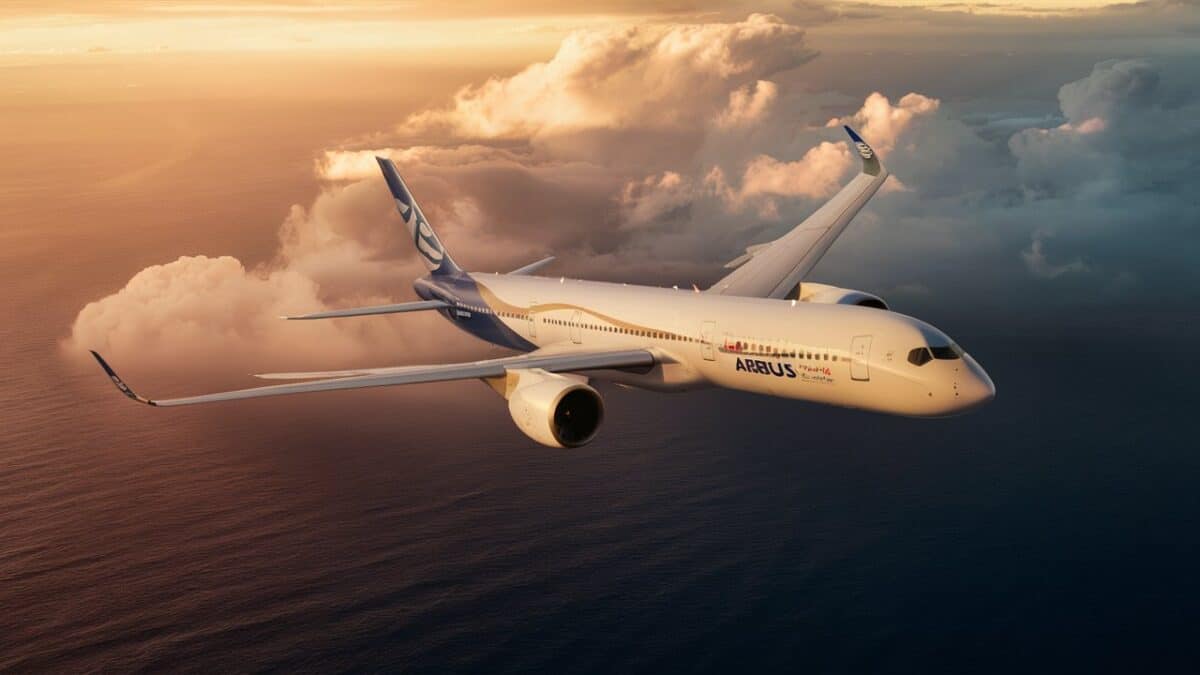
Image generated with Ai
The Airbus A350-1000 is reshaping global aviation with ultra-high frequency routes connecting major hubs like London, New York, Tokyo, Doha, and Hong Kong in 2026. Airlines are deploying it for efficiency, capacity, and premium demand. These routes reveal shifting travel patterns, intense competition on long-haul corridors, and growing reliance on next-generation widebody aircraft for sustainable intercontinental connectivity.
The Airbus A350-1000 has quietly become the backbone of global long-haul aviation. In 2026, it is not just a flagship aircraft. It is a network-defining machine shaping how continents connect.
Advertisement
From London to New York, Tokyo to Doha, and Hong Kong to Toronto, airlines are using the aircraft at record frequency levels. The pattern is clear: dense premium corridors are being rebuilt around efficiency, fuel savings, and high-yield business demand.
According to compiled 2026 schedule data, several routes now exceed 800 annual frequencies, showing how deeply embedded the aircraft has become in global airline strategy.
Advertisement
Advertisement
The surge in A350-1000 deployments is not accidental. It is the result of three powerful forces reshaping aviation.
First, international demand has fully normalised after pandemic-era disruptions. Business travel has returned strongly on transatlantic and Asia–North America routes. Second, airlines are retiring older Boeing 777-300ER aircraft in favour of more fuel-efficient alternatives. Third, slot constraints at major airports are forcing airlines to up-gauge aircraft rather than add frequencies.
The A350-1000 fits this environment perfectly. It delivers lower fuel burn per seat, extended range, and high-density cabin flexibility.
On routes like London Heathrow–New York JFK, carriers now operate up to 843 annual A350-1000 frequencies, making it the busiest deployment worldwide.
Advertisement
Advertisement
This is no longer just aircraft selection. It is network survival strategy.
The biggest winners are full-service carriers operating hub-to-hub long-haul corridors.
Airlines such as Virgin Atlantic, Qatar Airways, Cathay Pacific, and Japan Airlines are maximising fleet efficiency by deploying the A350-1000 on high-demand routes instead of fragmenting capacity across multiple smaller aircraft.
Mega hubs such as London Heathrow Airport, New York John F. Kennedy International Airport, Tokyo Haneda Airport, and Hamad International Airport benefit from predictable, high-capacity widebody flows that support premium connectivity and transit traffic.
Business travellers gain most from frequency stability and improved onboard products like suites, premium economy, and lie-flat cabins.
On routes such as Hong Kong–Toronto and Doha–São Paulo, frequencies exceed 500–648 annual A350-1000 operations, reflecting strong demand in long-haul leisure and corporate travel markets.
For passengers, the A350-1000 boom brings both advantages and trade-offs.
On key corridors like London–Delhi and Taipei–Tokyo Narita, passengers now see one to two A350-1000 flights daily, reducing dependence on single daily services.
The aircraft is increasingly used for premium positioning. Airlines deploy configurations ranging from ultra-dense 480-seat layouts to premium-heavy 239-seat flagship versions.
For example, Japan Airlines operates one of the most premium A350-1000 layouts with first class suites, while Air Caraïbes uses a high-density 10-abreast economy model.
The aircraft now dominates ultra-long-haul sectors such as Tokyo Haneda–New York JFK and Hong Kong–Toronto, both exceeding 6,700 nautical miles.
These routes highlight how modern widebodies are eliminating stopovers entirely, reshaping global mobility expectations.
The long-term trajectory is clear: the Airbus A350-1000 is becoming the global replacement for the Boeing 777-300ER.
Airlines are steadily shifting premium long-haul fleets toward this aircraft due to its fuel efficiency and lower operational cost per seat. Its versatility allows it to serve both ultra-long-haul missions and dense short intercontinental routes.
Future developments point toward:
In many ways, the aircraft is evolving into the default long-haul backbone of global aviation.
The busiest A350-1000 routes reveal a clear global pattern:
Each route is a strategic choice, not just a scheduling decision. Airlines are aligning aircraft capability with passenger yield potential.
Travellers can benefit strategically from this network evolution:
The aircraft is becoming a quality benchmark across global airlines.
The Airbus A350-1000 is no longer a niche widebody. It is a structural force reshaping global aviation networks.
Its dominance across London, New York, Tokyo, Doha, and Hong Kong reflects a deeper transformation in airline economics: fewer aircraft types, higher seat density, and stronger hub consolidation.
As demand grows and older fleets retire, the A350-1000 is positioned to define the next decade of long-haul connectivity, setting new standards for efficiency, comfort, and global reach.
Because it combines long range, fuel efficiency, and high seating capacity, making it ideal for busy international routes.
London Heathrow to New York JFK, with over 800 annual frequencies.
Virgin Atlantic, Qatar Airways, Japan Airlines, and Cathay Pacific.
Hong Kong to Toronto, exceeding 6,700 nautical miles.
Yes, it is increasingly seen as the main replacement for the Boeing 777-300ER.
Advertisement
Advertisement
Advertisement













Saturday, September 5, 2026

Friday, September 4, 2026

Saturday, September 5, 2026

Friday, September 4, 2026

Thursday, September 3, 2026

Wednesday, September 2, 2026

Friday, September 4, 2026