
Germany’s Medical Tourism Grows Around Advanced Cancer Care

Published
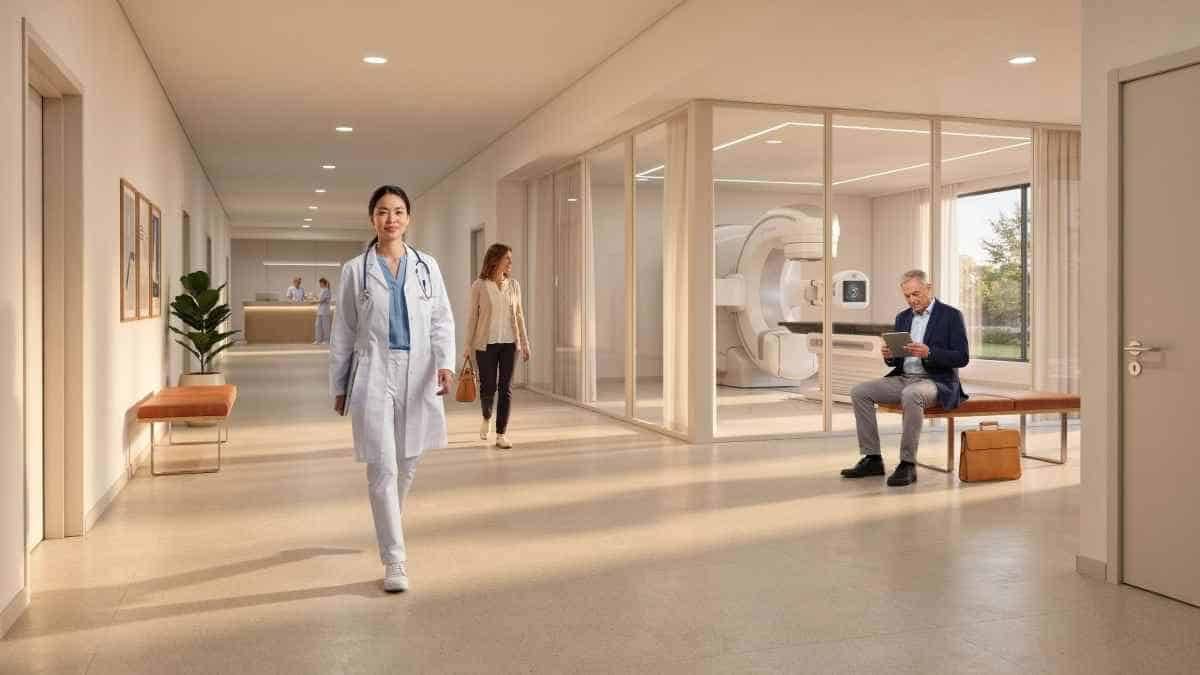
Image generated with Ai
Germany is improving its standing when it comes to medical tourism, and this is thanks to cities like Heidelberg, Berlin and Munich, which provide international visitors with access to cutting-edge cancer care, particle therapy, complicated reconstructive treatments and specialist surgeries. Germany’s university hospitals have been able to integrate their academic expertise with very specialised health care, thus forming a system that appeals to individuals seeking complicated treatments. German railway and airline networks, as well as hotels, have also made longer stays possible for foreign patients.
University Hospitals Lead Germany’s Medical Travel Sector
Germany’s medical tourism infrastructure is closely linked to its university hospitals. Institutions including Heidelberg University Hospital, Charité – Universitätsmedizin Berlin and LMU Klinikum Munich combine specialist clinical departments with research and teaching.
Heidelberg University Hospital operates an International Office that supports overseas patients with treatment enquiries, appointments, estimates and administrative coordination. Charité similarly provides international patient services for visitors seeking treatment in Berlin.
This structure allows international patients to submit medical records before travelling, helping specialists determine which department and treatment pathway may be appropriate.
Advertisement
Advertisement
Heidelberg Builds a Particle Therapy Advantage
Heidelberg is particularly significant in Germany’s international oncology sector because of the Heidelberg Ion-Beam Therapy Centre (HIT).
Advertisement
Advertisement
HIT provides both proton and carbon-ion therapy. The centre uses raster-scanning technology to deliver particle beams to precisely defined treatment areas, with the aim of limiting radiation exposure to surrounding healthy tissue.
Particle therapy can be considered for selected tumours, particularly where conventional radiation treatment may be challenging because of the tumour’s location or sensitivity of nearby organs.
The treatment is not suitable for every cancer. Patients require specialist assessment, imaging and treatment planning before a particle-therapy programme can be confirmed.
Advertisement
Advertisement
Carbon-Ion and Proton Therapy Support Complex Cases
Carbon-ion therapy differs from conventional photon radiation because carbon ions have different physical and biological characteristics. The treatment can deliver radiation with a highly concentrated dose distribution, while its biological effectiveness can be greater in certain tumour types.
At Heidelberg, particle therapy has been used for selected skull-base and spinal tumours, sarcomas and other difficult-to-treat cancers.
Advertisement
Advertisement
For international patients, treatment can require several weeks in Germany. This makes accommodation, airport transfers and access to local transport important parts of the medical travel plan.
Berlin Expands Complex Reconstruction
Berlin’s Charité is another major destination for international patients requiring complex specialist treatment.
The university hospital provides a wide range of surgical disciplines, including neurosurgery, orthopaedics, transplantation and reconstructive medicine. Its academic environment also supports advanced surgical research and clinical innovation.
Complex reconstruction can involve multiple specialties and may require detailed imaging, surgical planning and post-operative rehabilitation.
For international patients travelling for major surgery, the treatment journey may therefore include an initial consultation, diagnostic assessment, surgery, inpatient recovery and rehabilitation.
Advertisement
Advertisement
Robotic Surgery Adds Minimally Invasive Options
Robotic-assisted surgery is increasingly available at major German hospitals. Robotic platforms can assist surgeons in procedures where enhanced visualisation and precise instrument movement are clinically useful.
Munich’s LMU Klinikum provides advanced surgical services and transplant medicine within a large university-hospital network.
Robotic surgery can be considered for selected procedures involving urology, general surgery, gynaecology and other specialties. The use of a robotic system does not necessarily mean a shorter hospital stay for every patient, as recovery depends on the procedure and individual medical circumstances.
Germany’s International Patient Network
International patients form an established part of Germany’s private and university-hospital healthcare system. Hospitals commonly provide international patient coordinators, translation assistance, appointment scheduling and cost estimates.
For visitors from outside the European Union, treatment planning may also involve visa documentation and proof of financial arrangements.
Advertisement
Advertisement
Patients should secure written confirmation from their hospital before making travel arrangements. A medical treatment plan can also help determine how long accommodation will be required.
Recovery Travel Adds a Tourism Dimension
Germany’s medical travel ecosystem extends into destinations known for rehabilitation and wellness.
Baden-Baden, located in southwest Germany, has a long-established spa tradition and offers luxury hotels, thermal facilities and medical wellness services. Tegernsee, south of Munich, provides another destination associated with lakeside resorts, rehabilitation and wellness.
Patients recovering from complex surgery should only move to a resort or spa destination once their treating medical team confirms that travel is safe.
For accompanying family members, these destinations provide cultural, nature and leisure experiences while the patient follows a medically supervised recovery schedule.
Key Stats
- 2: Particle therapy modalities available at Heidelberg Ion-Beam Therapy Centre, proton and carbon-ion therapy.
- 2009: HIT began treating patients with carbon ions and protons.
- 40,000+: Patients treated at HIT since clinical operations began.
- 3 major hubs: Heidelberg, Berlin and Munich form important centres for Germany’s international specialist healthcare network.
- 2026: Germany continues expanding digital healthcare, international patient coordination and specialist medical infrastructure.
Travel Details for International Patients
There are some important international gateways in Germany. Frankfurt Airport has great connections throughout the world and is connected to Heidelberg by railway, while Berlin Brandenburg Airport is situated near the capital. Munich Airport connects international patients to Bavaria and Munich’s leading hospitals. It takes around an hour to reach Heidelberg from Frankfurt Airport by car, while the hospitals in Munich can be reached from Munich Airport via public transportation and transfers. Medical consultations should be planned to purchase tickets. Some hospitals may ask for imaging, pathology results, previous treatments and referral letters. In the case of complex oncology treatment, patients should also include follow-up visits after the treatment. Proximity of accommodation near the treating hospital can save patients’ time during the treatment period. German healthcare tourism industry is concentrating more on complex healthcare rather than simple elective procedures only. The particle therapy at Heidelberg, surgical knowledge in Berlin and specialist infrastructure in Munich offer opportunities for international patients to undergo specialized treatment in Germany, while Baden-Baden and Tegernsee attract international patients not only for medical treatment but also for relaxation and recovery.
Advertisement
