 Paramita Sarkar Paramita Sarkar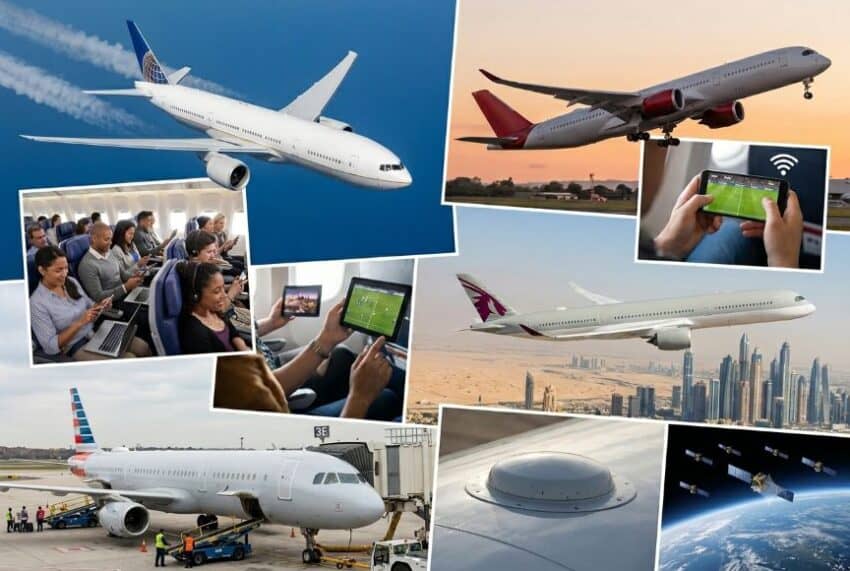
Image generated with Ai
As a definitive movement radically transforming the skies, the global commercial aviation sector actively joins the low-Earth orbit satellite internet paradigm to decisively annihilate in-flight friction. This strategic integration illustrates precisely how international air carriers are permanently joining their core operational digital networks with massive aerospace technology conglomerates to eliminate bandwidth dead zones entirely. To construct this definitive travel trade analysis, our primary mode of research relies exclusively on cross-referencing verified official civil aviation authority reports, national tourism board announcements, formal economic data, and official airline corporate filings. Consequently, this rigorous methodology confirms that advanced satellite connectivity now structurally dictates the future of the global passenger experience across the US, UK, and Qatar.
Fundamentally, the sudden transition toward advanced space-based internet completely rewrites the operational rulebook for global air carriers. Airlines historically struggled to provide adequate bandwidth over vast oceans, polar routes, and isolated territories using traditional geostationary satellites. However, the rapid introduction of low-Earth orbit satellite internet instantly eliminates these geographic blind spots, offering ground-like speeds at 35,000 feet. Travel trade professionals now uniformly recognise this technological leap as a critical driver for passenger retention and premium cabin yields.
Advertisement
Furthermore, this rapid deployment forces legacy inflight entertainment providers to radically reassess their long-term commercial models. Passengers increasingly demand the uninterrupted ability to utilise their personal devices for high-definition streaming, real-time corporate video conferencing, and online gaming. Therefore, airlines must aggressively modernise their fleets or risk immediately alienating the highly lucrative business traveller demographic. Ultimately, this structural industry shift leaves absolutely no room for complacency among major international carriers.
United Airlines is currently executing the most aggressive and comprehensive Starlink rollout within the modern aviation industry. In late June 2026, the major US carrier marked a historical milestone by flying its very first Starlink-equipped transatlantic widebody flight. Specifically, Flight 14 departed flawlessly from Newark to London aboard a Boeing 777-200, signalling a massive operational acceleration for the carrier. The airline officially expects to have nearly 1,000 aircraft entirely outfitted with this revolutionary technology before the end of 2026.
Advertisement
Advertisement
Crucially, the sheer scale of this technological deployment heavily impacts global travel markets and airline operational metrics. Since originally launching the service in the spring of 2025, United has already flown over 18.6 million passengers on Starlink-equipped aircraft. These passengers travelled seamlessly across more than 311,000 connected flights, fundamentally normalising high-speed aerial internet access for the masses. Consequently, United plans to complete its entire widebody fleet installation by next summer, setting a formidable new benchmark for North American competitors.
While United aggressively pursues a full-fleet integration, American Airlines is purposefully adopting a much more segmented deployment strategy. In May 2026, American Airlines formally announced it will bring Starlink technology to more than 500 of its Airbus narrowbody aircraft. This massive upgrade programme specifically targets the A319, A320, A321, and new Airbus deliveries, with physical installations officially beginning in early 2027.
Notably, American Airlines’ Boeing jets and twin-aisle widebody aircraft remain entirely excluded from this initial Starlink integration phase. The carrier will deliberately continue utilising its existing legacy connectivity providers for its long-haul international widebody routes for the foreseeable future. However, this focused narrowbody approach still guarantees that American’s domestic and short-haul international passengers will soon experience unprecedented internet speeds. Ultimately, this strategic decision highlights exactly how major US carriers are prioritising immediate hardware upgrades on their most heavily trafficked domestic corridors.
Across the Atlantic, Virgin Atlantic is uniquely leveraging its newly acquired advanced bandwidth to fundamentally redefine inflight entertainment capabilities. The prominent UK carrier recently established a high-profile commercial partnership with IMG to directly integrate the Sport 24 live broadcasting channel. Consequently, passengers flying on Starlink-equipped Virgin Atlantic aircraft can instantly access premium global sporting events in crystal-clear high definition. This highly innovative approach perfectly demonstrates how proactive airlines can maximise the commercial potential of space-based broadband networks.
Currently, this advanced connectivity remains fully active on exactly one-third of the airline’s entire operational fleet. Furthermore, Virgin Atlantic successfully fitted its final Airbus A350 aircraft with the required hardware several months ahead of its original corporate schedule. Passengers can now seamlessly stream over 6,000 hours of live sports annually, officially including the FIFA World Cup 26, Wimbledon, and major motorsports. Crucially, the airline generously offers this gate-to-gate streaming service completely free of charge, with a full fleet-wide rollout securely targeted for 2027.
Similarly, Qatar Airways is aggressively cementing its prestigious status as a definitive industry pioneer within the highly competitive Middle Eastern aviation market. As the very first carrier in the entire region to officially adopt Starlink, Qatar is rapidly outfitting its Boeing 777, 787, and Airbus A350 aircraft. The award-winning airline is actively delivering unprecedented data speeds of up to 500 Mbps, drastically outperforming standard terrestrial wireless networks.
Furthermore, Qatar Airways strategically leverages this immense bandwidth capacity to directly reward its most valuable and loyal returning customers. The carrier exclusively offers free gate-to-gate internet access to its esteemed Privilege Club members, driving significant loyalty programme engagement. Consequently, this high-speed integration firmly positions Qatar Airways at the absolute forefront of the luxury global travel trade.
Despite the massive industry momentum surrounding SpaceX, not all global carriers are willingly embracing the expanding Starlink ecosystem. Delta Air Lines notably took a radically different path, decisively choosing Amazon’s Project Kuiper network over Elon Musk’s established satellite infrastructure. This critical corporate decision immediately sparked a highly public, intensely scrutinised dispute between Delta’s top executives and the outspoken SpaceX founder. Delta CEO Ed Bastian strongly defended the strategic choice, explicitly stating that Amazon’s package unequivocally defeated Starlink on both fundamental technology and overall price.
Additionally, Bastian astutely noted that Amazon brings an immensely valuable ecosystem of retail capabilities, Prime video integration, and advanced video gaming technologies. Conversely, Elon Musk aggressively took to X to publicly criticise the deal, claiming the Starlink negotiations failed strictly over backend software control. Musk vehemently argued that Delta irrationally insisted on forcing all its passengers through a heavily branded “Delta Sync” corporate login portal. According to Musk, Starlink strictly enforces a “no-portal” policy to guarantee that inflight connectivity remains exactly as seamless and frictionless as home Wi-Fi.
Consequently, Musk issued a stark public warning that Delta would inevitably lose premium passengers due to this unnecessary digital friction. However, Delta aggressively pushed back against these bold assertions, publicly labelling Musk’s characterisation as fundamentally inaccurate and misleading. The airline categorically stated that integrating their branded portal would have been legally permitted under the officially proposed SpaceX contract terms. Ultimately, Delta forcefully reiterated that its final corporate decision strictly came down to aggressive cost management and securing Amazon’s broader entertainment ecosystem.
This rapid evolution of inflight connectivity severely disrupts traditional business models across the entire international B2B travel trade. Corporate travel managers are increasingly prioritising airlines that guarantee uninterrupted digital access when formally negotiating lucrative corporate routing contracts. Consequently, carriers still relying on heavily metered, painfully slow geostationary networks face severe competitive disadvantages in capturing high-yield business travellers. The global aviation market fundamentally demands continuous innovation, and uninterrupted connectivity is now formally considered a mandatory infrastructural baseline.
Regarding this unprecedented technological shift, Anup Kumar Keshan, founder and editor-in-chief of Travel And Tour World, offered a precise industry assessment. “The rapid deployment of low-Earth orbit satellite internet marks a definitive turning point for the global travel trade. Airlines that fail to provide seamless, high-speed digital infrastructure will inevitably lose high-yield business travellers to competitors who treat in-flight connectivity as a fundamental human necessity rather than a premium luxury,” states Anup Kumar Keshan. This expert perspective perfectly encapsulates the urgent operational reality currently facing global airline executives worldwide.
Ultimately, the aggressive implementation of low-Earth orbit satellite internet permanently alters the operational landscape of commercial global aviation. The UK, US, and Qatar are firmly establishing a rigorous new international standard for modern digital passenger experiences. Airlines can no longer afford to treat high-speed broadband as an optional ancillary revenue stream or a niche luxury product.
Moving forward, the travel trade must seamlessly integrate these profound technological advancements into their broader commercial strategies. Whether carriers choose SpaceX’s Starlink or Amazon’s Project Kuiper, the fundamental requirement for zero-latency connectivity remains absolutely paramount. Consequently, this fierce corporate competition will inevitably drive further industry innovation, ensuring that global travellers remain flawlessly connected regardless of their geographic location.
Advertisement
Tags: aviation technology infrastructure, global travel trade, in-flight connectivity, low-Earth orbit satellite internet, Starlink Wi-Fi rollout
Advertisement
Advertisement













Saturday, September 5, 2026

Friday, September 4, 2026

Saturday, September 5, 2026

Saturday, September 5, 2026

Thursday, September 3, 2026

Wednesday, September 2, 2026

Saturday, September 5, 2026

Saturday, September 5, 2026


